

5.3 Solutions
213
arrives at the opening the potential energy will be −G Mm/R and kinetic
energy
1
2
mv 2 .
Kinetic energy gained = potential energy lost
1
2
mv
2
= −
G Mm
2R
−
−
G Mm
R
=
1
2
G Mm
R
∴ v =
G M
R
After passing through the opening the particle traverses a force-free region
inside the shell. Thus, within the shell its velocity remains unaltered. Therefore, it hits the point C with velocity v =
G M
R
.
5.3.2 Rockets and Satellites
5.23 Energy conservation gives
1
2
mv
2
−
Gm M
R
= −
Gm M
r
+ 0
where r is the distance from the earth’s centre.
Using v =
G M
2R
, we find r =
4
3
R
Maximum height attained
h = r − R =
R
3
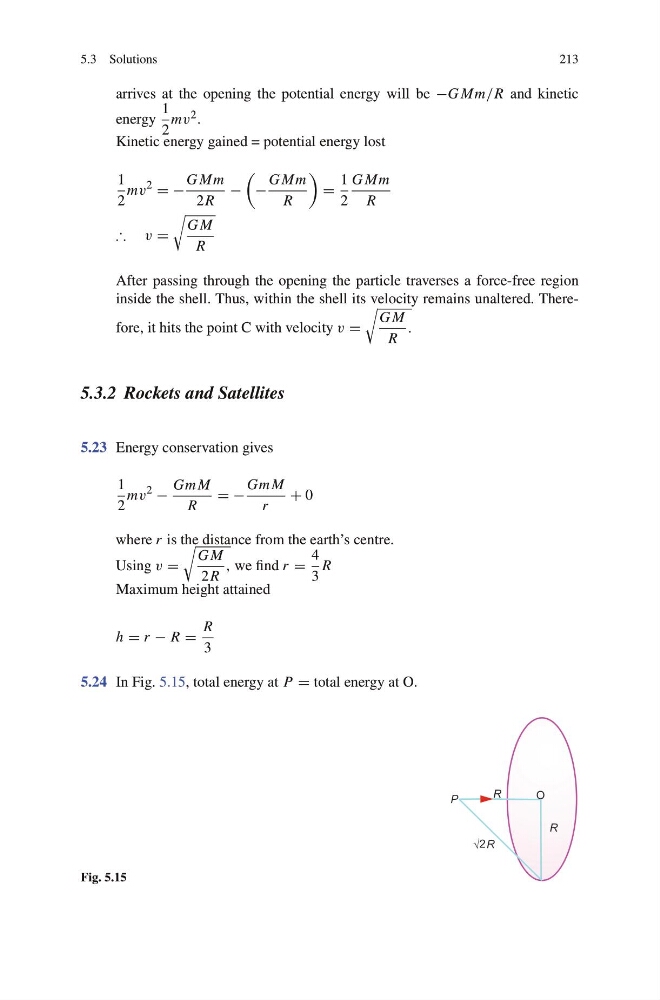
5.24 In Fig. 5.15, total energy at P = total energy at O.
Fig. 5.15
213
arrives at the opening the potential energy will be −G Mm/R and kinetic
energy
1
2
mv 2 .
Kinetic energy gained = potential energy lost
1
2
mv
2
= −
G Mm
2R
−
−
G Mm
R
=
1
2
G Mm
R
∴ v =
G M
R
After passing through the opening the particle traverses a force-free region
inside the shell. Thus, within the shell its velocity remains unaltered. Therefore, it hits the point C with velocity v =
G M
R
.
5.3.2 Rockets and Satellites
5.23 Energy conservation gives
1
2
mv
2
−
Gm M
R
= −
Gm M
r
+ 0
where r is the distance from the earth’s centre.
Using v =
G M
2R
, we find r =
4
3
R
Maximum height attained
h = r − R =
R
3
5.24 In Fig. 5.15, total energy at P = total energy at O.
Fig. 5.15