

198
5 Gravitation
5.30 A satellite is fired from the surface of the moon of mass M and radius R with
speed v 0 at 30 ◦ with the vertical. The satellite reaches a maximum distance of
5R/2 from the centre of the planet. Show that v 0 = (5G M/4R) 1/2 .
5.31 If a satellite has its largest and smallest speeds given by v max and v min , respectively, and has time period equal to T , then show that it moves on an elliptic
path of semi-major axis
T
2π
√ v max v min .
5.32 A satellite of radius ‘a’ revolves in a circular orbit about a planet of radius b
with period T . If the shortest distance between their surfaces is c, prove that
the mass of the planet is 4π 2 (a + b + c)/GT 2 .
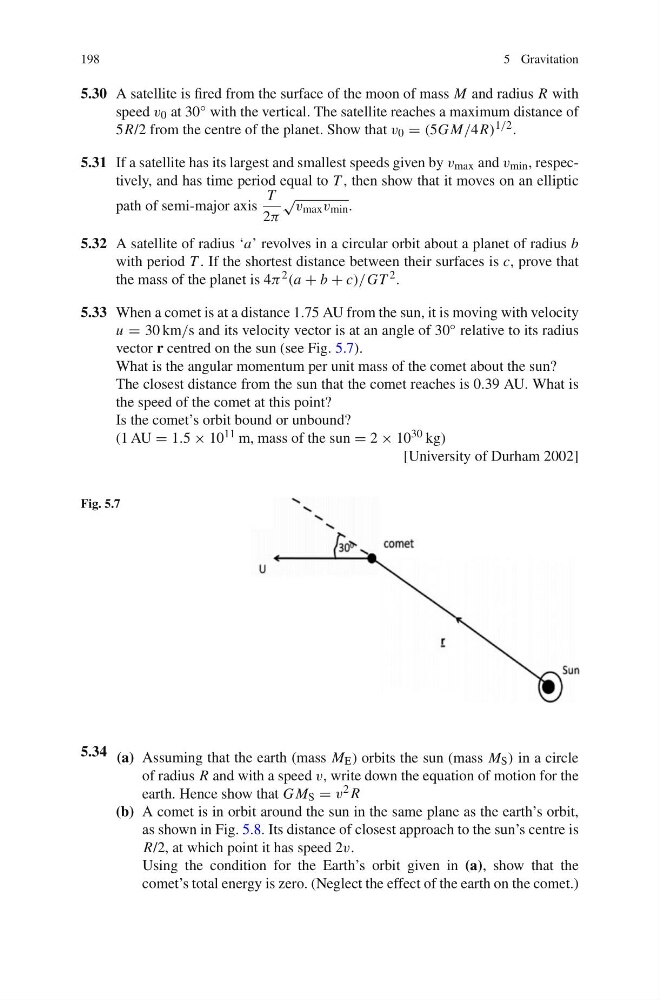
5.33 When a comet is at a distance 1.75 AU from the sun, it is moving with velocity
u = 30 km/s and its velocity vector is at an angle of 30 ◦ relative to its radius
vector r centred on the sun (see Fig. 5.7).
What is the angular momentum per unit mass of the comet about the sun?
The closest distance from the sun that the comet reaches is 0.39 AU. What is
the speed of the comet at this point?
Is the comet’s orbit bound or unbound?
(1 AU = 1.5 × 10 11 m, mass of the sun = 2 × 10 30 kg)
[University of Durham 2002]
Fig. 5.7
5.34 (a) Assuming that the earth (mass M E ) orbits the sun (mass M S ) in a circle
of radius R and with a speed v, write down the equation of motion for the
earth. Hence show that G M S = v 2 R
(b) A comet is in orbit around the sun in the same plane as the earth’s orbit,
as shown in Fig. 5.8. Its distance of closest approach to the sun’s centre is
R/2, at which point it has speed 2v.
Using the condition for the Earth’s orbit given in (a), show that the
comet’s total energy is zero. (Neglect the effect of the earth on the comet.)
5 Gravitation
5.30 A satellite is fired from the surface of the moon of mass M and radius R with
speed v 0 at 30 ◦ with the vertical. The satellite reaches a maximum distance of
5R/2 from the centre of the planet. Show that v 0 = (5G M/4R) 1/2 .
5.31 If a satellite has its largest and smallest speeds given by v max and v min , respectively, and has time period equal to T , then show that it moves on an elliptic
path of semi-major axis
T
2π
√ v max v min .
5.32 A satellite of radius ‘a’ revolves in a circular orbit about a planet of radius b
with period T . If the shortest distance between their surfaces is c, prove that
the mass of the planet is 4π 2 (a + b + c)/GT 2 .
5.33 When a comet is at a distance 1.75 AU from the sun, it is moving with velocity
u = 30 km/s and its velocity vector is at an angle of 30 ◦ relative to its radius
vector r centred on the sun (see Fig. 5.7).
What is the angular momentum per unit mass of the comet about the sun?
The closest distance from the sun that the comet reaches is 0.39 AU. What is
the speed of the comet at this point?
Is the comet’s orbit bound or unbound?
(1 AU = 1.5 × 10 11 m, mass of the sun = 2 × 10 30 kg)
[University of Durham 2002]
Fig. 5.7
5.34 (a) Assuming that the earth (mass M E ) orbits the sun (mass M S ) in a circle
of radius R and with a speed v, write down the equation of motion for the
earth. Hence show that G M S = v 2 R
(b) A comet is in orbit around the sun in the same plane as the earth’s orbit,
as shown in Fig. 5.8. Its distance of closest approach to the sun’s centre is
R/2, at which point it has speed 2v.
Using the condition for the Earth’s orbit given in (a), show that the
comet’s total energy is zero. (Neglect the effect of the earth on the comet.)