

5.2 Problems
197
axis, initially at rest. Show that the speed with which it crosses the centre of
the ring will be v =
(2 −
√
2)
G M
R
.
5.25 If W 1 is the work done in taking the satellite from the surface of the earth of
radius R to a height h, and W 2 the extra work required to put the satellite in
the orbit at altitude h, and if h = R/2 then show that the ratio
W 1
W 2
= 1.0.
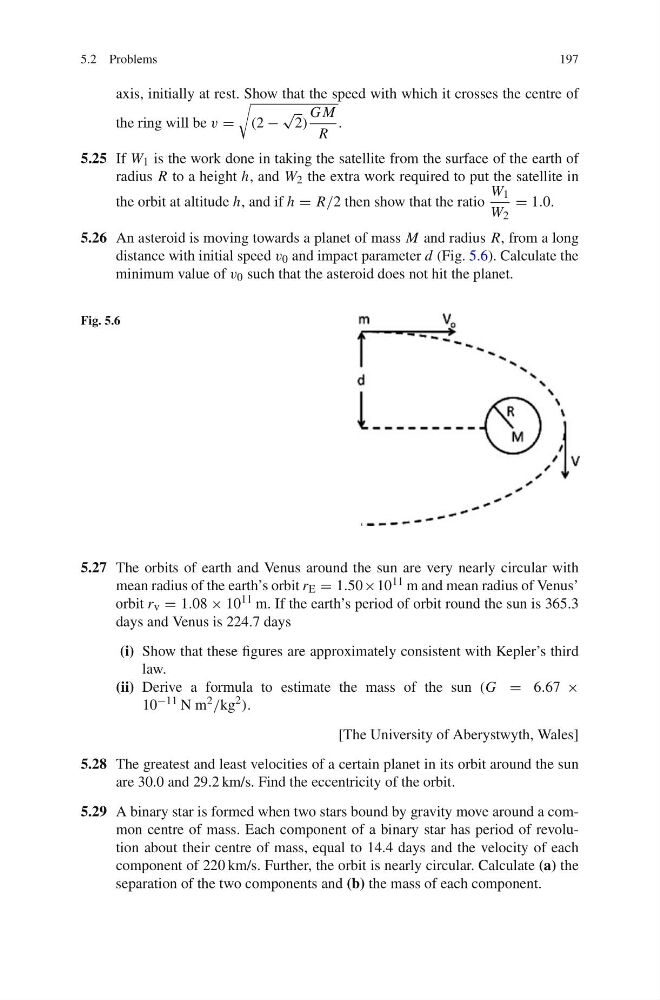
5.26 An asteroid is moving towards a planet of mass M and radius R, from a long
distance with initial speed v 0 and impact parameter d (Fig. 5.6). Calculate the
minimum value of v 0 such that the asteroid does not hit the planet.
Fig. 5.6
5.27 The orbits of earth and Venus around the sun are very nearly circular with
mean radius of the earth’s orbit r E = 1.50×10 11 m and mean radius of Venus’
orbit r v = 1.08 × 10 11 m. If the earth’s period of orbit round the sun is 365.3
days and Venus is 224.7 days
(i) Show that these figures are approximately consistent with Kepler’s third
law.
(ii) Derive a formula to estimate the mass of the sun (G = 6.67 ×
10 −11 N m 2 /kg
2
).
[The University of Aberystwyth, Wales]
5.28 The greatest and least velocities of a certain planet in its orbit around the sun
are 30.0 and 29.2 km/s. Find the eccentricity of the orbit.
5.29 A binary star is formed when two stars bound by gravity move around a common centre of mass. Each component of a binary star has period of revolution about their centre of mass, equal to 14.4 days and the velocity of each
component of 220 km/s. Further, the orbit is nearly circular. Calculate (a) the
separation of the two components and (b) the mass of each component.
197
axis, initially at rest. Show that the speed with which it crosses the centre of
the ring will be v =
(2 −
√
2)
G M
R
.
5.25 If W 1 is the work done in taking the satellite from the surface of the earth of
radius R to a height h, and W 2 the extra work required to put the satellite in
the orbit at altitude h, and if h = R/2 then show that the ratio
W 1
W 2
= 1.0.
5.26 An asteroid is moving towards a planet of mass M and radius R, from a long
distance with initial speed v 0 and impact parameter d (Fig. 5.6). Calculate the
minimum value of v 0 such that the asteroid does not hit the planet.
Fig. 5.6
5.27 The orbits of earth and Venus around the sun are very nearly circular with
mean radius of the earth’s orbit r E = 1.50×10 11 m and mean radius of Venus’
orbit r v = 1.08 × 10 11 m. If the earth’s period of orbit round the sun is 365.3
days and Venus is 224.7 days
(i) Show that these figures are approximately consistent with Kepler’s third
law.
(ii) Derive a formula to estimate the mass of the sun (G = 6.67 ×
10 −11 N m 2 /kg
2
).
[The University of Aberystwyth, Wales]
5.28 The greatest and least velocities of a certain planet in its orbit around the sun
are 30.0 and 29.2 km/s. Find the eccentricity of the orbit.
5.29 A binary star is formed when two stars bound by gravity move around a common centre of mass. Each component of a binary star has period of revolution about their centre of mass, equal to 14.4 days and the velocity of each
component of 220 km/s. Further, the orbit is nearly circular. Calculate (a) the
separation of the two components and (b) the mass of each component.