

196
5 Gravitation
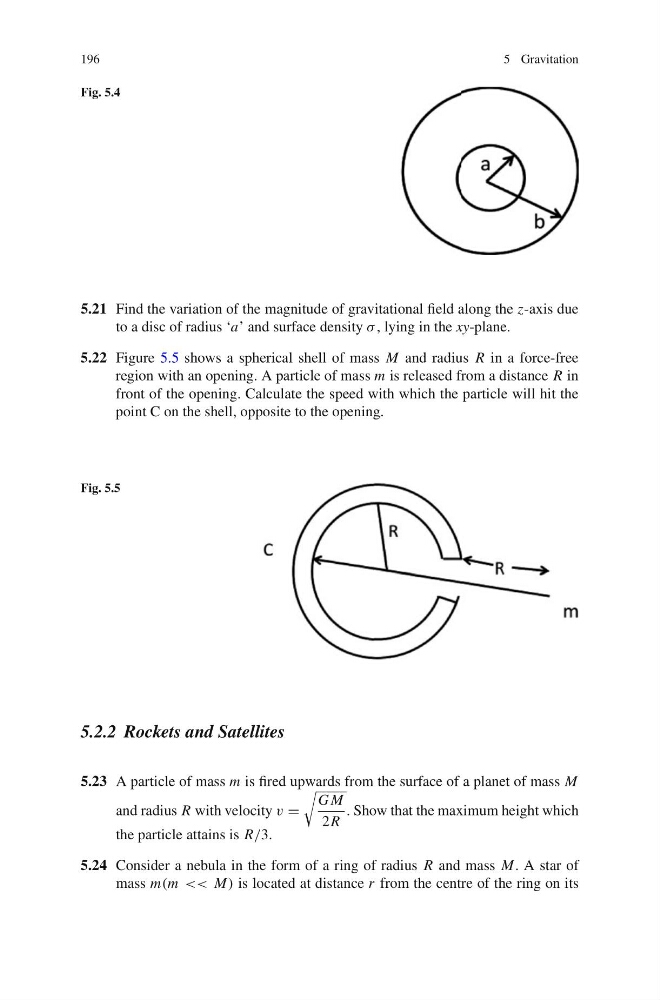
Fig. 5.4
5.21 Find the variation of the magnitude of gravitational field along the z-axis due
to a disc of radius ‘a’ and surface density σ , lying in the xy-plane.
5.22 Figure 5.5 shows a spherical shell of mass M and radius R in a force-free
region with an opening. A particle of mass m is released from a distance R in
front of the opening. Calculate the speed with which the particle will hit the
point C on the shell, opposite to the opening.
Fig. 5.5
5.2.2 Rockets and Satellites
5.23 A particle of mass m is fired upwards from the surface of a planet of mass M
and radius R with velocity v =
G M
2R
. Show that the maximum height which
the particle attains is R/3.
5.24 Consider a nebula in the form of a ring of radius R and mass M. A star of
mass m(m << M) is located at distance r from the centre of the ring on its
5 Gravitation
Fig. 5.4
5.21 Find the variation of the magnitude of gravitational field along the z-axis due
to a disc of radius ‘a’ and surface density σ , lying in the xy-plane.
5.22 Figure 5.5 shows a spherical shell of mass M and radius R in a force-free
region with an opening. A particle of mass m is released from a distance R in
front of the opening. Calculate the speed with which the particle will hit the
point C on the shell, opposite to the opening.
Fig. 5.5
5.2.2 Rockets and Satellites
5.23 A particle of mass m is fired upwards from the surface of a planet of mass M
and radius R with velocity v =
G M
2R
. Show that the maximum height which
the particle attains is R/3.
5.24 Consider a nebula in the form of a ring of radius R and mass M. A star of
mass m(m << M) is located at distance r from the centre of the ring on its