

5.2 Problems
195
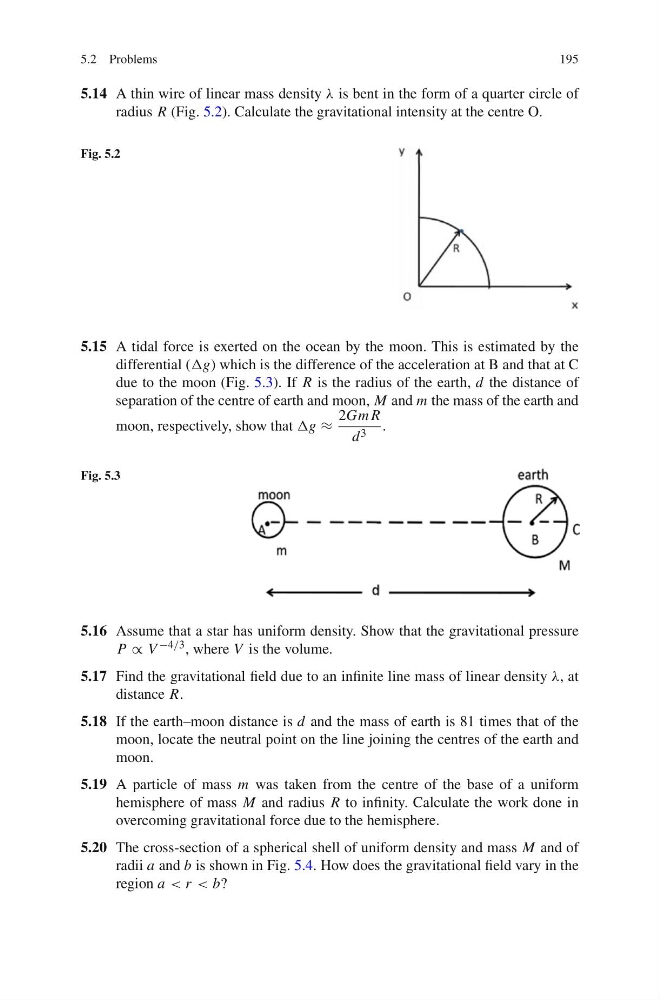
5.14 A thin wire of linear mass density λ is bent in the form of a quarter circle of
radius R (Fig. 5.2). Calculate the gravitational intensity at the centre O.
Fig. 5.2
5.15 A tidal force is exerted on the ocean by the moon. This is estimated by the
differential (g) which is the difference of the acceleration at B and that at C
due to the moon (Fig. 5.3). If R is the radius of the earth, d the distance of
separation of the centre of earth and moon, M and m the mass of the earth and
moon, respectively, show that g ≈
2Gm R
d 3 .
Fig. 5.3
5.16 Assume that a star has uniform density. Show that the gravitational pressure
P ∝ V −4/3 , where V is the volume.
5.17 Find the gravitational field due to an infinite line mass of linear density λ, at
distance R.
5.18 If the earth–moon distance is d and the mass of earth is 81 times that of the
moon, locate the neutral point on the line joining the centres of the earth and
moon.
5.19 A particle of mass m was taken from the centre of the base of a uniform
hemisphere of mass M and radius R to infinity. Calculate the work done in
overcoming gravitational force due to the hemisphere.
5.20 The cross-section of a spherical shell of uniform density and mass M and of
radii a and b is shown in Fig. 5.4. How does the gravitational field vary in the
region a < r < b?
195
5.14 A thin wire of linear mass density λ is bent in the form of a quarter circle of
radius R (Fig. 5.2). Calculate the gravitational intensity at the centre O.
Fig. 5.2
5.15 A tidal force is exerted on the ocean by the moon. This is estimated by the
differential (g) which is the difference of the acceleration at B and that at C
due to the moon (Fig. 5.3). If R is the radius of the earth, d the distance of
separation of the centre of earth and moon, M and m the mass of the earth and
moon, respectively, show that g ≈
2Gm R
d 3 .
Fig. 5.3
5.16 Assume that a star has uniform density. Show that the gravitational pressure
P ∝ V −4/3 , where V is the volume.
5.17 Find the gravitational field due to an infinite line mass of linear density λ, at
distance R.
5.18 If the earth–moon distance is d and the mass of earth is 81 times that of the
moon, locate the neutral point on the line joining the centres of the earth and
moon.
5.19 A particle of mass m was taken from the centre of the base of a uniform
hemisphere of mass M and radius R to infinity. Calculate the work done in
overcoming gravitational force due to the hemisphere.
5.20 The cross-section of a spherical shell of uniform density and mass M and of
radii a and b is shown in Fig. 5.4. How does the gravitational field vary in the
region a < r < b?