

5.2 Problems
199
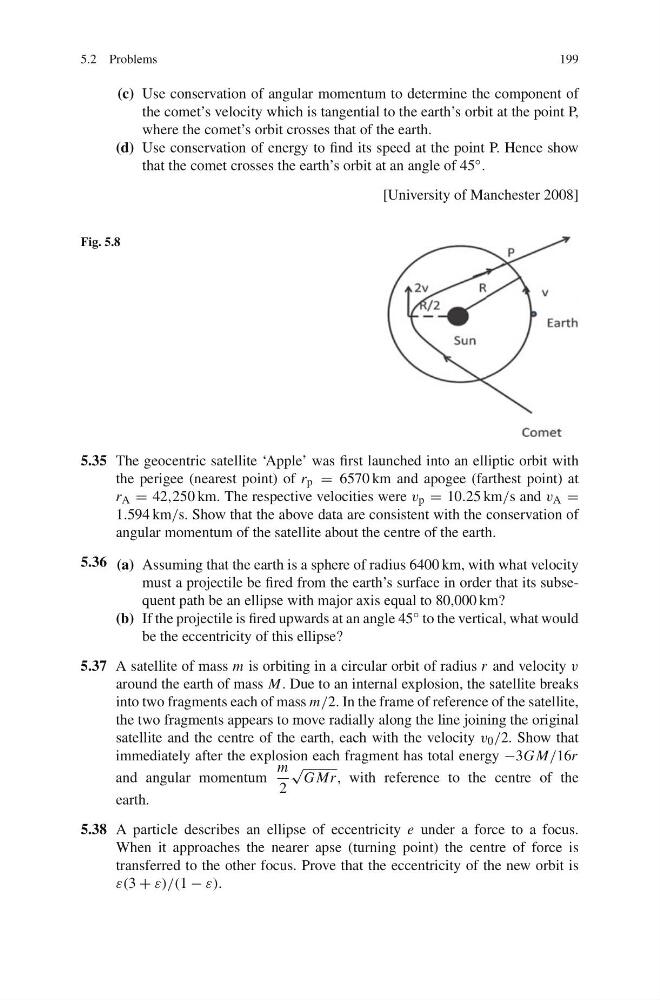
(c) Use conservation of angular momentum to determine the component of
the comet’s velocity which is tangential to the earth’s orbit at the point P,
where the comet’s orbit crosses that of the earth.
(d) Use conservation of energy to find its speed at the point P. Hence show
that the comet crosses the earth’s orbit at an angle of 45 ◦ .
[University of Manchester 2008]
Fig. 5.8
5.35 The geocentric satellite ‘Apple’ was first launched into an elliptic orbit with
the perigee (nearest point) of r p = 6570 km and apogee (farthest point) at
r A = 42,250 km. The respective velocities were v p = 10.25 km/s and v A =
1.594 km/s. Show that the above data are consistent with the conservation of
angular momentum of the satellite about the centre of the earth.
5.36 (a) Assuming that the earth is a sphere of radius 6400 km, with what velocity
must a projectile be fired from the earth’s surface in order that its subsequent path be an ellipse with major axis equal to 80,000 km?
(b) If the projectile is fired upwards at an angle 45 ◦ to the vertical, what would
be the eccentricity of this ellipse?
5.37 A satellite of mass m is orbiting in a circular orbit of radius r and velocity v
around the earth of mass M. Due to an internal explosion, the satellite breaks
into two fragments each of mass m/2. In the frame of reference of the satellite,
the two fragments appears to move radially along the line joining the original
satellite and the centre of the earth, each with the velocity v 0 /2. Show that
immediately after the explosion each fragment has total energy −3G M/16r
and angular momentum
m
2
√
G Mr, with reference to the centre of the
earth.
5.38 A particle describes an ellipse of eccentricity e under a force to a focus.
When it approaches the nearer apse (turning point) the centre of force is
transferred to the other focus. Prove that the eccentricity of the new orbit is
ε(3 + ε)/(1 − ε).
199
(c) Use conservation of angular momentum to determine the component of
the comet’s velocity which is tangential to the earth’s orbit at the point P,
where the comet’s orbit crosses that of the earth.
(d) Use conservation of energy to find its speed at the point P. Hence show
that the comet crosses the earth’s orbit at an angle of 45 ◦ .
[University of Manchester 2008]
Fig. 5.8
5.35 The geocentric satellite ‘Apple’ was first launched into an elliptic orbit with
the perigee (nearest point) of r p = 6570 km and apogee (farthest point) at
r A = 42,250 km. The respective velocities were v p = 10.25 km/s and v A =
1.594 km/s. Show that the above data are consistent with the conservation of
angular momentum of the satellite about the centre of the earth.
5.36 (a) Assuming that the earth is a sphere of radius 6400 km, with what velocity
must a projectile be fired from the earth’s surface in order that its subsequent path be an ellipse with major axis equal to 80,000 km?
(b) If the projectile is fired upwards at an angle 45 ◦ to the vertical, what would
be the eccentricity of this ellipse?
5.37 A satellite of mass m is orbiting in a circular orbit of radius r and velocity v
around the earth of mass M. Due to an internal explosion, the satellite breaks
into two fragments each of mass m/2. In the frame of reference of the satellite,
the two fragments appears to move radially along the line joining the original
satellite and the centre of the earth, each with the velocity v 0 /2. Show that
immediately after the explosion each fragment has total energy −3G M/16r
and angular momentum
m
2
√
G Mr, with reference to the centre of the
earth.
5.38 A particle describes an ellipse of eccentricity e under a force to a focus.
When it approaches the nearer apse (turning point) the centre of force is
transferred to the other focus. Prove that the eccentricity of the new orbit is
ε(3 + ε)/(1 − ε).