

20. Corrigés d’une sélection d’exercices
965
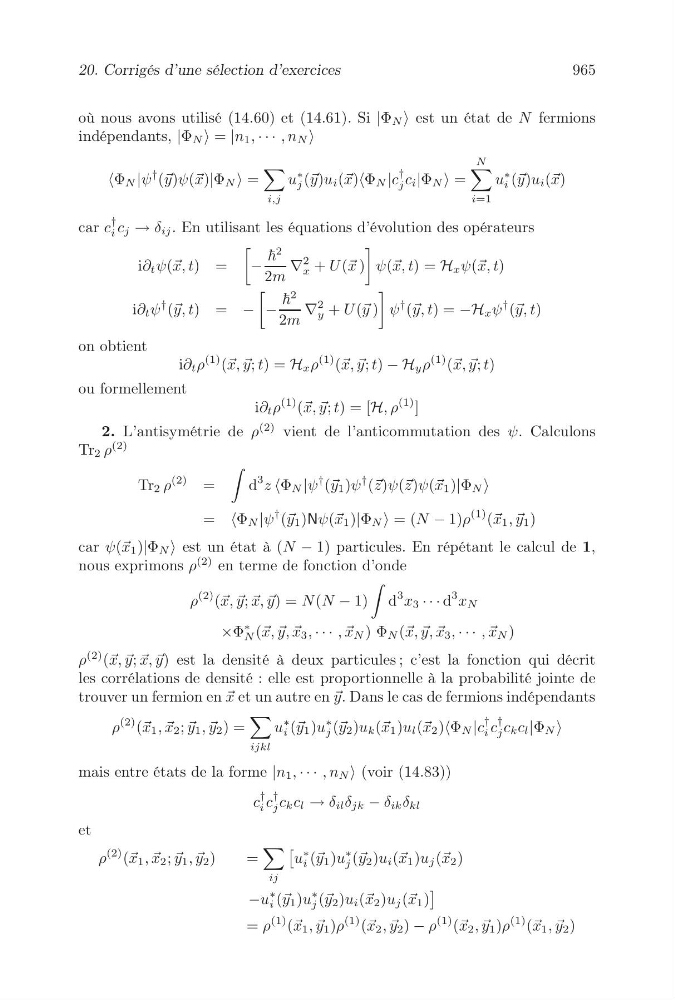
où nous avons utilisé (14.60) et (14.61). Si |Φ N est un état de N fermions
indépendants, |Φ N = |n 1 , ··· ,n N
Φ N |ψ
† ( y)ψ( x)|Φ N =
i,j
u
∗
j ( y)u i ( x)Φ N |c
†
j c i |Φ N =
N
i=1
u
∗
i ( y)u i ( x)
car c
†
i c j → δ ij . En utilisant les équations d’évolution des opérateurs
i∂ t ψ( x, t)=
−
2
2m
∇
2
x + U ( x )
ψ( x, t)=H x ψ( x, t)
i∂ t ψ
† ( y, t)=−
−
2
2m
∇
2
y + U ( y )
ψ
† ( y, t)=−H x ψ
† ( y, t)
on obtient
i∂ t ρ
(1) ( x, , y; t)=H x ρ
(1) ( x, , y; t) −H y ρ
(1) ( x, , y; t)
ou formellement
i∂ t ρ
(1) ( x, , y; t)=[H,ρ
(1) ]
2. L’antisymétrie de ρ
(2) vient de l’anticommutation des ψ.C a l c u l o n s
Tr 2 ρ
(2)
Tr 2 ρ
(2) =
d
3 z Φ N |ψ
† ( y 1 )ψ
† ( z)ψ( z)ψ( x 1 )|Φ N
= Φ N |ψ
† ( y 1 )Nψ( x 1 )|Φ N =(N − 1)ρ
(1) ( x 1 ,, y 1 )
car ψ( x 1 )|Φ N e s tu né t a tà(N − 1) particules. En répétant le calcul de 1,
nous exprimons ρ
(2) en terme de fonction d’onde
ρ
(2) ( x, , y; x, , y)=N (N − 1)
d
3 x 3 ···d
3 x N
×Φ
∗
N ( x, , y, , x 3 , ··· ,, x N )Φ N ( x, , y, , x 3 , ··· ,, x N )
ρ
(2) ( x, , y; x, , y) est la densité à deux particules ; c’est la fonction qui décrit
les corrélations de densité : elle est proportionnelle à la probabilité jointe de
trouver un fermion en x et un autre en y. Dans le cas de fermions indépendants
ρ
(2) ( x 1 ,, x 2 ; y 1 ,, y 2 )=
ijkl
u
∗
i ( y 1 )u
∗
j ( y 2 )u k ( x 1 )u l ( x 2 )Φ N |c
†
i c
†
j c k c l |Φ N
mais entre états de la forme |n 1 , ··· ,n N (voir (14.83))
c
†
i c
†
j c k c l → δ il δ jk − δ ik δ kl
et
ρ
(2) ( x 1 ,, x 2 ; y 1 ,, y 2 )=
ij
u
∗
i ( y 1 )u
∗
j ( y 2 )u i ( x 1 )u j ( x 2 )
−u
∗
i ( y 1 )u
∗
j ( y 2 )u i ( x 2 )u j ( x 1 )
= ρ
(1) ( x 1 ,, y 1 )ρ
(1) ( x 2 ,, y 2 ) − ρ
(1) ( x 2 ,, y 1 )ρ
(1) ( x 1 ,, y 2 )
965
où nous avons utilisé (14.60) et (14.61). Si |Φ N est un état de N fermions
indépendants, |Φ N = |n 1 , ··· ,n N
Φ N |ψ
† ( y)ψ( x)|Φ N =
i,j
u
∗
j ( y)u i ( x)Φ N |c
†
j c i |Φ N =
N
i=1
u
∗
i ( y)u i ( x)
car c
†
i c j → δ ij . En utilisant les équations d’évolution des opérateurs
i∂ t ψ( x, t)=
−
2
2m
∇
2
x + U ( x )
ψ( x, t)=H x ψ( x, t)
i∂ t ψ
† ( y, t)=−
−
2
2m
∇
2
y + U ( y )
ψ
† ( y, t)=−H x ψ
† ( y, t)
on obtient
i∂ t ρ
(1) ( x, , y; t)=H x ρ
(1) ( x, , y; t) −H y ρ
(1) ( x, , y; t)
ou formellement
i∂ t ρ
(1) ( x, , y; t)=[H,ρ
(1) ]
2. L’antisymétrie de ρ
(2) vient de l’anticommutation des ψ.C a l c u l o n s
Tr 2 ρ
(2)
Tr 2 ρ
(2) =
d
3 z Φ N |ψ
† ( y 1 )ψ
† ( z)ψ( z)ψ( x 1 )|Φ N
= Φ N |ψ
† ( y 1 )Nψ( x 1 )|Φ N =(N − 1)ρ
(1) ( x 1 ,, y 1 )
car ψ( x 1 )|Φ N e s tu né t a tà(N − 1) particules. En répétant le calcul de 1,
nous exprimons ρ
(2) en terme de fonction d’onde
ρ
(2) ( x, , y; x, , y)=N (N − 1)
d
3 x 3 ···d
3 x N
×Φ
∗
N ( x, , y, , x 3 , ··· ,, x N )Φ N ( x, , y, , x 3 , ··· ,, x N )
ρ
(2) ( x, , y; x, , y) est la densité à deux particules ; c’est la fonction qui décrit
les corrélations de densité : elle est proportionnelle à la probabilité jointe de
trouver un fermion en x et un autre en y. Dans le cas de fermions indépendants
ρ
(2) ( x 1 ,, x 2 ; y 1 ,, y 2 )=
ijkl
u
∗
i ( y 1 )u
∗
j ( y 2 )u k ( x 1 )u l ( x 2 )Φ N |c
†
i c
†
j c k c l |Φ N
mais entre états de la forme |n 1 , ··· ,n N (voir (14.83))
c
†
i c
†
j c k c l → δ il δ jk − δ ik δ kl
et
ρ
(2) ( x 1 ,, x 2 ; y 1 ,, y 2 )=
ij
u
∗
i ( y 1 )u
∗
j ( y 2 )u i ( x 1 )u j ( x 2 )
−u
∗
i ( y 1 )u
∗
j ( y 2 )u i ( x 2 )u j ( x 1 )
= ρ
(1) ( x 1 ,, y 1 )ρ
(1) ( x 2 ,, y 2 ) − ρ
(1) ( x 2 ,, y 1 )ρ
(1) ( x 1 ,, y 2 )