

924
Physique quantique : Exercices et applications
10.4.7 Transformations de jauge non abéliennes
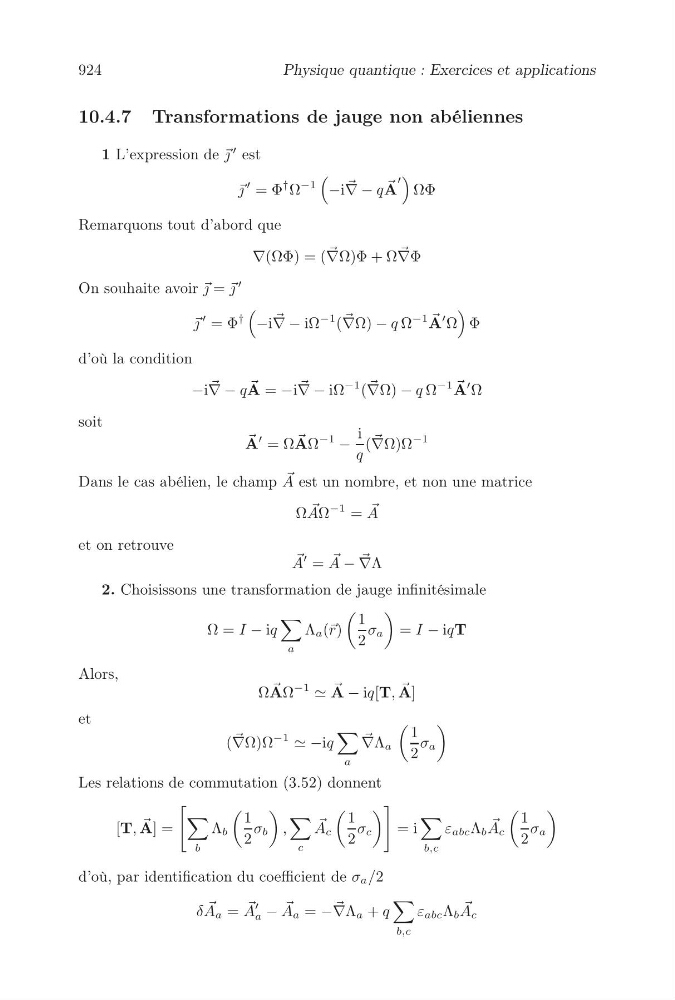
1 L’expression de j
′ est
j
′ =Φ
† Ω
−1
−i
∇−q
A
′
ΩΦ
Remarquons tout d’abord que
∇(ΩΦ) = (
∇Ω)Φ + Ω
∇Φ
On souhaite avoir j = j
′
j
′ =Φ
†
−i
∇−iΩ
−1 (
∇Ω) − q Ω
−1
A
′ Ω
Φ
d’où la condition
−i
∇−q
A = −i
∇−iΩ
−1 (
∇Ω) − q Ω
−1
A
′ Ω
soit
A
′ =Ω
AΩ
−1 −
i
q
(
∇Ω)Ω
−1
Dans le cas abélien, le champ
A est un nombre, et non une matrice
Ω
AΩ
−1 =
A
et on retrouve
A
′ =
A −
∇Λ
2. Choisissons une transformation de jauge infinitésimale
Ω=I − iq
a
Λ a ( r)
1
2
σ a
= I − iqT
Alors,
Ω
AΩ
−1 ≃
A − iq[T,
A]
et
(
∇Ω)Ω
−1 ≃−iq
a
∇Λ a
1
2
σ a
Les relations de commutation (3.52) donnent
[T,
A]=
b
Λ b
1
2
σ b
,
c
A c
1
2
σ c
= i
b,c
ε abc Λ b
A c
1
2
σ a
d’où, par identification du coefficient de σ a /2
δ
A a =
A
′
a −
A a = −
∇Λ a + q
b,c
ε abc Λ b
A c
Physique quantique : Exercices et applications
10.4.7 Transformations de jauge non abéliennes
1 L’expression de j
′ est
j
′ =Φ
† Ω
−1
−i
∇−q
A
′
ΩΦ
Remarquons tout d’abord que
∇(ΩΦ) = (
∇Ω)Φ + Ω
∇Φ
On souhaite avoir j = j
′
j
′ =Φ
†
−i
∇−iΩ
−1 (
∇Ω) − q Ω
−1
A
′ Ω
Φ
d’où la condition
−i
∇−q
A = −i
∇−iΩ
−1 (
∇Ω) − q Ω
−1
A
′ Ω
soit
A
′ =Ω
AΩ
−1 −
i
q
(
∇Ω)Ω
−1
Dans le cas abélien, le champ
A est un nombre, et non une matrice
Ω
AΩ
−1 =
A
et on retrouve
A
′ =
A −
∇Λ
2. Choisissons une transformation de jauge infinitésimale
Ω=I − iq
a
Λ a ( r)
1
2
σ a
= I − iqT
Alors,
Ω
AΩ
−1 ≃
A − iq[T,
A]
et
(
∇Ω)Ω
−1 ≃−iq
a
∇Λ a
1
2
σ a
Les relations de commutation (3.52) donnent
[T,
A]=
b
Λ b
1
2
σ b
,
c
A c
1
2
σ c
= i
b,c
ε abc Λ b
A c
1
2
σ a
d’où, par identification du coefficient de σ a /2
δ
A a =
A
′
a −
A a = −
∇Λ a + q
b,c
ε abc Λ b
A c