

900
Physique quantique : Exercices et applications
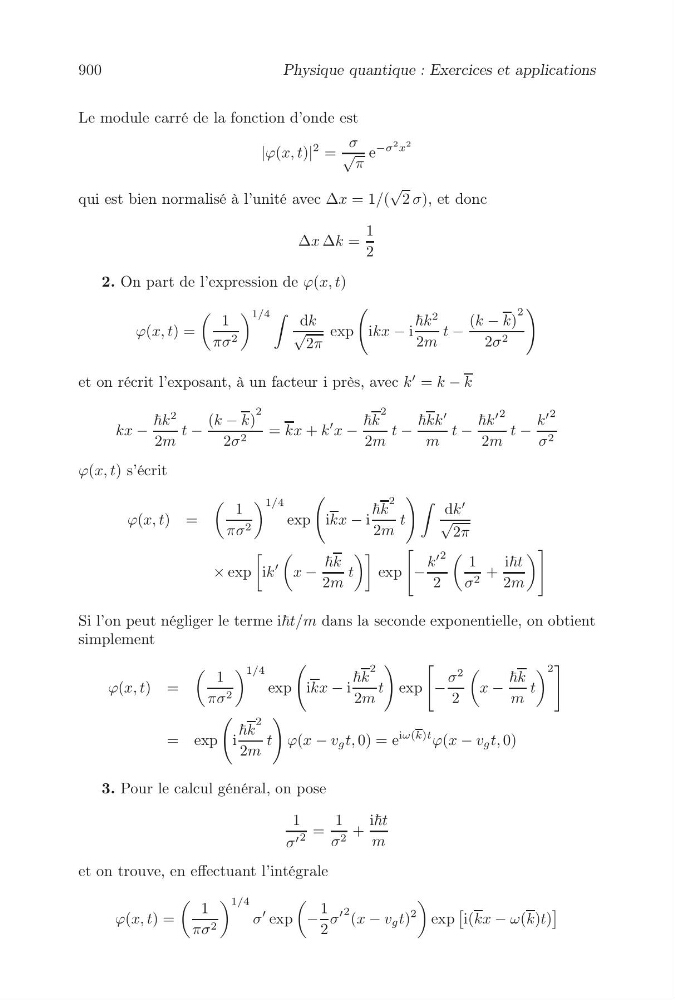
Le module carré de la fonction d’onde est
|ϕ(x, t)|
2 =
σ
√ π
e
−σ
2 x
2
qui est bien normalisé à l’unité avec ∆x =1/(
√
2 σ),e td o n c
∆x ∆k =
1
2
2. On part de l’expression de ϕ(x, t)
ϕ(x, t)=
1
πσ 2
1/4
dk
√
2π
exp
ikx − i
k
2
2m
t −
(k − k)
2
2σ 2
et on récrit l’exposant, à un facteur i près, avec k
′ = k − k
kx −
k
2
2m
t −
(k − k)
2
2σ 2 = kx + k
′ x −
k
2
2m
t −
kk
′
m
t −
k
′ 2
2m
t −
k
′ 2
σ 2
ϕ(x, t) s’écrit
ϕ(x, t)=
1
πσ 2
1/4
exp
ikx − i
k
2
2m
t
dk
′
√
2π
× exp
ik
′
x −
k
2m
t
exp
−
k
′ 2
2
1
σ 2 +
it
2m
Si l’on peut négliger le terme it/m dans la seconde exponentielle, on obtient
simplement
ϕ(x, t)=
1
πσ 2
1/4
exp
ikx − i
k
2
2m
t
exp
−
σ
2
2
x −
k
m
t
2
=e x p
i
k
2
2m
t
ϕ(x − v g t, 0) = e
iω(k)t ϕ(x − v g t, 0)
3. Pour le calcul général, on pose
1
σ ′ 2 =
1
σ 2 +
it
m
et on trouve, en effectuant l’intégrale
ϕ(x, t)=
1
πσ 2
1/4
σ
′ exp
−
1
2
σ
′ 2 (x − v g t)
2
exp
i(kx − ω(k)t)
Physique quantique : Exercices et applications
Le module carré de la fonction d’onde est
|ϕ(x, t)|
2 =
σ
√ π
e
−σ
2 x
2
qui est bien normalisé à l’unité avec ∆x =1/(
√
2 σ),e td o n c
∆x ∆k =
1
2
2. On part de l’expression de ϕ(x, t)
ϕ(x, t)=
1
πσ 2
1/4
dk
√
2π
exp
ikx − i
k
2
2m
t −
(k − k)
2
2σ 2
et on récrit l’exposant, à un facteur i près, avec k
′ = k − k
kx −
k
2
2m
t −
(k − k)
2
2σ 2 = kx + k
′ x −
k
2
2m
t −
kk
′
m
t −
k
′ 2
2m
t −
k
′ 2
σ 2
ϕ(x, t) s’écrit
ϕ(x, t)=
1
πσ 2
1/4
exp
ikx − i
k
2
2m
t
dk
′
√
2π
× exp
ik
′
x −
k
2m
t
exp
−
k
′ 2
2
1
σ 2 +
it
2m
Si l’on peut négliger le terme it/m dans la seconde exponentielle, on obtient
simplement
ϕ(x, t)=
1
πσ 2
1/4
exp
ikx − i
k
2
2m
t
exp
−
σ
2
2
x −
k
m
t
2
=e x p
i
k
2
2m
t
ϕ(x − v g t, 0) = e
iω(k)t ϕ(x − v g t, 0)
3. Pour le calcul général, on pose
1
σ ′ 2 =
1
σ 2 +
it
m
et on trouve, en effectuant l’intégrale
ϕ(x, t)=
1
πσ 2
1/4
σ
′ exp
−
1
2
σ
′ 2 (x − v g t)
2
exp
i(kx − ω(k)t)