

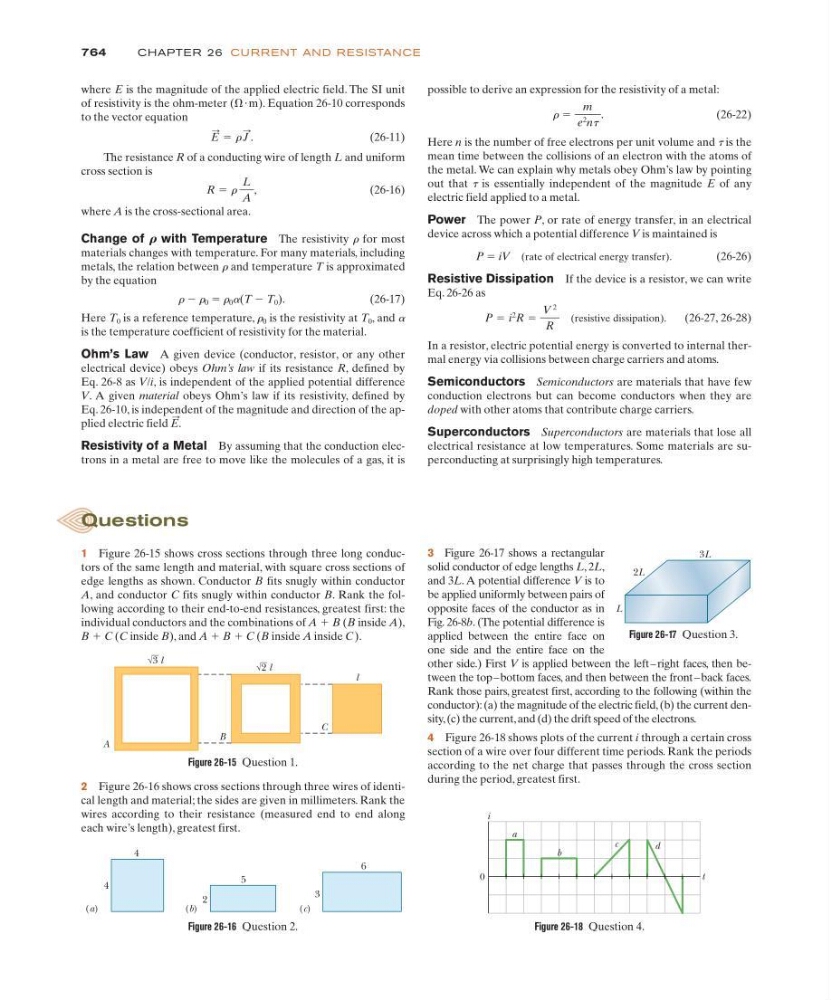
3 Figure 26-17 shows a rectangular
solid conductor of edge lengths L, 2L,
and 3L. A potential difference V is to
be applied uniformly between pairs of
opposite faces of the conductor as in
Fig. 26-8b. (The potential difference is
applied between the entire face on
one side and the entire face on the
other side.) First V is applied between the left – right faces, then between the top – bottom faces, and then between the front – back faces.
Rank those pairs, greatest first, according to the following (within the
conductor): (a) the magnitude of the electric field, (b) the current density, (c) the current, and (d) the drift speed of the electrons.
4 Figure 26-18 shows plots of the current i through a certain cross
section of a wire over four different time periods. Rank the periods
according to the net charge that passes through the cross section
during the period, greatest first.
764
CHAPTE R 26 CU R R E NT AN D R ESISTANCE
1 Figure 26-15 shows cross sections through three long conductors of the same length and material, with square cross sections of
edge lengths as shown. Conductor B fits snugly within conductor
A, and conductor C fits snugly within conductor B. Rank the following according to their end-to-end resistances, greatest first: the
individual conductors and the combinations of A ϩ B (B inside A),
B ϩ C (C inside B), and A ϩ B ϩ C (B inside A inside C).
Questions
Figure 26-15 Question 1.
A
C
B
√3 l
√2 l
l
4
4
(a)
2
5
(b)
3
6
(c)
Figure 26-16 Question 2.
L
2L
3L
Figure 26-17 Question 3.
i
t
d
c
b
a
0
Figure 26-18 Question 4.
2 Figure 26-16 shows cross sections through three wires of identical length and material; the sides are given in millimeters. Rank the
wires according to their resistance (measured end to end along
each wire’s length), greatest first.
where E is the magnitude of the applied electric field. The SI unit
of resistivity is the ohm-meter (⍀иm). Equation 26-10 corresponds
to the vector equation
(26-11)
The resistance R of a conducting wire of length L and uniform
cross section is
(26-16)
where A is the cross-sectional area.
Change of r with Temperature The resistivity r for most
materials changes with temperature. For many materials, including
metals, the relation between r and temperature T is approximated
by the equation
r Ϫ r 0 ϭ r 0 a(T Ϫ T 0 ).
(26-17)
Here T 0 is a reference temperature, r 0 is the resistivity at T 0 , and a
is the temperature coefficient of resistivity for the material.
Ohm’s Law A given device (conductor, resistor, or any other
electrical device) obeys Ohm’s law if its resistance R, defined by
Eq. 26-8 as V/i, is independent of the applied potential difference
V. A given material obeys Ohm’s law if its resistivity, defined by
Eq. 26-10, is independent of the magnitude and direction of the applied electric field
Resistivity of a Metal By assuming that the conduction electrons in a metal are free to move like the molecules of a gas, it is
E
:
.
R ϭ r
L
A
,
E
: ϭ r J
: .
possible to derive an expression for the resistivity of a metal:
(26-22)
Here n is the number of free electrons per unit volume and t is the
mean time between the collisions of an electron with the atoms of
the metal. We can explain why metals obey Ohm’s law by pointing
out that t is essentially independent of the magnitude E of any
electric field applied to a metal.
Power The power P, or rate of energy transfer, in an electrical
device across which a potential difference V is maintained is
P ϭ iV (rate of electrical energy transfer).
(26-26)
Resistive Dissipation If the device is a resistor, we can write
Eq. 26-26 as
(resistive dissipation).
(26-27, 26-28)
In a resistor, electric potential energy is converted to internal thermal energy via collisions between charge carriers and atoms.
Semiconductors Semiconductors are materials that have few
conduction electrons but can become conductors when they are
doped with other atoms that contribute charge carriers.
Superconductors Superconductors are materials that lose all
electrical resistance at low temperatures. Some materials are superconducting at surprisingly high temperatures.
P ϭ i
2
R ϭ
V
2
R
r ϭ
m
e
2
nt
.