

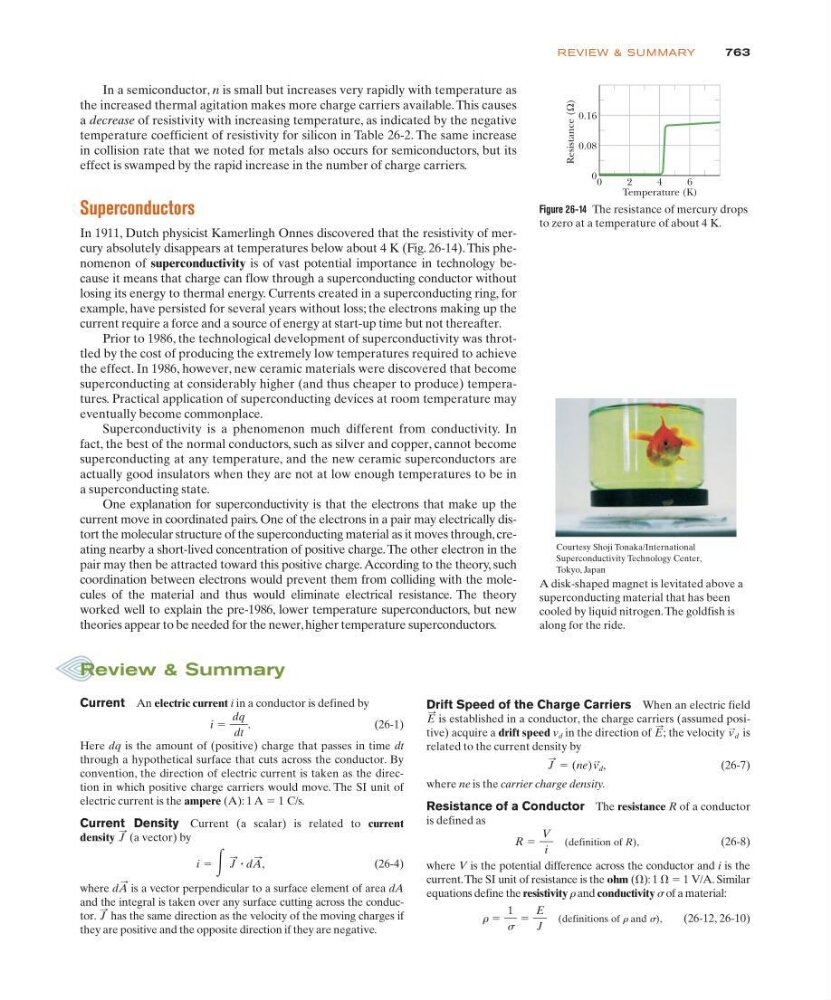
Courtesy Shoji Tonaka/International
Superconductivity Technology Center,
Tokyo, Japan
In a semiconductor, n is small but increases very rapidly with temperature as
the increased thermal agitation makes more charge carriers available. This causes
a decrease of resistivity with increasing temperature, as indicated by the negative
temperature coefficient of resistivity for silicon in Table 26-2. The same increase
in collision rate that we noted for metals also occurs for semiconductors, but its
effect is swamped by the rapid increase in the number of charge carriers.
Superconductors
In 1911, Dutch physicist Kamerlingh Onnes discovered that the resistivity of mercury absolutely disappears at temperatures below about 4 K (Fig. 26-14). This phenomenon of superconductivity is of vast potential importance in technology because it means that charge can flow through a superconducting conductor without
losing its energy to thermal energy. Currents created in a superconducting ring, for
example, have persisted for several years without loss; the electrons making up the
current require a force and a source of energy at start-up time but not thereafter.
Prior to 1986, the technological development of superconductivity was throttled by the cost of producing the extremely low temperatures required to achieve
the effect. In 1986, however, new ceramic materials were discovered that become
superconducting at considerably higher (and thus cheaper to produce) temperatures. Practical application of superconducting devices at room temperature may
eventually become commonplace.
Superconductivity is a phenomenon much different from conductivity. In
fact, the best of the normal conductors, such as silver and copper, cannot become
superconducting at any temperature, and the new ceramic superconductors are
actually good insulators when they are not at low enough temperatures to be in
a superconducting state.
One explanation for superconductivity is that the electrons that make up the
current move in coordinated pairs. One of the electrons in a pair may electrically distort the molecular structure of the superconducting material as it moves through, creating nearby a short-lived concentration of positive charge. The other electron in the
pair may then be attracted toward this positive charge. According to the theory, such
coordination between electrons would prevent them from colliding with the molecules of the material and thus would eliminate electrical resistance. The theory
worked well to explain the pre-1986, lower temperature superconductors, but new
theories appear to be needed for the newer, higher temperature superconductors.
763
REVIEW & SUM MARY
0.16
0.08
0
0
2
4
6
Temperature (K)
Resistance ( )
Ω
Figure 26-14 The resistance of mercury drops
to zero at a temperature of about 4 K.
A disk-shaped magnet is levitated above a
superconducting material that has been
cooled by liquid nitrogen. The goldfish is
along for the ride.
Current An electric current i in a conductor is defined by
(26-1)
Here dq is the amount of (positive) charge that passes in time dt
through a hypothetical surface that cuts across the conductor. By
convention, the direction of electric current is taken as the direction in which positive charge carriers would move. The SI unit of
electric current is the ampere (A): 1 A ϭ 1 C/s.
Current Density Current (a scalar) is related to current
density (a vector) by
(26-4)
where
is a vector perpendicular to a surface element of area dA
and the integral is taken over any surface cutting across the conductor. has the same direction as the velocity of the moving charges if
they are positive and the opposite direction if they are negative.
J
:
dA
:
i ϭ ͵ J
: ؒ dA
:
,
J
:
i ϭ
dq
dt
.
Review & Summary
Drift Speed of the Charge Carriers When an electric field
is established in a conductor, the charge carriers (assumed positive) acquire a drift speed v d in the direction of
the velocity
is
related to the current density by
(26-7)
where ne is the carrier charge density.
Resistance of a Conductor The resistance R of a conductor
is defined as
(definition of R),
(26-8)
where V is the potential difference across the conductor and i is the
current.The SI unit of resistance is the ohm (⍀): 1 ⍀ ϭ 1 V/A. Similar
equations define the resistivity r and conductivity s of a material:
(definitions of r and s),
(26-12, 26-10)
r ϭ
1
s
ϭ
E
J
R ϭ
V
i
J
: ϭ (ne)v
:
d ,
v
:
d
E
:
;
E
: