

Semiconductors
Semiconducting devices are at the heart of the microelectronic revolution that
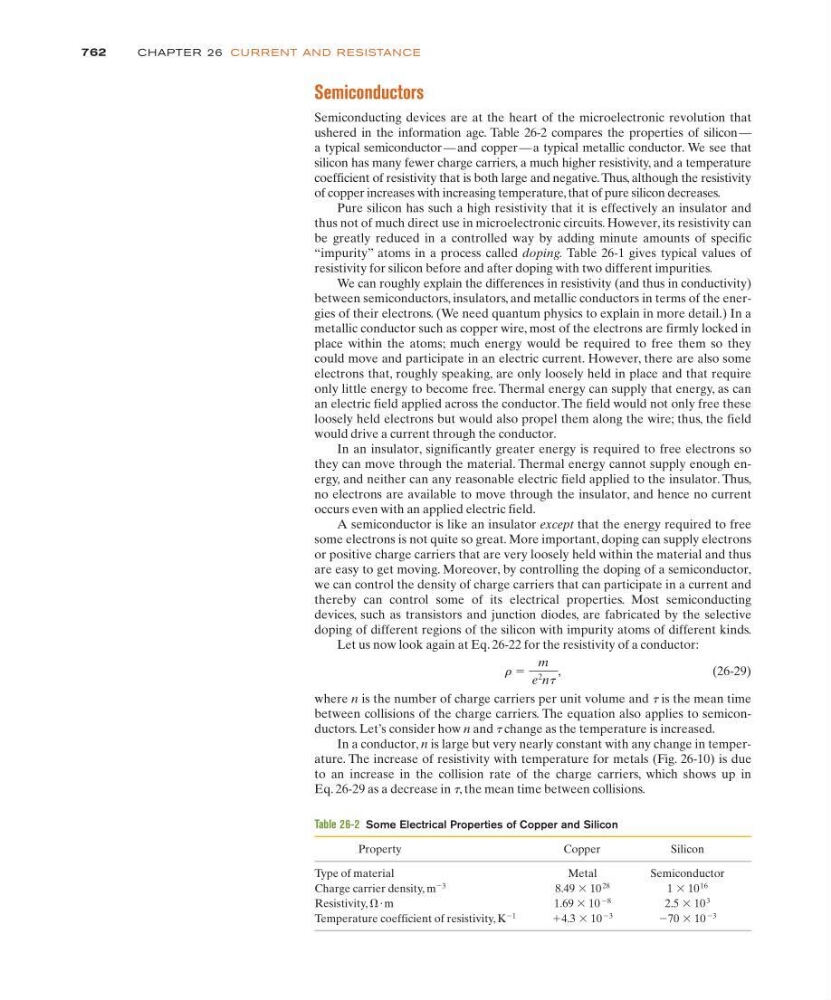
ushered in the information age. Table 26-2 compares the properties of silicon —
a typical semiconductor—and copper—a typical metallic conductor. We see that
silicon has many fewer charge carriers, a much higher resistivity, and a temperature
coefficient of resistivity that is both large and negative. Thus, although the resistivity
of copper increases with increasing temperature, that of pure silicon decreases.
Pure silicon has such a high resistivity that it is effectively an insulator and
thus not of much direct use in microelectronic circuits. However, its resistivity can
be greatly reduced in a controlled way by adding minute amounts of specific
“impurity” atoms in a process called doping. Table 26-1 gives typical values of
resistivity for silicon before and after doping with two different impurities.
We can roughly explain the differences in resistivity (and thus in conductivity)
between semiconductors, insulators, and metallic conductors in terms of the energies of their electrons. (We need quantum physics to explain in more detail.) In a
metallic conductor such as copper wire, most of the electrons are firmly locked in
place within the atoms; much energy would be required to free them so they
could move and participate in an electric current. However, there are also some
electrons that, roughly speaking, are only loosely held in place and that require
only little energy to become free. Thermal energy can supply that energy, as can
an electric field applied across the conductor. The field would not only free these
loosely held electrons but would also propel them along the wire; thus, the field
would drive a current through the conductor.
In an insulator, significantly greater energy is required to free electrons so
they can move through the material. Thermal energy cannot supply enough energy, and neither can any reasonable electric field applied to the insulator. Thus,
no electrons are available to move through the insulator, and hence no current
occurs even with an applied electric field.
A semiconductor is like an insulator except that the energy required to free
some electrons is not quite so great. More important, doping can supply electrons
or positive charge carriers that are very loosely held within the material and thus
are easy to get moving. Moreover, by controlling the doping of a semiconductor,
we can control the density of charge carriers that can participate in a current and
thereby can control some of its electrical properties. Most semiconducting
devices, such as transistors and junction diodes, are fabricated by the selective
doping of different regions of the silicon with impurity atoms of different kinds.
Let us now look again at Eq. 26-22 for the resistivity of a conductor:
(26-29)
where n is the number of charge carriers per unit volume and t is the mean time
between collisions of the charge carriers. The equation also applies to semiconductors. Let’s consider how n and t change as the temperature is increased.
In a conductor, n is large but very nearly constant with any change in temperature. The increase of resistivity with temperature for metals (Fig. 26-10) is due
to an increase in the collision rate of the charge carriers, which shows up in
Eq. 26-29 as a decrease in t, the mean time between collisions.
r ϭ
m
e
2
nt
,
762
CHAPTE R 26 CU R R E NT AN D R ESISTANCE
Table 26-2 Some Electrical Properties of Copper and Silicon
Property
Copper
Silicon
Type of material
Metal
Semiconductor
Charge carrier density, m
Ϫ3
8.49 ϫ 10
28
1 ϫ 10
16
Resistivity, ⍀иm
1.69 ϫ 10
Ϫ8
2.5 ϫ 10
3
Temperature coefficient of resistivity, K
Ϫ1
ϩ4.3 ϫ 10
Ϫ3
Ϫ70 ϫ 10
Ϫ3