

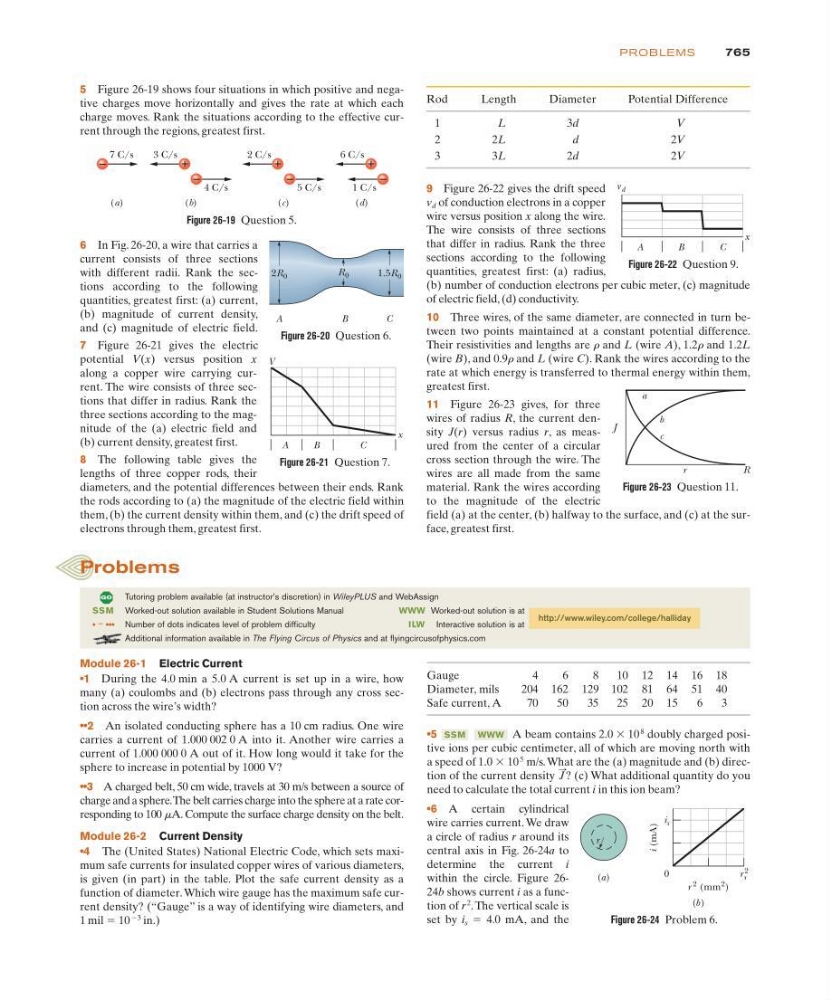
Rod
Length
Diameter
Potential Difference
1
L
3d
V
2
2 L
d
2V
3
3 L
2d
2V
9 Figure 26-22 gives the drift speed
v d of conduction electrons in a copper
wire versus position x along the wire.
The wire consists of three sections
that differ in radius. Rank the three
sections according to the following
quantities, greatest first: (a) radius,
(b) number of conduction electrons per cubic meter, (c) magnitude
of electric field, (d) conductivity.
10 Three wires, of the same diameter, are connected in turn between two points maintained at a constant potential difference.
Their resistivities and lengths are r and L (wire A), 1.2r and 1.2L
(wire B), and 0.9r and L (wire C). Rank the wires according to the
rate at which energy is transferred to thermal energy within them,
greatest first.
11 Figure 26-23 gives, for three
wires of radius R, the current density J(r) versus radius r, as measured from the center of a circular
cross section through the wire. The
wires are all made from the same
material. Rank the wires according
to the magnitude of the electric
field (a) at the center, (b) halfway to the surface, and (c) at the surface, greatest first.
765
PROB LE M S
+
+
+
7 C/s
3 C/s
2 C/s
4 C/s
6 C/s
5 C/s
1 C/s
(a)
(b)
(c)
(d)
Figure 26-19 Question 5.
v d
A
B
C
x
Figure 26-22 Question 9.
a
b
c
J
r
R
Figure 26-23 Question 11.
5 Figure 26-19 shows four situations in which positive and negative charges move horizontally and gives the rate at which each
charge moves. Rank the situations according to the effective current through the regions, greatest first.
6 In Fig. 26-20, a wire that carries a
current consists of three sections
with different radii. Rank the sections according to the following
quantities, greatest first: (a) current,
(b) magnitude of current density,
and (c) magnitude of electric field.
7 Figure 26-21 gives the electric
potential V(x) versus position x
along a copper wire carrying current. The wire consists of three sections that differ in radius. Rank the
three sections according to the magnitude of the (a) electric field and
(b) current density, greatest first.
8 The following table gives the
lengths of three copper rods, their
diameters, and the potential differences between their ends. Rank
the rods according to (a) the magnitude of the electric field within
them, (b) the current density within them, and (c) the drift speed of
electrons through them, greatest first.
A
B
C
2R 0
1.5R 0
R 0
Figure 26-20 Question 6.
V
x
C
B
A
Figure 26-21 Question 7.
Tutoring problem available (at instructor’s discretion) in WileyPLUS and WebAssign
SSM Worked-out solution available in Student Solutions Manual
• – ••• Number of dots indicates level of problem difficulty
Additional information available in The Flying Circus of Physics and at flyingcircusofphysics.com
WWW Worked-out solution is at
ILW Interactive solution is at
http://www.wiley.com/college/halliday
Problems
Module 26-1 Electric Current
•1 During the 4.0 min a 5.0 A current is set up in a wire, how
many (a) coulombs and (b) electrons pass through any cross section across the wire’s width?
••2 An isolated conducting sphere has a 10 cm radius. One wire
carries a current of 1.000 002 0 A into it. Another wire carries a
current of 1.000 000 0 A out of it. How long would it take for the
sphere to increase in potential by 1000 V?
••3 A charged belt, 50 cm wide, travels at 30 m/s between a source of
charge and a sphere.The belt carries charge into the sphere at a rate corresponding to 100 mA. Compute the surface charge density on the belt.
Module 26-2 Current Density
•4 The (United States) National Electric Code, which sets maximum safe currents for insulated copper wires of various diameters,
is given (in part) in the table. Plot the safe current density as a
function of diameter. Which wire gauge has the maximum safe current density? (“Gauge” is a way of identifying wire diameters, and
1 mil ϭ 10
Ϫ3
in.)
Gauge
4
6
8
10 12 14 16 18
Diameter, mils
204 162 129 102 81 64 51 40
Safe current, A
70
50
35
25 20 15
6
3
•5
A beam contains 2.0 ϫ 10
8
doubly charged positive ions per cubic centimeter, all of which are moving north with
a speed of 1.0 ϫ 10
5
m/s. What are the (a) magnitude and (b) direction of the current density
(c) What additional quantity do you
need to calculate the total current i in this ion beam?
•6 A certain cylindrical
wire carries current. We draw
a circle of radius r around its
central axis in Fig. 26-24a to
determine the current i
within the circle. Figure 2624b shows current i as a function of r
2
. The vertical scale is
set by i s ϭ 4.0 mA, and the
J
:
?
WWW
SSM
Figure 26-24 Problem 6.
r
i s
0
r
2 (mm
2 )
r s
2
i (mA)
(a)
(b)