

712
CHAPTE R 24 ELECTRIC POTENTIAL
••30
The smiling face of Fig. 2449 consists of three items:
1. a thin rod of charge Ϫ3.0 mC that
forms a full circle of radius 6.0 cm;
2. a second thin rod of charge 2.0 mC
that forms a circular arc of radius
4.0 cm, subtending an angle of 90Њ
about the center of the full circle;
3. an electric dipole with a dipole
Figure 24-49 Problem 30.
y
x
Q 1
Q 3
Q 2
2.00R
R
R
θ
Figure 24-48 Problem 29.
Figure 24-47 Problems 28, 33,
38, and 40.
0.2
0.4
Ϫ2V s
x (m)
V (V)
V s
0
0.2
0.4
y (m)
V (V)
ϪV s
0
Figure 24-51 Problem 39.
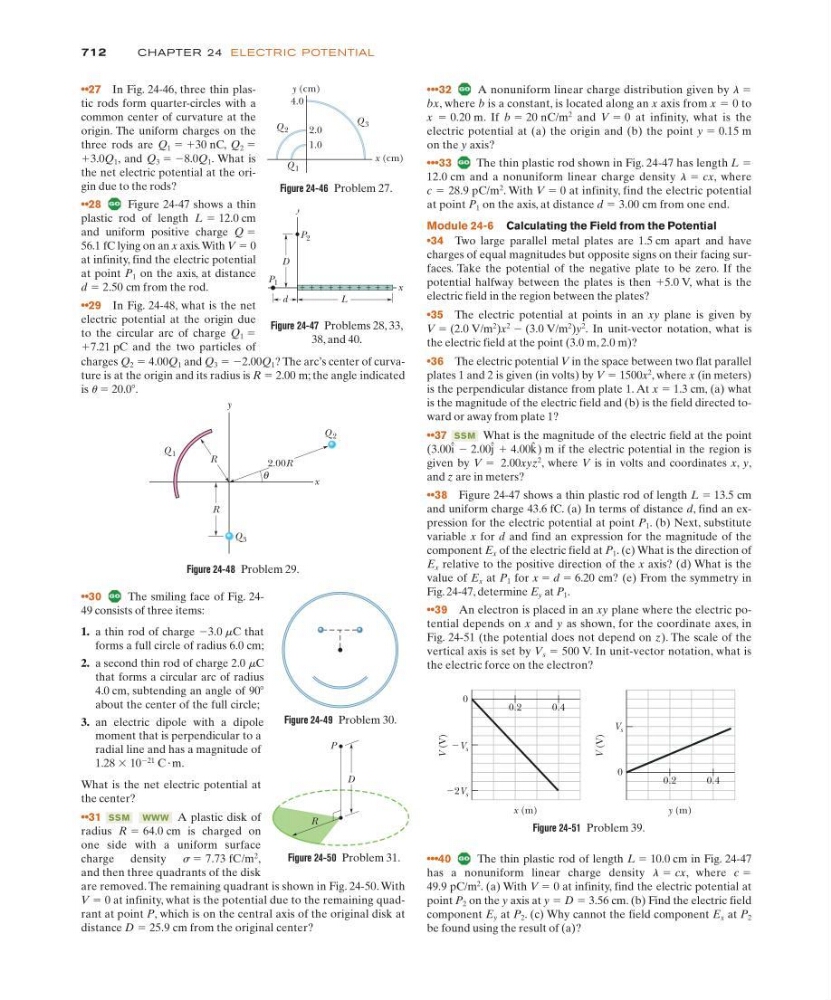
••27 In Fig. 24-46, three thin plastic rods form quarter-circles with a
common center of curvature at the
origin. The uniform charges on the
three rods are Q 1 ϭ ϩ30 nC, Q 2 ϭ
ϩ3.0Q 1 , and Q 3 ϭ Ϫ8.0Q 1 . What is
the net electric potential at the origin due to the rods?
••28
Figure 24-47 shows a thin
plastic rod of length L 12.0 cm
and uniform positive charge Q
56.1 fC lying on an x axis.With V ϭ 0
at infinity, find the electric potential
at point P 1 on the axis, at distance
d ϭ 2.50 cm from the rod.
••29 In Fig. 24-48, what is the net
electric potential at the origin due
to the circular arc of charge Q 1 ϭ
ϩ7.21 pC and the two particles of
ϭ
ϭ
x (cm)
y (cm)
4.0
2.0
1.0
Q 2
Q 3
Q 1
Figure 24-46 Problem 27.
charges Q 2 ϭ 4.00Q 1 and Q 3 ϭ Ϫ2.00Q 1 ? The arc’s center of curvature is at the origin and its radius is R ϭ 2.00 m; the angle indicated
is u ϭ 20.0Њ.
•••32
A nonuniform linear charge distribution given by l ϭ
bx, where b is a constant, is located along an x axis from x 0 to
x
0.20 m. If b ϭ 20 nC/m
2
and V ϭ 0 at infinity, what is the
electric potential at (a) the origin and (b) the point y ϭ 0.15 m
on the y axis?
•••33
The thin plastic rod shown in Fig. 24-47 has length L
12.0 cm and a nonuniform linear charge density l cx, where
c 28.9 pC/m
2
. With V ϭ 0 at infinity, find the electric potential
at point P 1 on the axis, at distance d ϭ 3.00 cm from one end.
Module 24-6 Calculating the Field from the Potential
•34 Two large parallel metal plates are 1.5 cm apart and have
charges of equal magnitudes but opposite signs on their facing surfaces. Take the potential of the negative plate to be zero. If the
potential halfway between the plates is then ϩ5.0 V, what is the
electric field in the region between the plates?
•35 The electric potential at points in an xy plane is given by
V ϭ (2.0 V/m
2
)x
2 Ϫ (3.0 V/m
2
)y
2
. In unit-vector notation, what is
the electric field at the point (3.0 m, 2.0 m)?
•36 The electric potential V in the space between two flat parallel
plates 1 and 2 is given (in volts) by V ϭ 1500x
2
, where x (in meters)
is the perpendicular distance from plate 1. At x ϭ 1.3 cm, (a) what
is the magnitude of the electric field and (b) is the field directed toward or away from plate 1?
••37
What is the magnitude of the electric field at the point
if the electric potential in the region is
given by V
2.00xyz
2
, where V is in volts and coordinates x, y,
and z are in meters?
••38 Figure 24-47 shows a thin plastic rod of length L ϭ 13.5 cm
and uniform charge 43.6 fC. (a) In terms of distance d, find an expression for the electric potential at point P 1 . (b) Next, substitute
variable x for d and find an expression for the magnitude of the
component E x of the electric field at P 1 . (c) What is the direction of
E x relative to the positive direction of the x axis? (d) What is the
value of E x at P 1 for x ϭ d ϭ 6.20 cm? (e) From the symmetry in
Fig. 24-47, determine E y at P 1 .
••39 An electron is placed in an xy plane where the electric potential depends on x and y as shown, for the coordinate axes, in
Fig. 24-51 (the potential does not depend on z). The scale of the
vertical axis is set by V s 500 V. In unit-vector notation, what is
the electric force on the electron?
ϭ
ϭ
(3.00i ˆ Ϫ 2.00j ˆ ϩ 4.00k ˆ ) m
SSM
ϭ
ϭ
ϭ
ϭ
ϭ
moment that is perpendicular to a
radial line and has a magnitude of
1.28 ϫ 10
Ϫ21
C иm.
What is the net electric potential at
the center?
••31
A plastic disk of
radius R 64.0 cm is charged on
one side with a uniform surface
charge density s 7.73 fC/m
2
,
and then three quadrants of the disk
ϭ
ϭ
WWW
SSM
D
P
R
Figure 24-50 Problem 31.
+ + + + + + + + + +
L
x
P 2
D
y
d
P 1
are removed. The remaining quadrant is shown in Fig. 24-50. With
V ϭ 0 at infinity, what is the potential due to the remaining quadrant at point P, which is on the central axis of the original disk at
distance D ϭ 25.9 cm from the original center?
•••40
The thin plastic rod of length L ϭ 10.0 cm in Fig. 24-47
has a nonuniform linear charge density l cx, where c
49.9 pC/m
2
. (a) With V ϭ 0 at infinity, find the electric potential at
point P 2 on the y axis at y ϭ D ϭ 3.56 cm. (b) Find the electric field
component E y at P 2 . (c) Why cannot the field component E x at P 2
be found using the result of (a)?
ϭ
ϭ