

711
PROB LE M S
an electric dipole, on the positive side of the dipole. (The origin of z
is at the center of the dipole.) The particle is then moved along a
circular path around the dipole center until it is at coordinate z ϭ
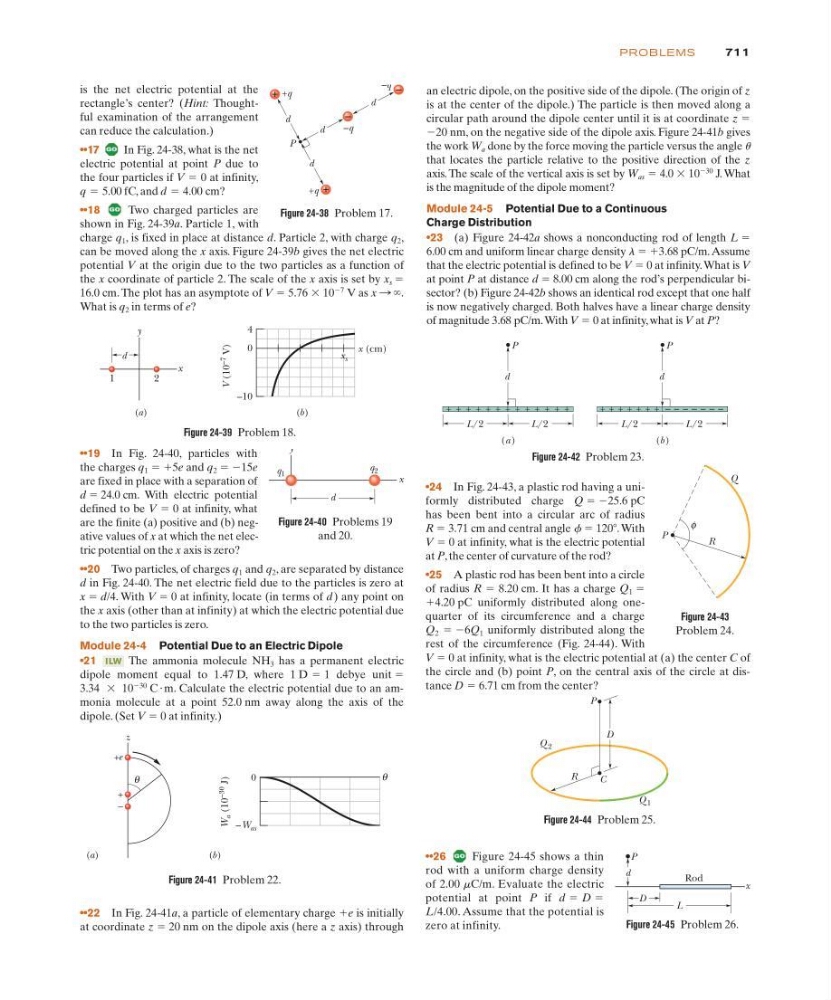
Ϫ20 nm, on the negative side of the dipole axis. Figure 24-41b gives
the work W a done by the force moving the particle versus the angle u
that locates the particle relative to the positive direction of the z
axis. The scale of the vertical axis is set by W as ϭ 4.0 ϫ 10
Ϫ30
J. What
is the magnitude of the dipole moment?
Module 24-5 Potential Due to a Continuous
Charge Distribution
•23 (a) Figure 24-42a shows a nonconducting rod of length L ϭ
6.00 cm and uniform linear charge density l ϭ ϩ3.68 pC/m. Assume
that the electric potential is defined to be V ϭ 0 at infinity. What is V
at point P at distance d ϭ 8.00 cm along the rod’s perpendicular bisector? (b) Figure 24-42b shows an identical rod except that one half
is now negatively charged. Both halves have a linear charge density
of magnitude 3.68 pC/m.With V ϭ 0 at infinity, what is V at P?
is the net electric potential at the
rectangle’s center? (Hint: Thoughtful examination of the arrangement
can reduce the calculation.)
••17
In Fig. 24-38, what is the net
electric potential at point P due to
the four particles if V 0 at infinity,
q 5.00 fC, and d 4.00 cm?
••18
Two charged particles are
shown in Fig. 24-39a. Particle 1, with
charge q 1 , is fixed in place at distance d. Particle 2, with charge q 2 ,
can be moved along the x axis. Figure 24-39b gives the net electric
potential V at the origin due to the two particles as a function of
the x coordinate of particle 2. The scale of the x axis is set by x s
16.0 cm. The plot has an asymptote of V ϭ 5.76 ϫ 10
Ϫ7
V as x : ϱ.
What is q 2 in terms of e?
ϭ
ϭ
ϭ
ϭ
d
d
d
d
+q
P
+q
–q
–q
+
+
Figure 24-38 Problem 17.
Figure 24-39 Problem 18.
x (cm)
x s
4
0
–10
V (10
–7
V)
1
2
y
x
d
(a)
(b)
Figure 24-40 Problems 19
and 20.
••19 In Fig. 24-40, particles with
the charges q 1 ϭ ϩ5e and q 2 ϭ Ϫ15e
are fixed in place with a separation of
d ϭ 24.0 cm. With electric potential
defined to be V 0 at infinity, what
are the finite (a) positive and (b) negative values of x at which the net electric potential on the x axis is zero?
ϭ
Figure 24-41 Problem 22.
Figure 24-42 Problem 23.
+ + + + + + + + + + + + +
L/2
L/2
P
d
+ + + + + + + – – – – – – –
L/2
L/2
P
d
(a )
( b )
Q
φ
R
P
Figure 24-43
Problem 24.
q 1
d
x
y
q 2
(a)
( b)
0
–W as
θ
θ
W
a (10
–30
J)
z
+
–
+e
•24 In Fig. 24-43, a plastic rod having a uniformly distributed charge Q ϭ Ϫ25.6 pC
has been bent into a circular arc of radius
R ϭ 3.71 cm and central angle f ϭ 120Њ.With
V ϭ 0 at infinity, what is the electric potential
at P, the center of curvature of the rod?
•25 A plastic rod has been bent into a circle
of radius R ϭ 8.20 cm. It has a charge Q 1 ϭ
ϩ4.20 pC uniformly distributed along onequarter of its circumference and a charge
Q 2 ϭ Ϫ6Q 1 uniformly distributed along the
rest of the circumference (Fig. 24-44). With
••20 Two particles, of charges q 1 and q 2 , are separated by distance
d in Fig. 24-40. The net electric field due to the particles is zero at
x ϭ d/4. With V ϭ 0 at infinity, locate (in terms of d) any point on
the x axis (other than at infinity) at which the electric potential due
to the two particles is zero.
Module 24-4 Potential Due to an Electric Dipole
•21
The ammonia molecule NH 3 has a permanent electric
dipole moment equal to 1.47 D, where 1 D 1 debye unit
3.34
10
Ϫ30
C иm. Calculate the electric potential due to an ammonia molecule at a point 52.0 nm away along the axis of the
dipole. (Set V ϭ 0 at infinity.)
ϫ
ϭ
ϭ
ILW
••22 In Fig. 24-41a, a particle of elementary charge ϩe is initially
at coordinate z ϭ 20 nm on the dipole axis (here a z axis) through
V ϭ 0 at infinity, what is the electric potential at (a) the center C of
the circle and (b) point P, on the central axis of the circle at distance D ϭ 6.71 cm from the center?
••26
Figure 24-45 shows a thin
rod with a uniform charge density
of 2.00 mC/m. Evaluate the electric
potential at point P if d D ϭ
L/4.00. Assume that the potential is
zero at infinity.
ϭ
C
D
P
Q 2
R
Q 1
Figure 24-44 Problem 25.
d
D
L
P
x
Rod
Figure 24-45 Problem 26.