

713
PROB LE M S
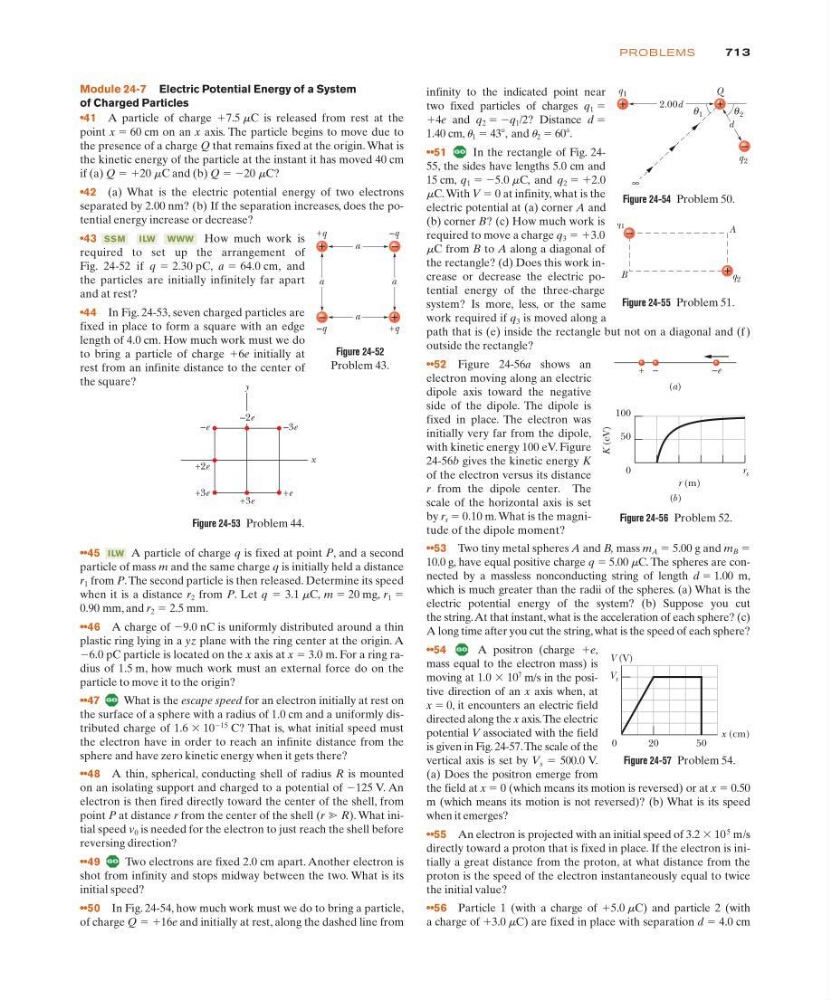
infinity to the indicated point near
two fixed particles of charges q 1 ϭ
ϩ4e and q 2 ϭ Ϫq 1 /2? Distance d ϭ
1.40 cm, u 1 ϭ 43Њ, and u 2 ϭ 60Њ.
••51
In the rectangle of Fig. 2455, the sides have lengths 5.0 cm and
15 cm, q 1 ϭ Ϫ5.0 mC, and q 2 ϭ ϩ2.0
mC. With V ϭ 0 at infinity, what is the
electric potential at (a) corner A and
(b) corner B? (c) How much work is
required to move a charge q 3 ϭ ϩ3.0
mC from B to A along a diagonal of
the rectangle? (d) Does this work increase or decrease the electric potential energy of the three-charge
system? Is more, less, or the same
work required if q 3 is moved along a
path that is (e) inside the rectangle but not on a diagonal and (f)
outside the rectangle?
••52 Figure 24-56a shows an
electron moving along an electric
dipole axis toward the negative
side of the dipole. The dipole is
fixed in place. The electron was
initially very far from the dipole,
with kinetic energy 100 eV. Figure
24-56b gives the kinetic energy K
of the electron versus its distance
r from the dipole center. The
scale of the horizontal axis is set
by r s ϭ 0.10 m. What is the magnitude of the dipole moment?
••53 Two tiny metal spheres A and B, mass m A ϭ 5.00 g and m B ϭ
10.0 g, have equal positive charge q ϭ 5.00 mC. The spheres are connected by a massless nonconducting string of length d ϭ 1.00 m,
which is much greater than the radii of the spheres. (a) What is the
electric potential energy of the system? (b) Suppose you cut
the string.At that instant, what is the acceleration of each sphere? (c)
A long time after you cut the string, what is the speed of each sphere?
••54
A positron (charge ϩe,
mass equal to the electron mass) is
moving at 1.0 10
7
m/s in the positive direction of an x axis when, at
x ϭ 0, it encounters an electric field
directed along the x axis.The electric
potential V associated with the field
is given in Fig. 24-57.The scale of the
vertical axis is set by V s ϭ 500.0 V.
(a) Does the positron emerge from
the field at x ϭ 0 (which means its motion is reversed) or at x ϭ 0.50
m (which means its motion is not reversed)? (b) What is its speed
when it emerges?
••55 An electron is projected with an initial speed of 3.2 ϫ 10
5
m/s
directly toward a proton that is fixed in place. If the electron is initially a great distance from the proton, at what distance from the
proton is the speed of the electron instantaneously equal to twice
the initial value?
••56 Particle 1 (with a charge of ϩ5.0 mC) and particle 2 (with
a charge of ϩ3.0 mC) are fixed in place with separation d ϭ 4.0 cm
ϫ
Module 24-7 Electric Potential Energy of a System
of Charged Particles
•41 A particle of charge ϩ7.5 mC is released from rest at the
point x ϭ 60 cm on an x axis. The particle begins to move due to
the presence of a charge Q that remains fixed at the origin. What is
the kinetic energy of the particle at the instant it has moved 40 cm
if (a) Q ϭ ϩ20 mC and (b) Q ϭ Ϫ20 mC?
•42 (a) What is the electric potential energy of two electrons
separated by 2.00 nm? (b) If the separation increases, does the potential energy increase or decrease?
•43
How much work is
required to set up the arrangement of
Fig. 24-52 if q 2.30 pC, a 64.0 cm, and
the particles are initially infinitely far apart
and at rest?
•44 In Fig. 24-53, seven charged particles are
fixed in place to form a square with an edge
length of 4.0 cm. How much work must we do
to bring a particle of charge ϩ6e initially at
rest from an infinite distance to the center of
the square?
ϭ
ϭ
WWW
ILW
SSM
–q
+q
a
+q
–q
a
a
a
+
+
Figure 24-52
Problem 43.
Figure 24-54 Problem 50.
2.00d
q 1
Q
q 2
d
1
∞
+
+
θ
2
θ
B
A
q 1
q 2
+
Figure 24-55 Problem 51.
Figure 24-56 Problem 52.
r s
+ –
–e
100
50
0
r (m)
K (eV)
(a)
(b)
Figure 24-53 Problem 44.
x
–e
+3e
–3e
+e
+3e
–2e
+2e
y
••45
A particle of charge q is fixed at point P, and a second
particle of mass m and the same charge q is initially held a distance
r 1 from P.The second particle is then released. Determine its speed
when it is a distance r 2 from P. Let q ϭ 3.1 mC, m ϭ 20 mg, r 1 ϭ
0.90 mm, and r 2 ϭ 2.5 mm.
••46 A charge of Ϫ9.0 nC is uniformly distributed around a thin
plastic ring lying in a yz plane with the ring center at the origin. A
Ϫ6.0 pC particle is located on the x axis at x ϭ 3.0 m. For a ring radius of 1.5 m, how much work must an external force do on the
particle to move it to the origin?
••47
What is the escape speed for an electron initially at rest on
the surface of a sphere with a radius of 1.0 cm and a uniformly distributed charge of 1.6 ϫ 10
Ϫ15
C? That is, what initial speed must
the electron have in order to reach an infinite distance from the
sphere and have zero kinetic energy when it gets there?
••48 A thin, spherical, conducting shell of radius R is mounted
on an isolating support and charged to a potential of Ϫ125 V. An
electron is then fired directly toward the center of the shell, from
point P at distance r from the center of the shell
. What initial speed v 0 is needed for the electron to just reach the shell before
reversing direction?
••49
Two electrons are fixed 2.0 cm apart. Another electron is
shot from infinity and stops midway between the two. What is its
initial speed?
••50 In Fig. 24-54, how much work must we do to bring a particle,
of charge Q ϭ ϩ16e and initially at rest, along the dashed line from
(r ӷ R)
ILW
V s
V (V)
20
0
50
x (cm)
Figure 24-57 Problem 54.