

700
CHAPTE R 24 ELECTRIC POTENTIAL
Since the charge on the rod is positive and we have taken V ϭ 0 at infinity, we
know from Module 24-3 that dV in Eq. 24-34 must be positive.
We now find the total potential V produced by the rod at point P by integrating Eq. 24-34 along the length of the rod, from x ϭ 0 to x ϭ L (Figs. 24-15d and e),
using integral 17 in Appendix E. We find
We can simplify this result by using the general relation ln A ln B ln(A/B).
We then find
(24-35)
Because V is the sum of positive values of dV, it too is positive, consistent with
the logarithm being positive for an argument greater than 1.
Charged Disk
In Module 22-5, we calculated the magnitude of the electric field at points on the
central axis of a plastic disk of radius R that has a uniform charge density s on
one surface. Here we derive an expression for V(z), the electric potential at any
point on the central axis. Because we have a circular distribution of charge on the
disk, we could start with a differential element that occupies angle du and radial
distance dr. We would then need to set up a two-dimensional integration.
However, let’s do something easier.
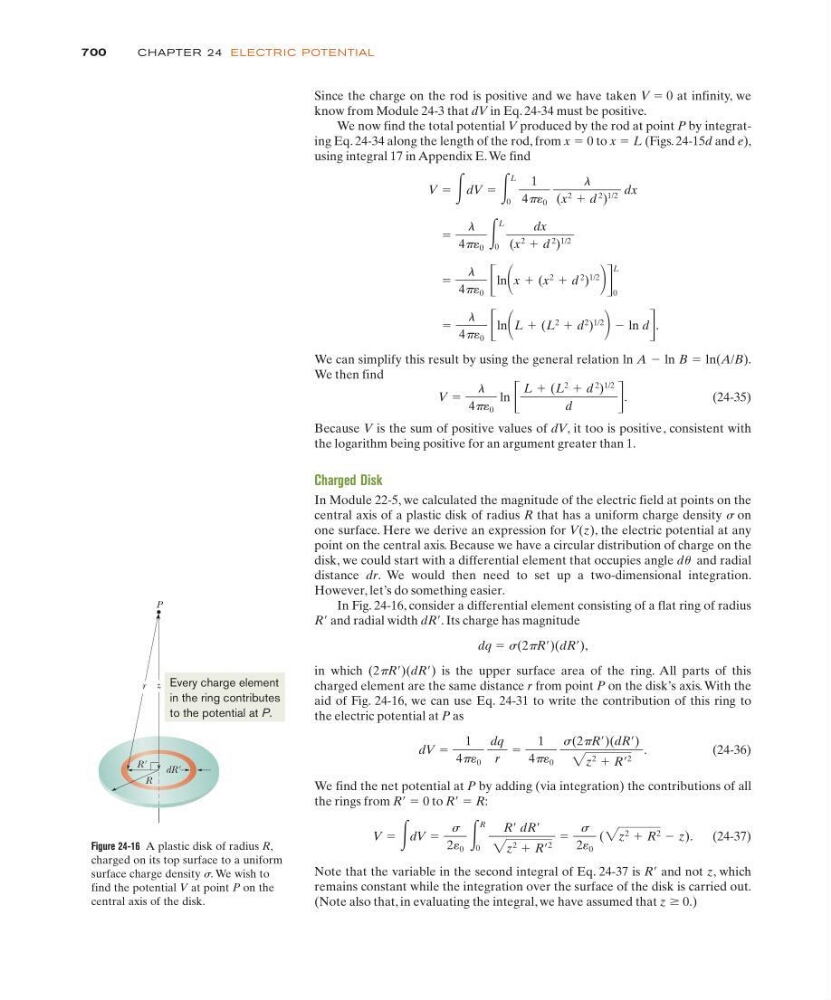
In Fig. 24-16, consider a differential element consisting of a flat ring of radius
RЈ and radial width dRЈ. Its charge has magnitude
dq ϭ s(2pRЈ)(dRЈ),
in which (2pRЈ)(dRЈ) is the upper surface area of the ring. All parts of this
charged element are the same distance r from point P on the disk’s axis. With the
aid of Fig. 24-16, we can use Eq. 24-31 to write the contribution of this ring to
the electric potential at P as
(24-36)
We find the net potential at P by adding (via integration) the contributions of all
the rings from RЈ ϭ 0 to RЈ ϭ R:
(24-37)
Note that the variable in the second integral of Eq. 24-37 is RЈ and not z, which
remains constant while the integration over the surface of the disk is carried out.
(Note also that, in evaluating the integral, we have assumed that z Ն 0.)
V ϭ ͵dV ϭ
s
2´ 0
͵
R
0
RЈ dRЈ
2z
2 ϩ RЈ
2
ϭ
s
2´ 0
(2z
2 ϩ R
2 Ϫ z).
dV ϭ
1
4p´ 0
dq
r
ϭ
1
4p´ 0
s(2pRЈ)(dRЈ)
2z
2 ϩ RЈ
2
.
V ϭ
l
4p´ 0
ln ΄
L ϩ (L
2 ϩ d
2
)
1/2
d
΅ .
ϭ
Ϫ
ϭ
l
4p´ 0
΄ ln L ϩ (L
2 ϩ d
2
)
1/2
Ϫ ln d ΅ .
ϭ
l
4p´ 0
΄ ln x ϩ (x
2 ϩ d
2
)
1/2
΅ 0
L
ϭ
l
4p´ 0
͵
L
0
dx
(x
2 ϩ d
2
)
1/2
V ϭ ͵dV ϭ ͵
L
0
1
4p´ 0
l
(x
2 ϩ d
2
)
1/2
dx
z
r
P
R'
R
dR'
Every charge element
in the ring contributes
to the potential at P.
Figure 24-16 A plastic disk of radius R,
charged on its top surface to a uniform
surface charge density s. We wish to
find the potential V at point P on the
central axis of the disk.