

619
21-2 CHARG E IS QUANTI Z E D
(Answer)
The spheres, now positively charged, repel each other.
(b) Next, suppose sphere A is grounded momentarily, and
then the ground connection is removed. What now is the
electrostatic force between the spheres?
Reasoning: When we provide a conducting path between a
charged object and the ground (which is a huge conductor),
we neutralize the object. Were sphere A negatively charged,
the mutual repulsion between the excess electrons would
cause them to move from the sphere to the ground.
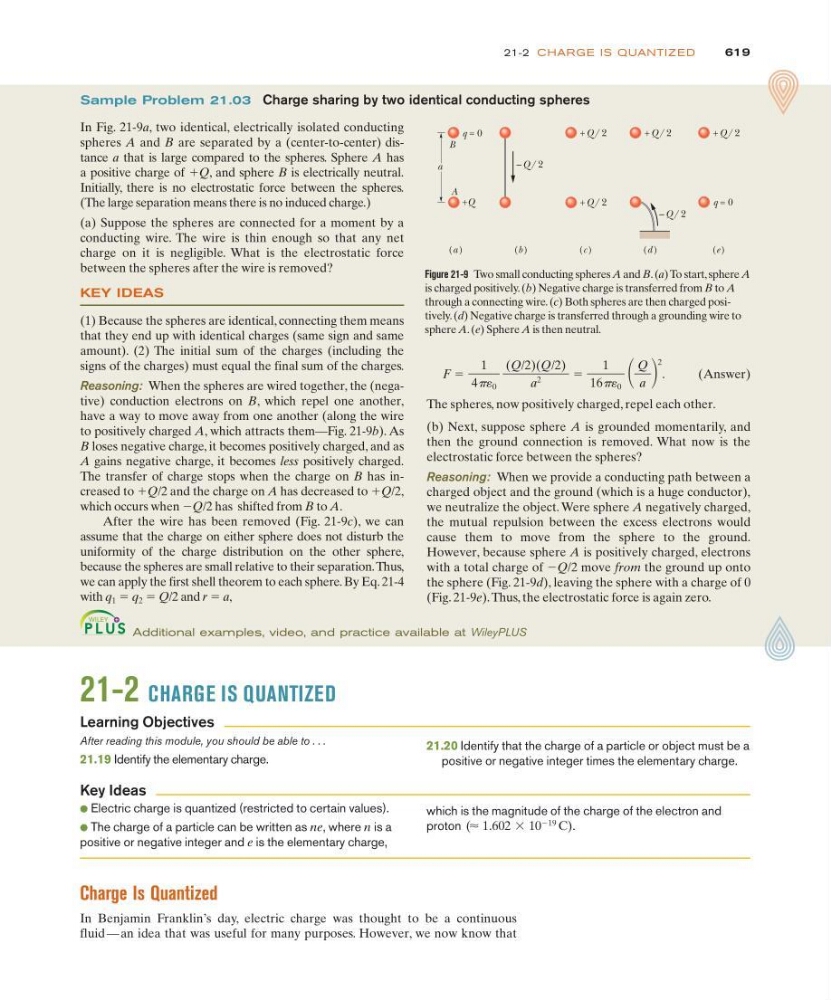
However, because sphere A is positively charged, electrons
with a total charge of ϪQ/2 move from the ground up onto
the sphere (Fig. 21-9d), leaving the sphere with a charge of 0
(Fig. 21-9e). Thus, the electrostatic force is again zero.
F ϭ
1
4p´ 0
(Q/2)(Q/2)
a
2
ϭ
1
16p´ 0
Q
a
2
.
Sample Problem 21.03 Charge sharing by two identical conducting spheres
In Fig. 21-9a, two identical, electrically isolated conducting
spheres A and B are separated by a (center-to-center) distance a that is large compared to the spheres. Sphere A has
a positive charge of ϩQ, and sphere B is electrically neutral.
Initially, there is no electrostatic force between the spheres.
(The large separation means there is no induced charge.)
(a) Suppose the spheres are connected for a moment by a
conducting wire. The wire is thin enough so that any net
charge on it is negligible. What is the electrostatic force
between the spheres after the wire is removed?
KEY IDEAS
(1) Because the spheres are identical, connecting them means
that they end up with identical charges (same sign and same
amount). (2) The initial sum of the charges (including the
signs of the charges) must equal the final sum of the charges.
Reasoning: When the spheres are wired together, the (negative) conduction electrons on B, which repel one another,
have a way to move away from one another (along the wire
to positively charged A, which attracts them—Fig. 21-9b). As
B loses negative charge, it becomes positively charged, and as
A gains negative charge, it becomes less positively charged.
The transfer of charge stops when the charge on B has increased to ϩQ/2 and the charge on A has decreased to ϩQ/2,
which occurs when ϪQ/2 has shifted from B to A.
After the wire has been removed (Fig. 21-9c), we can
assume that the charge on either sphere does not disturb the
uniformity of the charge distribution on the other sphere,
because the spheres are small relative to their separation.Thus,
we can apply the first shell theorem to each sphere. By Eq. 21-4
with q 1 ϭ q 2 ϭ Q/2 and r ϭ a,
Figure 21-9 Two small conducting spheres A and B.(a) To start, sphere A
is charged positively. (b) Negative charge is transferred from B to A
through a connecting wire. (c) Both spheres are then charged positively. (d) Negative charge is transferred through a grounding wire to
sphere A. (e) Sphere A is then neutral.
q = 0
B
a
A
+Q
(a )
– Q / 2
(b )
+ Q / 2
+ Q / 2
(c )
+ Q / 2
– Q / 2
(d )
+ Q / 2
q = 0
(e )
Additional examples, video, and practice available at WileyPLUS
21-2 CHARGE IS QUANTIZED
After reading this module, you should be able to . . .
21.19 Identify the elementary charge.
21.20 Identify that the charge of a particle or object must be a
positive or negative integer times the elementary charge.
● Electric charge is quantized (restricted to certain values).
● The charge of a particle can be written as ne, where n is a
positive or negative integer and e is the elementary charge,
which is the magnitude of the charge of the electron and
proton (Ϸ 1.602 ϫ 10
Ϫ19
C).
Learning Objectives
Key Ideas
Charge Is Quantized
In Benjamin Franklin’s day, electric charge was thought to be a continuous
fluid — an idea that was useful for many purposes. However, we now know that