

620
CHAPTE R 21 COU LOM B’S L AW
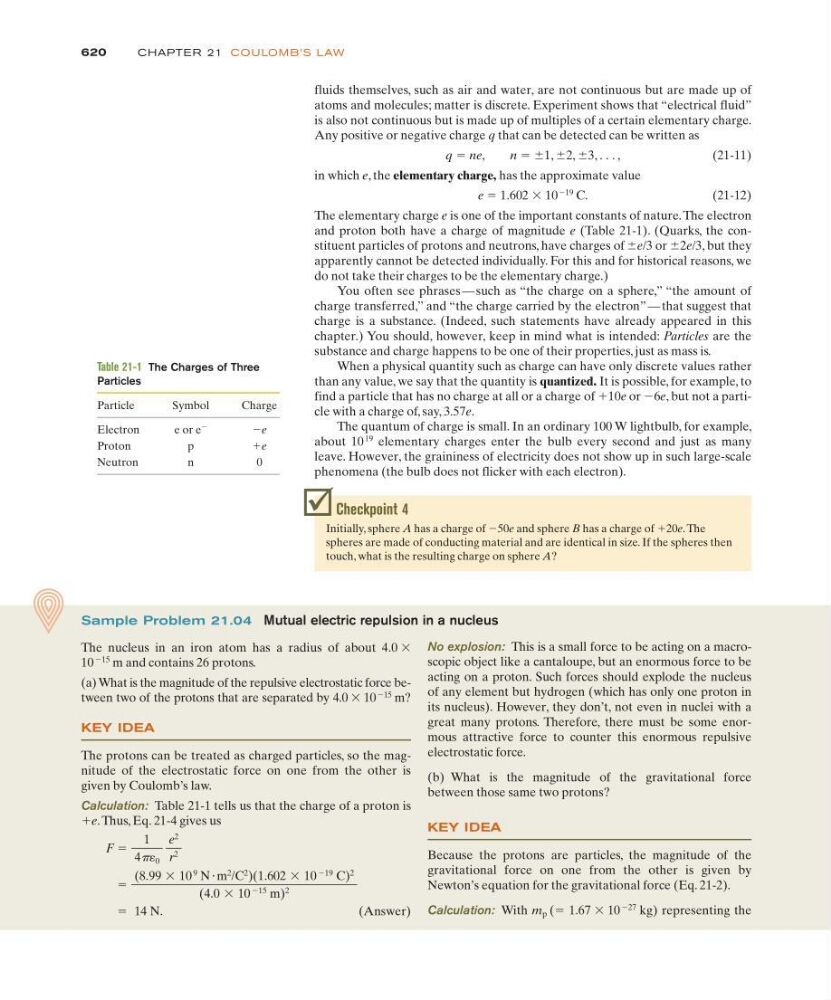
Table 21-1 The Charges of Three
Particles
Particle
Symbol
Charge
Electron
e or e
Ϫ
Ϫe
Proton
p
ϩe
Neutron
n
0
Checkpoint 4
Initially, sphere A has a charge of Ϫ50e and sphere B has a charge of ϩ20e.The
spheres are made of conducting material and are identical in size. If the spheres then
touch, what is the resulting charge on sphere A?
No explosion: This is a small force to be acting on a macroscopic object like a cantaloupe, but an enormous force to be
acting on a proton. Such forces should explode the nucleus
of any element but hydrogen (which has only one proton in
its nucleus). However, they don’t, not even in nuclei with a
great many protons. Therefore, there must be some enormous attractive force to counter this enormous repulsive
electrostatic force.
(b) What is the magnitude of the gravitational force
between those same two protons?
KEY IDEA
Because the protons are particles, the magnitude of the
gravitational force on one from the other is given by
Newton’s equation for the gravitational force (Eq. 21-2).
Calculation: With m p (ϭ 1.67 ϫ 10
Ϫ27
kg) representing the
Sample Problem 21.04 Mutual electric repulsion in a nucleus
The nucleus in an iron atom has a radius of about 4.0 ϫ
10
Ϫ15
m and contains 26 protons.
(a) What is the magnitude of the repulsive electrostatic force between two of the protons that are separated by 4.0 ϫ 10
Ϫ15
m?
KEY IDEA
The protons can be treated as charged particles, so the magnitude of the electrostatic force on one from the other is
given by Coulomb’s law.
Calculation: Table 21-1 tells us that the charge of a proton is
ϩe.Thus, Eq. 21-4 gives us
.
( A n s w e r )
ϭ 14 N
ϭ
(8.99 ϫ 10
9
Nиm
2
/C
2
)(1.602 ϫ 10
Ϫ19
C)
2
(4.0 ϫ 10
Ϫ15
m)
2
F ϭ
1
4p´ 0
e
2
r
2
fluids themselves, such as air and water, are not continuous but are made up of
atoms and molecules; matter is discrete. Experiment shows that “electrical fluid”
is also not continuous but is made up of multiples of a certain elementary charge.
Any positive or negative charge q that can be detected can be written as
q ϭ ne,
n ϭ Ϯ1, Ϯ2, Ϯ3, . . . ,
(21-11)
in which e, the elementary charge, has the approximate value
e ϭ 1.602 ϫ 10
Ϫ19
C.
(21-12)
The elementary charge e is one of the important constants of nature. The electron
and proton both have a charge of magnitude e (Table 21-1). (Quarks, the constituent particles of protons and neutrons, have charges of Ϯe/3 or Ϯ2e/3, but they
apparently cannot be detected individually. For this and for historical reasons, we
do not take their charges to be the elementary charge.)
You often see phrases — such as “the charge on a sphere,” “the amount of
charge transferred,” and “the charge carried by the electron” — that suggest that
charge is a substance. (Indeed, such statements have already appeared in this
chapter.) You should, however, keep in mind what is intended: Particles are the
substance and charge happens to be one of their properties, just as mass is.
When a physical quantity such as charge can have only discrete values rather
than any value, we say that the quantity is quantized. It is possible, for example, to
find a particle that has no charge at all or a charge of ϩ10e or Ϫ6e, but not a particle with a charge of, say, 3.57e.
The quantum of charge is small. In an ordinary 100 W lightbulb, for example,
about 10
19
elementary charges enter the bulb every second and just as many
leave. However, the graininess of electricity does not show up in such large-scale
phenomena (the bulb does not flicker with each electron).