

618
CHAPTE R 21 COU LOM B’S L AW
Checkpoint 3
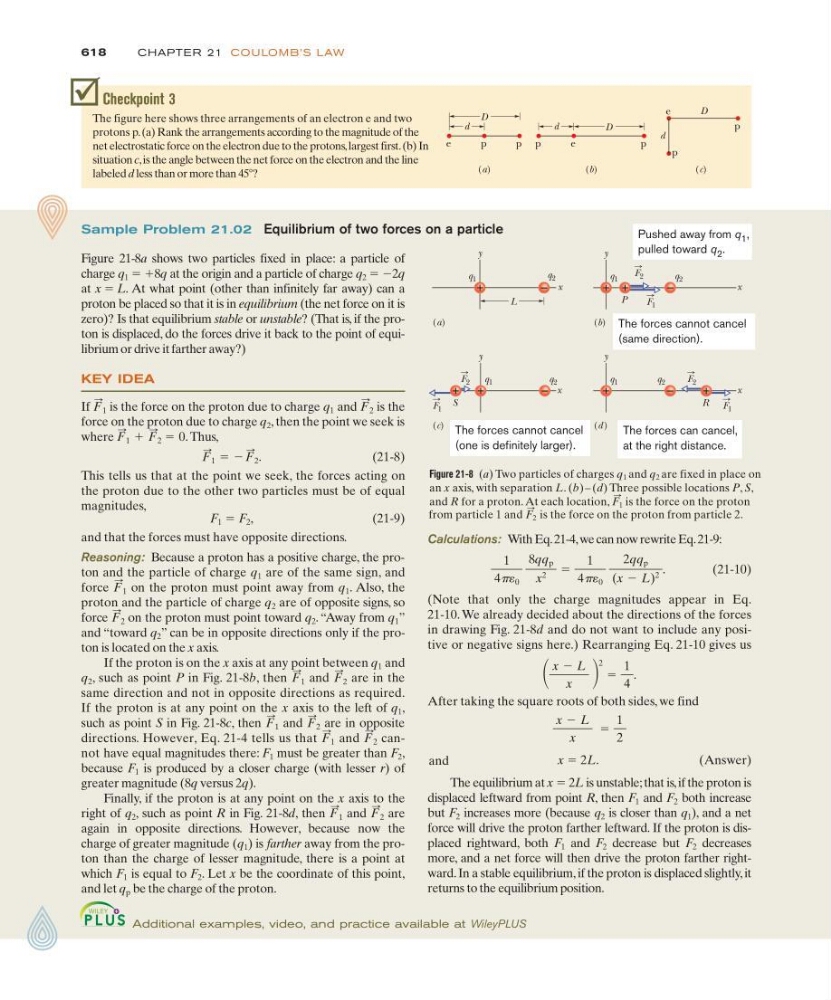
The figure here shows three arrangements of an electron e and two
protons p.(a) Rank the arrangements according to the magnitude of the
net electrostatic force on the electron due to the protons, largest first. (b) In
situation c,is the angle between the net force on the electron and the line
labeled d less than or more than 45Њ?
D
d
e
p
p
D
d
p
e
p
D
d
e
p
p
(a)
(b)
(c)
Calculations: With Eq.21-4,we can now rewrite Eq.21-9:
(21-10)
(Note that only the charge magnitudes appear in Eq.
21-10. We already decided about the directions of the forces
in drawing Fig. 21-8d and do not want to include any positive or negative signs here.) Rearranging Eq. 21-10 gives us
After taking the square roots of both sides, we find
x ϭ 2L.
( A n s w e r )
The equilibrium at x ϭ 2L is unstable; that is, if the proton is
displaced leftward from point R, then F 1 and F 2 both increase
but F 2 increases more (because q 2 is closer than q 1 ), and a net
force will drive the proton farther leftward. If the proton is displaced rightward, both F 1 and F 2 decrease but F 2 decreases
more, and a net force will then drive the proton farther rightward. In a stable equilibrium, if the proton is displaced slightly, it
returns to the equilibrium position.
x Ϫ L
x
ϭ
1
2
x Ϫ L
x
2
ϭ
1
4
.
1
4p´ 0
8qq p
x
2
ϭ
1
4p´ 0
2qq p
(x Ϫ L)
2
.
Sample Problem 21.02 Equilibrium of two forces on a particle
Figure 21-8a shows two particles fixed in place: a particle of
charge q 1 ϭ ϩ8q at the origin and a particle of charge q 2 ϭ Ϫ2q
at x ϭ L. At what point (other than infinitely far away) can a
proton be placed so that it is in equilibrium (the net force on it is
zero)? Is that equilibrium stable or unstable? (That is, if the proton is displaced, do the forces drive it back to the point of equilibrium or drive it farther away?)
KEY IDEA
If
is the force on the proton due to charge q 1 and
is the
force on the proton due to charge q 2 , then the point we seek is
where
Thus,
(21-8)
This tells us that at the point we seek, the forces acting on
the proton due to the other two particles must be of equal
magnitudes,
F 1 ϭ F 2 ,
( 2 1 - 9 )
and that the forces must have opposite directions.
Reasoning: Because a proton has a positive charge, the proton and the particle of charge q 1 are of the same sign, and
force
on the proton must point away from q 1 . Also, the
proton and the particle of charge q 2 are of opposite signs, so
force
on the proton must point toward q 2 . “Away from q 1 ”
and “toward q 2 ” can be in opposite directions only if the proton is located on the x axis.
If the proton is on the x axis at any point between q 1 and
q 2 , such as point P in Fig. 21-8b, then
and
are in the
same direction and not in opposite directions as required.
If the proton is at any point on the x axis to the left of q 1 ,
such as point S in Fig. 21-8c, then
and
are in opposite
directions. However, Eq. 21-4 tells us that
and
cannot have equal magnitudes there: F 1 must be greater than F 2 ,
because F 1 is produced by a closer charge (with lesser r) of
greater magnitude (8q versus 2q).
Finally, if the proton is at any point on the x axis to the
right of q 2 , such as point R in Fig. 21-8d, then
and
are
again in opposite directions. However, because now the
charge of greater magnitude (q 1 ) is farther away from the proton than the charge of lesser magnitude, there is a point at
which F 1 is equal to F 2 . Let x be the coordinate of this point,
and let q p be the charge of the proton.
F
:
2
F
:
1
F
:
2
F
:
1
F
:
2
F
:
1
F
:
2
F
:
1
F
:
2
F
:
1
F
:
1 ϭ ϪF
:
2 .
F
:
1 ϩ F
:
2 ϭ 0.
F
:
2
F
:
1
L
y
x
q 2
q 1
(a)
y
x
S
(c)
q 1
q 2
F 2
F 1
y
x
P
(b)
q 1
q 2
F 2
F 1
Pushed away from q 1 ,
pulled toward q 2 .
The forces cannot cancel
(same direction).
The forces cannot cancel
(one is definitely larger).
y
x
R
(d)
q 1
q 2
F 2
F 1
The forces can cancel,
at the right distance.
Figure 21-8 (a) Two particles of charges q 1 and q 2 are fixed in place on
an x axis, with separation L. (b) – (d) Three possible locations P, S,
and R for a proton. At each location, is the force on the proton
F
:
1
from particle 1 and
is the force on the proton from particle 2.
F
:
2
Additional examples, video, and practice available at WileyPLUS
and