

581
PROB LE M S
1.20 atm and 0.200 m
3
. Its final pressure
is 2.40 atm. How much work is done by
the gas?
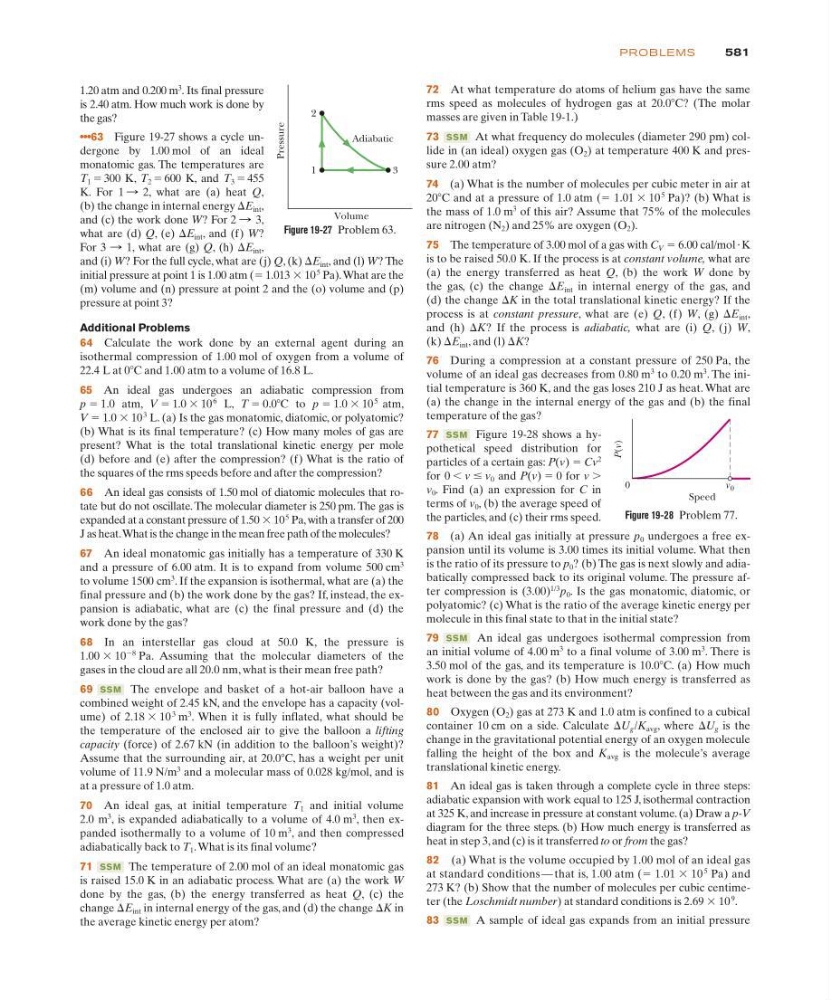
•••63 Figure 19-27 shows a cycle undergone by 1.00 mol of an ideal
monatomic gas. The temperatures are
T 1 ϭ 300 K, T 2 ϭ 600 K, and T 3 ϭ 455
K. For 1 : 2, what are (a) heat Q,
(b) the change in internal energy ⌬E int ,
and (c) the work done W? For 2 : 3,
what are (d) Q, (e) ⌬E int , and (f) W?
For 3 : 1, what are (g) Q, (h) ⌬E int ,
and (i) W? For the full cycle, what are (j) Q, (k) ⌬E int , and (l) W? The
initial pressure at point 1 is 1.00 atm (ϭ 1.013 ϫ 10
5
Pa).What are the
(m) volume and (n) pressure at point 2 and the (o) volume and (p)
pressure at point 3?
Additional Problems
64 Calculate the work done by an external agent during an
isothermal compression of 1.00 mol of oxygen from a volume of
22.4 L at 0ЊC and 1.00 atm to a volume of 16.8 L.
65 An ideal gas undergoes an adiabatic compression from
p ϭ 1.0 atm, V ϭ 1.0 ϫ 10
6
L, T ϭ 0.0ЊC to p ϭ 1.0 ϫ 10
5
atm,
V ϭ 1.0 ϫ 10
3
L. (a) Is the gas monatomic, diatomic, or polyatomic?
(b) What is its final temperature? (c) How many moles of gas are
present? What is the total translational kinetic energy per mole
(d) before and (e) after the compression? (f) What is the ratio of
the squares of the rms speeds before and after the compression?
66 An ideal gas consists of 1.50 mol of diatomic molecules that rotate but do not oscillate. The molecular diameter is 250 pm. The gas is
expanded at a constant pressure of 1.50 ϫ 10
5
Pa, with a transfer of 200
J as heat.What is the change in the mean free path of the molecules?
67 An ideal monatomic gas initially has a temperature of 330 K
and a pressure of 6.00 atm. It is to expand from volume 500 cm
3
to volume 1500 cm
3
. If the expansion is isothermal, what are (a) the
final pressure and (b) the work done by the gas? If, instead, the expansion is adiabatic, what are (c) the final pressure and (d) the
work done by the gas?
68 In an interstellar gas cloud at 50.0 K, the pressure is
1.00 ϫ 10
Ϫ8
Pa. Assuming that the molecular diameters of the
gases in the cloud are all 20.0 nm, what is their mean free path?
69
The envelope and basket of a hot-air balloon have a
combined weight of 2.45 kN, and the envelope has a capacity (volume) of 2.18 ϫ 10
3
m
3
. When it is fully inflated, what should be
the temperature of the enclosed air to give the balloon a lifting
capacity (force) of 2.67 kN (in addition to the balloon’s weight)?
Assume that the surrounding air, at 20.0ЊC, has a weight per unit
volume of 11.9 N/m
3
and a molecular mass of 0.028 kg/mol, and is
at a pressure of 1.0 atm.
70 An ideal gas, at initial temperature T 1 and initial volume
2.0 m
3
, is expanded adiabatically to a volume of 4.0 m
3
, then expanded isothermally to a volume of 10 m
3
, and then compressed
adiabatically back to T 1 .What is its final volume?
71
The temperature of 2.00 mol of an ideal monatomic gas
is raised 15.0 K in an adiabatic process. What are (a) the work W
done by the gas, (b) the energy transferred as heat Q, (c) the
change ⌬E int in internal energy of the gas, and (d) the change ⌬K in
the average kinetic energy per atom?
SSM
SSM
72 At what temperature do atoms of helium gas have the same
rms speed as molecules of hydrogen gas at 20.0ЊC? (The molar
masses are given in Table 19-1.)
73
At what frequency do molecules (diameter 290 pm) collide in (an ideal) oxygen gas (O 2 ) at temperature 400 K and pressure 2.00 atm?
74 (a) What is the number of molecules per cubic meter in air at
20ЊC and at a pressure of 1.0 atm (ϭ 1.01 ϫ 10
5
Pa)? (b) What is
the mass of 1.0 m
3
of this air? Assume that 75% of the molecules
are nitrogen (N 2 ) and 25% are oxygen (O 2 ).
75 The temperature of 3.00 mol of a gas with C V ϭ 6.00 cal/mol иK
is to be raised 50.0 K. If the process is at constant volume, what are
(a) the energy transferred as heat Q, (b) the work W done by
the gas, (c) the change ⌬E int in internal energy of the gas, and
(d) the change ⌬K in the total translational kinetic energy? If the
process is at constant pressure, what are (e) Q, (f) W, (g) E int ,
and (h) ⌬K? If the process is adiabatic, what are (i) Q, (j) W,
(k) ⌬E int , and (l) ⌬K?
76 During a compression at a constant pressure of 250 Pa, the
volume of an ideal gas decreases from 0.80 m
3
to 0.20 m
3
. The initial temperature is 360 K, and the gas loses 210 J as heat. What are
(a) the change in the internal energy of the gas and (b) the final
temperature of the gas?
77
Figure 19-28 shows a hypothetical speed distribution for
particles of a certain gas: P(v) ϭ Cv
2
for 0 Ͻ v Յ v 0 and P(v) ϭ 0 for v Ͼ
v 0 . Find (a) an expression for C in
terms of v 0 , (b) the average speed of
the particles, and (c) their rms speed.
78 (a) An ideal gas initially at pressure p 0 undergoes a free expansion until its volume is 3.00 times its initial volume. What then
is the ratio of its pressure to p 0 ? (b) The gas is next slowly and adiabatically compressed back to its original volume. The pressure after compression is (3.00)
1/3
p 0 . Is the gas monatomic, diatomic, or
polyatomic? (c) What is the ratio of the average kinetic energy per
molecule in this final state to that in the initial state?
79
An ideal gas undergoes isothermal compression from
an initial volume of 4.00 m
3
to a final volume of 3.00 m
3
. There is
3.50 mol of the gas, and its temperature is 10.0ЊC. (a) How much
work is done by the gas? (b) How much energy is transferred as
heat between the gas and its environment?
80 Oxygen (O 2 ) gas at 273 K and 1.0 atm is confined to a cubical
container 10 cm on a side. Calculate ⌬U g /K avg , where ⌬U g is the
change in the gravitational potential energy of an oxygen molecule
falling the height of the box and K avg is the molecule’s average
translational kinetic energy.
81 An ideal gas is taken through a complete cycle in three steps:
adiabatic expansion with work equal to 125 J, isothermal contraction
at 325 K, and increase in pressure at constant volume. (a) Draw a p-V
diagram for the three steps. (b) How much energy is transferred as
heat in step 3, and (c) is it transferred to or from the gas?
82 (a) What is the volume occupied by 1.00 mol of an ideal gas
at standard conditions — that is, 1.00 atm (ϭ 1.01 ϫ 10
5
Pa) and
273 K? (b) Show that the number of molecules per cubic centimeter (the Loschmidt number) at standard conditions is 2.69 ϫ 10
9
.
83
A sample of ideal gas expands from an initial pressure
SSM
SSM
SSM
⌬
SSM
P(v)
Speed
v 0
0
Figure 19-28 Problem 77.
Volume
Pressure
2
Adiabatic
3
1
Figure 19-27 Problem 63.
PROB LE M S
1.20 atm and 0.200 m
3
. Its final pressure
is 2.40 atm. How much work is done by
the gas?
•••63 Figure 19-27 shows a cycle undergone by 1.00 mol of an ideal
monatomic gas. The temperatures are
T 1 ϭ 300 K, T 2 ϭ 600 K, and T 3 ϭ 455
K. For 1 : 2, what are (a) heat Q,
(b) the change in internal energy ⌬E int ,
and (c) the work done W? For 2 : 3,
what are (d) Q, (e) ⌬E int , and (f) W?
For 3 : 1, what are (g) Q, (h) ⌬E int ,
and (i) W? For the full cycle, what are (j) Q, (k) ⌬E int , and (l) W? The
initial pressure at point 1 is 1.00 atm (ϭ 1.013 ϫ 10
5
Pa).What are the
(m) volume and (n) pressure at point 2 and the (o) volume and (p)
pressure at point 3?
Additional Problems
64 Calculate the work done by an external agent during an
isothermal compression of 1.00 mol of oxygen from a volume of
22.4 L at 0ЊC and 1.00 atm to a volume of 16.8 L.
65 An ideal gas undergoes an adiabatic compression from
p ϭ 1.0 atm, V ϭ 1.0 ϫ 10
6
L, T ϭ 0.0ЊC to p ϭ 1.0 ϫ 10
5
atm,
V ϭ 1.0 ϫ 10
3
L. (a) Is the gas monatomic, diatomic, or polyatomic?
(b) What is its final temperature? (c) How many moles of gas are
present? What is the total translational kinetic energy per mole
(d) before and (e) after the compression? (f) What is the ratio of
the squares of the rms speeds before and after the compression?
66 An ideal gas consists of 1.50 mol of diatomic molecules that rotate but do not oscillate. The molecular diameter is 250 pm. The gas is
expanded at a constant pressure of 1.50 ϫ 10
5
Pa, with a transfer of 200
J as heat.What is the change in the mean free path of the molecules?
67 An ideal monatomic gas initially has a temperature of 330 K
and a pressure of 6.00 atm. It is to expand from volume 500 cm
3
to volume 1500 cm
3
. If the expansion is isothermal, what are (a) the
final pressure and (b) the work done by the gas? If, instead, the expansion is adiabatic, what are (c) the final pressure and (d) the
work done by the gas?
68 In an interstellar gas cloud at 50.0 K, the pressure is
1.00 ϫ 10
Ϫ8
Pa. Assuming that the molecular diameters of the
gases in the cloud are all 20.0 nm, what is their mean free path?
69
The envelope and basket of a hot-air balloon have a
combined weight of 2.45 kN, and the envelope has a capacity (volume) of 2.18 ϫ 10
3
m
3
. When it is fully inflated, what should be
the temperature of the enclosed air to give the balloon a lifting
capacity (force) of 2.67 kN (in addition to the balloon’s weight)?
Assume that the surrounding air, at 20.0ЊC, has a weight per unit
volume of 11.9 N/m
3
and a molecular mass of 0.028 kg/mol, and is
at a pressure of 1.0 atm.
70 An ideal gas, at initial temperature T 1 and initial volume
2.0 m
3
, is expanded adiabatically to a volume of 4.0 m
3
, then expanded isothermally to a volume of 10 m
3
, and then compressed
adiabatically back to T 1 .What is its final volume?
71
The temperature of 2.00 mol of an ideal monatomic gas
is raised 15.0 K in an adiabatic process. What are (a) the work W
done by the gas, (b) the energy transferred as heat Q, (c) the
change ⌬E int in internal energy of the gas, and (d) the change ⌬K in
the average kinetic energy per atom?
SSM
SSM
72 At what temperature do atoms of helium gas have the same
rms speed as molecules of hydrogen gas at 20.0ЊC? (The molar
masses are given in Table 19-1.)
73
At what frequency do molecules (diameter 290 pm) collide in (an ideal) oxygen gas (O 2 ) at temperature 400 K and pressure 2.00 atm?
74 (a) What is the number of molecules per cubic meter in air at
20ЊC and at a pressure of 1.0 atm (ϭ 1.01 ϫ 10
5
Pa)? (b) What is
the mass of 1.0 m
3
of this air? Assume that 75% of the molecules
are nitrogen (N 2 ) and 25% are oxygen (O 2 ).
75 The temperature of 3.00 mol of a gas with C V ϭ 6.00 cal/mol иK
is to be raised 50.0 K. If the process is at constant volume, what are
(a) the energy transferred as heat Q, (b) the work W done by
the gas, (c) the change ⌬E int in internal energy of the gas, and
(d) the change ⌬K in the total translational kinetic energy? If the
process is at constant pressure, what are (e) Q, (f) W, (g) E int ,
and (h) ⌬K? If the process is adiabatic, what are (i) Q, (j) W,
(k) ⌬E int , and (l) ⌬K?
76 During a compression at a constant pressure of 250 Pa, the
volume of an ideal gas decreases from 0.80 m
3
to 0.20 m
3
. The initial temperature is 360 K, and the gas loses 210 J as heat. What are
(a) the change in the internal energy of the gas and (b) the final
temperature of the gas?
77
Figure 19-28 shows a hypothetical speed distribution for
particles of a certain gas: P(v) ϭ Cv
2
for 0 Ͻ v Յ v 0 and P(v) ϭ 0 for v Ͼ
v 0 . Find (a) an expression for C in
terms of v 0 , (b) the average speed of
the particles, and (c) their rms speed.
78 (a) An ideal gas initially at pressure p 0 undergoes a free expansion until its volume is 3.00 times its initial volume. What then
is the ratio of its pressure to p 0 ? (b) The gas is next slowly and adiabatically compressed back to its original volume. The pressure after compression is (3.00)
1/3
p 0 . Is the gas monatomic, diatomic, or
polyatomic? (c) What is the ratio of the average kinetic energy per
molecule in this final state to that in the initial state?
79
An ideal gas undergoes isothermal compression from
an initial volume of 4.00 m
3
to a final volume of 3.00 m
3
. There is
3.50 mol of the gas, and its temperature is 10.0ЊC. (a) How much
work is done by the gas? (b) How much energy is transferred as
heat between the gas and its environment?
80 Oxygen (O 2 ) gas at 273 K and 1.0 atm is confined to a cubical
container 10 cm on a side. Calculate ⌬U g /K avg , where ⌬U g is the
change in the gravitational potential energy of an oxygen molecule
falling the height of the box and K avg is the molecule’s average
translational kinetic energy.
81 An ideal gas is taken through a complete cycle in three steps:
adiabatic expansion with work equal to 125 J, isothermal contraction
at 325 K, and increase in pressure at constant volume. (a) Draw a p-V
diagram for the three steps. (b) How much energy is transferred as
heat in step 3, and (c) is it transferred to or from the gas?
82 (a) What is the volume occupied by 1.00 mol of an ideal gas
at standard conditions — that is, 1.00 atm (ϭ 1.01 ϫ 10
5
Pa) and
273 K? (b) Show that the number of molecules per cubic centimeter (the Loschmidt number) at standard conditions is 2.69 ϫ 10
9
.
83
A sample of ideal gas expands from an initial pressure
SSM
SSM
SSM
⌬
SSM
P(v)
Speed
v 0
0
Figure 19-28 Problem 77.
Volume
Pressure
2
Adiabatic
3
1
Figure 19-27 Problem 63.