

until the water rises halfway
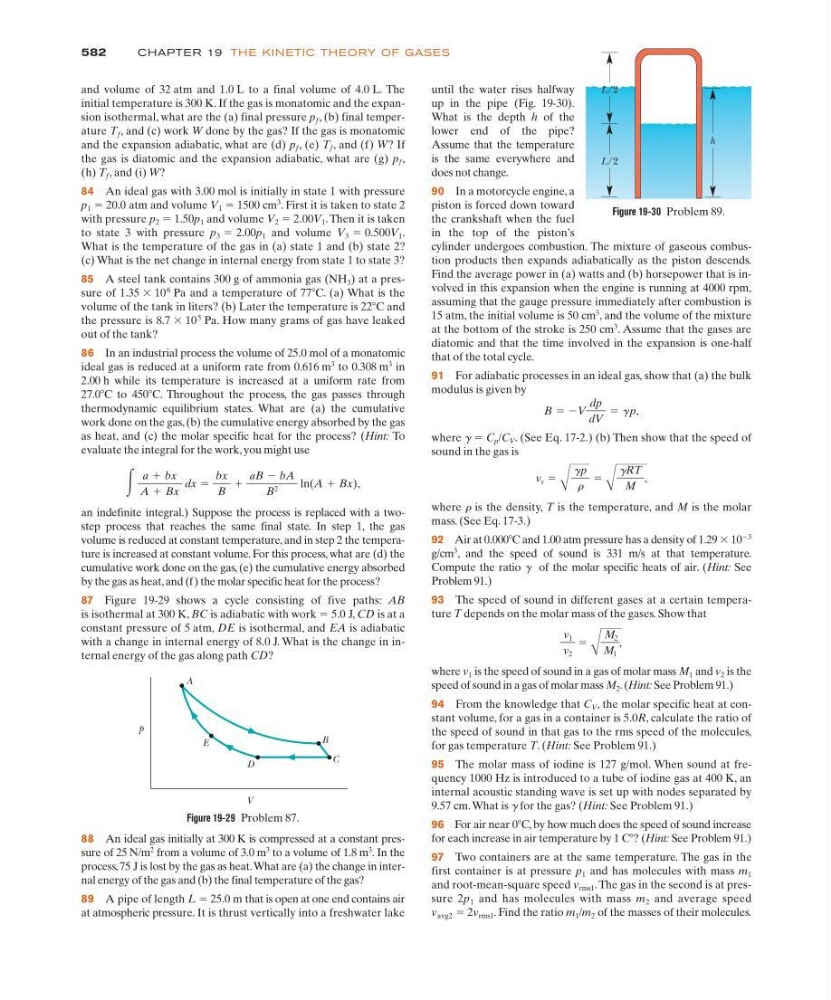
up in the pipe (Fig. 19-30).
What is the depth h of the
lower end of the pipe?
Assume that the temperature
is the same everywhere and
does not change.
90 In a motorcycle engine, a
piston is forced down toward
the crankshaft when the fuel
in the top of the piston’s
cylinder undergoes combustion. The mixture of gaseous combustion products then expands adiabatically as the piston descends.
Find the average power in (a) watts and (b) horsepower that is involved in this expansion when the engine is running at 4000 rpm,
assuming that the gauge pressure immediately after combustion is
15 atm, the initial volume is 50 cm
3
, and the volume of the mixture
at the bottom of the stroke is 250 cm
3
. Assume that the gases are
diatomic and that the time involved in the expansion is one-half
that of the total cycle.
91 For adiabatic processes in an ideal gas, show that (a) the bulk
modulus is given by
where g ϭ C p /C V . (See Eq. 17-2.) (b) Then show that the speed of
sound in the gas is
where r is the density, T is the temperature, and M is the molar
mass. (See Eq. 17-3.)
92 Air at 0.000ЊC and 1.00 atm pressure has a density of 1.29 ϫ 10
Ϫ3
g/cm
3
, and the speed of sound is 331 m/s at that temperature.
Compute the ratio g of the molar specific heats of air. (Hint: See
Problem 91.)
93 The speed of sound in different gases at a certain temperature T depends on the molar mass of the gases. Show that
where v 1 is the speed of sound in a gas of molar mass M 1 and v 2 is the
speed of sound in a gas of molar mass M 2 . (Hint: See Problem 91.)
94 From the knowledge that C V , the molar specific heat at constant volume, for a gas in a container is 5.0R, calculate the ratio of
the speed of sound in that gas to the rms speed of the molecules,
for gas temperature T. (Hint: See Problem 91.)
95 The molar mass of iodine is 127 g/mol. When sound at frequency 1000 Hz is introduced to a tube of iodine gas at 400 K, an
internal acoustic standing wave is set up with nodes separated by
9.57 cm. What is g for the gas? (Hint: See Problem 91.)
96 For air near 0ЊC, by how much does the speed of sound increase
for each increase in air temperature by 1 CЊ? (Hint: See Problem 91.)
97 Two containers are at the same temperature. The gas in the
first container is at pressure p 1 and has molecules with mass m 1
and root-mean-square speed v rms1 . The gas in the second is at pressure 2p 1 and has molecules with mass m 2 and average speed
v avg2 ϭ 2v rms1 . Find the ratio m 1 /m 2 of the masses of their molecules.
v 1
v 2
ϭ A
M 2
M 1
,
v s ϭ A
gp
r
ϭ A
gRT
M
,
B ϭ ϪV
dp
dV
ϭ g p,
and volume of 32 atm and 1.0 L to a final volume of 4.0 L. The
initial temperature is 300 K. If the gas is monatomic and the expansion isothermal, what are the (a) final pressure p f , (b) final temperature T f , and (c) work W done by the gas? If the gas is monatomic
and the expansion adiabatic, what are (d) p f , (e) T f , and (f) W? If
the gas is diatomic and the expansion adiabatic, what are (g) p f ,
(h) T f , and (i) W?
84 An ideal gas with 3.00 mol is initially in state 1 with pressure
p 1 ϭ 20.0 atm and volume V 1 ϭ 1500 cm
3
. First it is taken to state 2
with pressure p 2 ϭ 1.50p 1 and volume V 2 ϭ 2.00V 1 . Then it is taken
to state 3 with pressure p 3 2.00p 1 and volume V 3 0.500V 1 .
What is the temperature of the gas in (a) state 1 and (b) state 2?
(c) What is the net change in internal energy from state 1 to state 3?
85 A steel tank contains 300 g of ammonia gas (NH 3 ) at a pressure of 1.35 ϫ 10
6
Pa and a temperature of 77ЊC. (a) What is the
volume of the tank in liters? (b) Later the temperature is 22ЊC and
the pressure is 8.7 ϫ 10
5
Pa. How many grams of gas have leaked
out of the tank?
86 In an industrial process the volume of 25.0 mol of a monatomic
ideal gas is reduced at a uniform rate from 0.616 m
3
to 0.308 m
3
in
2.00 h while its temperature is increased at a uniform rate from
27.0ЊC to 450ЊC. Throughout the process, the gas passes through
thermodynamic equilibrium states. What are (a) the cumulative
work done on the gas, (b) the cumulative energy absorbed by the gas
as heat, and (c) the molar specific heat for the process? (Hint: To
evaluate the integral for the work, you might use
an indefinite integral.) Suppose the process is replaced with a twostep process that reaches the same final state. In step 1, the gas
volume is reduced at constant temperature, and in step 2 the temperature is increased at constant volume. For this process, what are (d) the
cumulative work done on the gas, (e) the cumulative energy absorbed
by the gas as heat, and (f) the molar specific heat for the process?
87 Figure 19-29 shows a cycle consisting of five paths: AB
is isothermal at 300 K, BC is adiabatic with work ϭ 5.0 J, CD is at a
constant pressure of 5 atm, DE is isothermal, and EA is adiabatic
with a change in internal energy of 8.0 J. What is the change in internal energy of the gas along path CD?
͵
a ϩ bx
A ϩ Bx
dx ϭ
bx
B
ϩ
aB Ϫ bA
B
2
ln(A ϩ Bx),
ϭ
ϭ
582
CHAPTE R 19 TH E KI N ETIC TH EORY OF GASES
Figure 19-30 Problem 89.
h
L/2
L/2
A
E
D
C
B
V
p
Figure 19-29 Problem 87.
88 An ideal gas initially at 300 K is compressed at a constant pressure of 25 N/m
2
from a volume of 3.0 m
3
to a volume of 1.8 m
3
. In the
process, 75 J is lost by the gas as heat.What are (a) the change in internal energy of the gas and (b) the final temperature of the gas?
89 A pipe of length L ϭ 25.0 m that is open at one end contains air
at atmospheric pressure. It is thrust vertically into a freshwater lake
up in the pipe (Fig. 19-30).
What is the depth h of the
lower end of the pipe?
Assume that the temperature
is the same everywhere and
does not change.
90 In a motorcycle engine, a
piston is forced down toward
the crankshaft when the fuel
in the top of the piston’s
cylinder undergoes combustion. The mixture of gaseous combustion products then expands adiabatically as the piston descends.
Find the average power in (a) watts and (b) horsepower that is involved in this expansion when the engine is running at 4000 rpm,
assuming that the gauge pressure immediately after combustion is
15 atm, the initial volume is 50 cm
3
, and the volume of the mixture
at the bottom of the stroke is 250 cm
3
. Assume that the gases are
diatomic and that the time involved in the expansion is one-half
that of the total cycle.
91 For adiabatic processes in an ideal gas, show that (a) the bulk
modulus is given by
where g ϭ C p /C V . (See Eq. 17-2.) (b) Then show that the speed of
sound in the gas is
where r is the density, T is the temperature, and M is the molar
mass. (See Eq. 17-3.)
92 Air at 0.000ЊC and 1.00 atm pressure has a density of 1.29 ϫ 10
Ϫ3
g/cm
3
, and the speed of sound is 331 m/s at that temperature.
Compute the ratio g of the molar specific heats of air. (Hint: See
Problem 91.)
93 The speed of sound in different gases at a certain temperature T depends on the molar mass of the gases. Show that
where v 1 is the speed of sound in a gas of molar mass M 1 and v 2 is the
speed of sound in a gas of molar mass M 2 . (Hint: See Problem 91.)
94 From the knowledge that C V , the molar specific heat at constant volume, for a gas in a container is 5.0R, calculate the ratio of
the speed of sound in that gas to the rms speed of the molecules,
for gas temperature T. (Hint: See Problem 91.)
95 The molar mass of iodine is 127 g/mol. When sound at frequency 1000 Hz is introduced to a tube of iodine gas at 400 K, an
internal acoustic standing wave is set up with nodes separated by
9.57 cm. What is g for the gas? (Hint: See Problem 91.)
96 For air near 0ЊC, by how much does the speed of sound increase
for each increase in air temperature by 1 CЊ? (Hint: See Problem 91.)
97 Two containers are at the same temperature. The gas in the
first container is at pressure p 1 and has molecules with mass m 1
and root-mean-square speed v rms1 . The gas in the second is at pressure 2p 1 and has molecules with mass m 2 and average speed
v avg2 ϭ 2v rms1 . Find the ratio m 1 /m 2 of the masses of their molecules.
v 1
v 2
ϭ A
M 2
M 1
,
v s ϭ A
gp
r
ϭ A
gRT
M
,
B ϭ ϪV
dp
dV
ϭ g p,
and volume of 32 atm and 1.0 L to a final volume of 4.0 L. The
initial temperature is 300 K. If the gas is monatomic and the expansion isothermal, what are the (a) final pressure p f , (b) final temperature T f , and (c) work W done by the gas? If the gas is monatomic
and the expansion adiabatic, what are (d) p f , (e) T f , and (f) W? If
the gas is diatomic and the expansion adiabatic, what are (g) p f ,
(h) T f , and (i) W?
84 An ideal gas with 3.00 mol is initially in state 1 with pressure
p 1 ϭ 20.0 atm and volume V 1 ϭ 1500 cm
3
. First it is taken to state 2
with pressure p 2 ϭ 1.50p 1 and volume V 2 ϭ 2.00V 1 . Then it is taken
to state 3 with pressure p 3 2.00p 1 and volume V 3 0.500V 1 .
What is the temperature of the gas in (a) state 1 and (b) state 2?
(c) What is the net change in internal energy from state 1 to state 3?
85 A steel tank contains 300 g of ammonia gas (NH 3 ) at a pressure of 1.35 ϫ 10
6
Pa and a temperature of 77ЊC. (a) What is the
volume of the tank in liters? (b) Later the temperature is 22ЊC and
the pressure is 8.7 ϫ 10
5
Pa. How many grams of gas have leaked
out of the tank?
86 In an industrial process the volume of 25.0 mol of a monatomic
ideal gas is reduced at a uniform rate from 0.616 m
3
to 0.308 m
3
in
2.00 h while its temperature is increased at a uniform rate from
27.0ЊC to 450ЊC. Throughout the process, the gas passes through
thermodynamic equilibrium states. What are (a) the cumulative
work done on the gas, (b) the cumulative energy absorbed by the gas
as heat, and (c) the molar specific heat for the process? (Hint: To
evaluate the integral for the work, you might use
an indefinite integral.) Suppose the process is replaced with a twostep process that reaches the same final state. In step 1, the gas
volume is reduced at constant temperature, and in step 2 the temperature is increased at constant volume. For this process, what are (d) the
cumulative work done on the gas, (e) the cumulative energy absorbed
by the gas as heat, and (f) the molar specific heat for the process?
87 Figure 19-29 shows a cycle consisting of five paths: AB
is isothermal at 300 K, BC is adiabatic with work ϭ 5.0 J, CD is at a
constant pressure of 5 atm, DE is isothermal, and EA is adiabatic
with a change in internal energy of 8.0 J. What is the change in internal energy of the gas along path CD?
͵
a ϩ bx
A ϩ Bx
dx ϭ
bx
B
ϩ
aB Ϫ bA
B
2
ln(A ϩ Bx),
ϭ
ϭ
582
CHAPTE R 19 TH E KI N ETIC TH EORY OF GASES
Figure 19-30 Problem 89.
h
L/2
L/2
A
E
D
C
B
V
p
Figure 19-29 Problem 87.
88 An ideal gas initially at 300 K is compressed at a constant pressure of 25 N/m
2
from a volume of 3.0 m
3
to a volume of 1.8 m
3
. In the
process, 75 J is lost by the gas as heat.What are (a) the change in internal energy of the gas and (b) the final temperature of the gas?
89 A pipe of length L ϭ 25.0 m that is open at one end contains air
at atmospheric pressure. It is thrust vertically into a freshwater lake