

580
CHAPTE R 19 TH E KI N ETIC TH EORY OF GASES
much energy is added to the gas as heat? (c) How much heat is required if the gas goes from a to c along the indirect path abc?
••45
The mass of a gas molecule can be computed from its
specific heat at constant volume c V . (Note that this is not C V .) Take
c V ϭ 0.075 cal/g иCЊ for argon and calculate (a) the mass of an argon atom and (b) the molar mass of argon.
••46 Under constant pressure, the temperature of 2.00 mol of an
ideal monatomic gas is raised 15.0 K. What are (a) the work W
done by the gas, (b) the energy transferred as heat Q, (c) the
change ⌬E int in the internal energy of the gas, and (d) the change
⌬K in the average kinetic energy per atom?
••47 The temperature of 2.00 mol of an ideal monatomic gas is
raised 15.0 K at constant volume. What are (a) the work W done by
the gas, (b) the energy transferred as heat Q, (c) the change ⌬E int in
the internal energy of the gas, and (d) the change ⌬K in the average kinetic energy per atom?
••48
When 20.9 J was added as heat to a particular ideal gas,
the volume of the gas changed from 50.0 cm
3
to 100 cm
3
while the
pressure remained at 1.00 atm. (a) By how much did the internal
energy of the gas change? If the quantity of gas present was 2.00 ϫ
10
Ϫ3
mol, find (b) C p and (c) C V .
••49
A container holds a mixture of three nonreacting gases:
SSM
ILW
•56 Suppose 1.00 L of a gas with g ϭ 1.30, initially at 273 K and
1.00 atm, is suddenly compressed adiabatically to half its initial volume. Find its final (a) pressure and (b) temperature. (c) If the gas is
then cooled to 273 K at constant pressure, what is its final volume?
••57 The volume of an ideal gas is adiabatically reduced from
200 L to 74.3 L. The initial pressure and temperature are 1.00 atm
and 300 K. The final pressure is 4.00 atm. (a) Is the gas monatomic,
diatomic, or polyatomic? (b) What is the final temperature?
(c) How many moles are in the gas?
••58
Opening champagne. In a bottle of champagne, the
pocket of gas (primarily carbon dioxide) between the liquid and
the cork is at pressure of p i ϭ 5.00 atm. When the cork is pulled
from the bottle, the gas undergoes an adiabatic expansion until its
pressure matches the ambient air pressure of 1.00 atm. Assume
that the ratio of the molar specific heats is
. If the gas has
␥ ϭ
4
3
p
V
Path 1
Isothermal
Isothermal
Adiabatic
Path 2
f
i
Figure 19-26 Problem 59.
2.40 mol of gas 1 with C V1 12.0 J/mol иK, 1.50 mol of gas 2 with
C V2 ϭ 12.8 J/mol иK, and 3.20 mol of gas 3 with C V3 ϭ 20.0 J/mol иK.
What is C V of the mixture?
Module 19-8 Degrees of Freedom and Molar Specific Heats
•50 We give 70 J as heat to a diatomic gas, which then expands at
constant pressure. The gas molecules rotate but do not oscillate. By
how much does the internal energy of the gas increase?
•51
When 1.0 mol of oxygen (O 2 ) gas is heated at constant
pressure starting at 0 C, how much energy must be added to the
gas as heat to double its volume? (The molecules rotate but do not
oscillate.)
••52
Suppose 12.0 g of oxygen (O 2 ) gas is heated at constant
atmospheric pressure from 25.0 C to 125 C. (a) How many moles
of oxygen are present? (See Table 19-1 for the molar mass.)
(b) How much energy is transferred to the oxygen as heat? (The
Њ
Њ
Њ
ILW
ϭ
molecules rotate but do not oscillate.) (c) What fraction of the heat
is used to raise the internal energy of the oxygen?
••53
Suppose 4.00 mol of an ideal diatomic gas, with
molecular rotation but not oscillation, experienced a temperature
increase of 60.0 K under constant-pressure conditions. What are
(a) the energy transferred as heat Q, (b) the change ⌬E int in internal energy of the gas, (c) the work W done by the gas, and (d) the
change ⌬K in the total translational kinetic energy of the gas?
Module 19-9 The Adiabatic Expansion of an Ideal Gas
•54 We know that for an adiabatic process pV
g ϭ a constant.
Evaluate “a constant” for an adiabatic process involving exactly
2.0 mol of an ideal gas passing through the state having exactly
p ϭ 1.0 atm and T ϭ 300 K. Assume a diatomic gas whose molecules rotate but do not oscillate.
•55 A certain gas occupies a volume of 4.3 L at a pressure of
1.2 atm and a temperature of 310 K. It is compressed adiabatically
to a volume of 0.76 L. Determine (a) the final pressure and
(b) the final temperature, assuming the gas to be an ideal gas for
which g ϭ 1.4.
WWW
SSM
••60
Adiabatic wind. The normal airflow over the
Rocky Mountains is west to east. The air loses much of its moisture
content and is chilled as it climbs the western side of the mountains. When it descends on the eastern side, the increase in pressure
toward lower altitudes causes the temperature to increase. The
flow, then called a chinook wind, can rapidly raise the air temperature at the base of the mountains. Assume that the air pressure p
depends on altitude y according to p p 0 exp (Ϫay), where p 0 ϭ
1.00 atm and a 1.16 10
Ϫ4
m
Ϫ1
. Also assume that the ratio of
the molar specific heats is
. A parcel of air with an initial temperature of
.00 C descends adiabatically from y 1 4267 m to
y 1567 m. What is its temperature at the end of the descent?
••61
A gas is to be expanded from initial state i to final state f
along either path 1 or path 2 on a p-V diagram. Path 1 consists of
three steps: an isothermal expansion (work is 40 J in magnitude),
an adiabatic expansion (work is 20 J in magnitude), and another
isothermal expansion (work is 30 J in magnitude). Path 2 consists
of two steps: a pressure reduction at constant volume and an expansion at constant pressure. What is the change in the internal energy of the gas along path 2?
•••62
An ideal diatomic gas, with rotation but no oscillation, undergoes an adiabatic compression. Its initial pressure and volume are
ϭ
ϭ
Њ
Ϫ5
g ϭ
4
3
ϫ
ϭ
ϭ
initial temperature T i ϭ 5.00 C, what is its temperature at the end
of the adiabatic expansion?
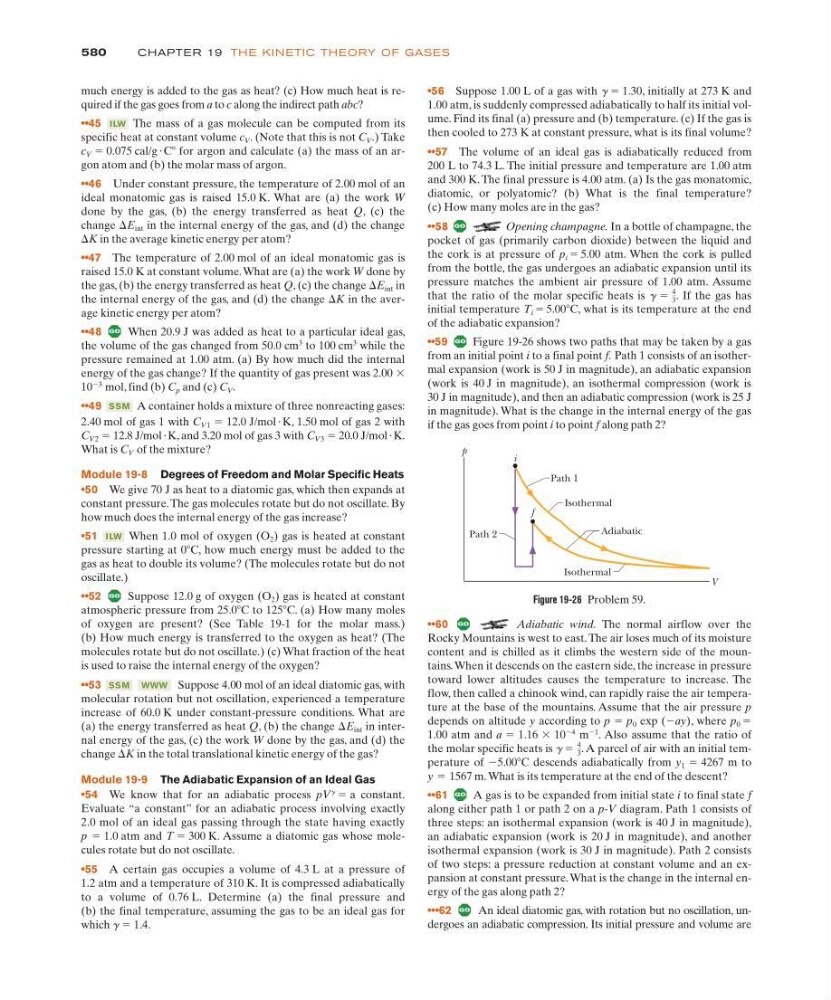
••59
Figure 19-26 shows two paths that may be taken by a gas
from an initial point i to a final point f. Path 1 consists of an isothermal expansion (work is 50 J in magnitude), an adiabatic expansion
(work is 40 J in magnitude), an isothermal compression (work is
30 J in magnitude), and then an adiabatic compression (work is 25 J
in magnitude). What is the change in the internal energy of the gas
if the gas goes from point i to point f along path 2?
Њ
CHAPTE R 19 TH E KI N ETIC TH EORY OF GASES
much energy is added to the gas as heat? (c) How much heat is required if the gas goes from a to c along the indirect path abc?
••45
The mass of a gas molecule can be computed from its
specific heat at constant volume c V . (Note that this is not C V .) Take
c V ϭ 0.075 cal/g иCЊ for argon and calculate (a) the mass of an argon atom and (b) the molar mass of argon.
••46 Under constant pressure, the temperature of 2.00 mol of an
ideal monatomic gas is raised 15.0 K. What are (a) the work W
done by the gas, (b) the energy transferred as heat Q, (c) the
change ⌬E int in the internal energy of the gas, and (d) the change
⌬K in the average kinetic energy per atom?
••47 The temperature of 2.00 mol of an ideal monatomic gas is
raised 15.0 K at constant volume. What are (a) the work W done by
the gas, (b) the energy transferred as heat Q, (c) the change ⌬E int in
the internal energy of the gas, and (d) the change ⌬K in the average kinetic energy per atom?
••48
When 20.9 J was added as heat to a particular ideal gas,
the volume of the gas changed from 50.0 cm
3
to 100 cm
3
while the
pressure remained at 1.00 atm. (a) By how much did the internal
energy of the gas change? If the quantity of gas present was 2.00 ϫ
10
Ϫ3
mol, find (b) C p and (c) C V .
••49
A container holds a mixture of three nonreacting gases:
SSM
ILW
•56 Suppose 1.00 L of a gas with g ϭ 1.30, initially at 273 K and
1.00 atm, is suddenly compressed adiabatically to half its initial volume. Find its final (a) pressure and (b) temperature. (c) If the gas is
then cooled to 273 K at constant pressure, what is its final volume?
••57 The volume of an ideal gas is adiabatically reduced from
200 L to 74.3 L. The initial pressure and temperature are 1.00 atm
and 300 K. The final pressure is 4.00 atm. (a) Is the gas monatomic,
diatomic, or polyatomic? (b) What is the final temperature?
(c) How many moles are in the gas?
••58
Opening champagne. In a bottle of champagne, the
pocket of gas (primarily carbon dioxide) between the liquid and
the cork is at pressure of p i ϭ 5.00 atm. When the cork is pulled
from the bottle, the gas undergoes an adiabatic expansion until its
pressure matches the ambient air pressure of 1.00 atm. Assume
that the ratio of the molar specific heats is
. If the gas has
␥ ϭ
4
3
p
V
Path 1
Isothermal
Isothermal
Adiabatic
Path 2
f
i
Figure 19-26 Problem 59.
2.40 mol of gas 1 with C V1 12.0 J/mol иK, 1.50 mol of gas 2 with
C V2 ϭ 12.8 J/mol иK, and 3.20 mol of gas 3 with C V3 ϭ 20.0 J/mol иK.
What is C V of the mixture?
Module 19-8 Degrees of Freedom and Molar Specific Heats
•50 We give 70 J as heat to a diatomic gas, which then expands at
constant pressure. The gas molecules rotate but do not oscillate. By
how much does the internal energy of the gas increase?
•51
When 1.0 mol of oxygen (O 2 ) gas is heated at constant
pressure starting at 0 C, how much energy must be added to the
gas as heat to double its volume? (The molecules rotate but do not
oscillate.)
••52
Suppose 12.0 g of oxygen (O 2 ) gas is heated at constant
atmospheric pressure from 25.0 C to 125 C. (a) How many moles
of oxygen are present? (See Table 19-1 for the molar mass.)
(b) How much energy is transferred to the oxygen as heat? (The
Њ
Њ
Њ
ILW
ϭ
molecules rotate but do not oscillate.) (c) What fraction of the heat
is used to raise the internal energy of the oxygen?
••53
Suppose 4.00 mol of an ideal diatomic gas, with
molecular rotation but not oscillation, experienced a temperature
increase of 60.0 K under constant-pressure conditions. What are
(a) the energy transferred as heat Q, (b) the change ⌬E int in internal energy of the gas, (c) the work W done by the gas, and (d) the
change ⌬K in the total translational kinetic energy of the gas?
Module 19-9 The Adiabatic Expansion of an Ideal Gas
•54 We know that for an adiabatic process pV
g ϭ a constant.
Evaluate “a constant” for an adiabatic process involving exactly
2.0 mol of an ideal gas passing through the state having exactly
p ϭ 1.0 atm and T ϭ 300 K. Assume a diatomic gas whose molecules rotate but do not oscillate.
•55 A certain gas occupies a volume of 4.3 L at a pressure of
1.2 atm and a temperature of 310 K. It is compressed adiabatically
to a volume of 0.76 L. Determine (a) the final pressure and
(b) the final temperature, assuming the gas to be an ideal gas for
which g ϭ 1.4.
WWW
SSM
••60
Adiabatic wind. The normal airflow over the
Rocky Mountains is west to east. The air loses much of its moisture
content and is chilled as it climbs the western side of the mountains. When it descends on the eastern side, the increase in pressure
toward lower altitudes causes the temperature to increase. The
flow, then called a chinook wind, can rapidly raise the air temperature at the base of the mountains. Assume that the air pressure p
depends on altitude y according to p p 0 exp (Ϫay), where p 0 ϭ
1.00 atm and a 1.16 10
Ϫ4
m
Ϫ1
. Also assume that the ratio of
the molar specific heats is
. A parcel of air with an initial temperature of
.00 C descends adiabatically from y 1 4267 m to
y 1567 m. What is its temperature at the end of the descent?
••61
A gas is to be expanded from initial state i to final state f
along either path 1 or path 2 on a p-V diagram. Path 1 consists of
three steps: an isothermal expansion (work is 40 J in magnitude),
an adiabatic expansion (work is 20 J in magnitude), and another
isothermal expansion (work is 30 J in magnitude). Path 2 consists
of two steps: a pressure reduction at constant volume and an expansion at constant pressure. What is the change in the internal energy of the gas along path 2?
•••62
An ideal diatomic gas, with rotation but no oscillation, undergoes an adiabatic compression. Its initial pressure and volume are
ϭ
ϭ
Њ
Ϫ5
g ϭ
4
3
ϫ
ϭ
ϭ
initial temperature T i ϭ 5.00 C, what is its temperature at the end
of the adiabatic expansion?
••59
Figure 19-26 shows two paths that may be taken by a gas
from an initial point i to a final point f. Path 1 consists of an isothermal expansion (work is 50 J in magnitude), an adiabatic expansion
(work is 40 J in magnitude), an isothermal compression (work is
30 J in magnitude), and then an adiabatic compression (work is 25 J
in magnitude). What is the change in the internal energy of the gas
if the gas goes from point i to point f along path 2?
Њ