

579
PROB LE M S
and (b) 100ЊC. What is the translational kinetic energy per mole of
an ideal gas at (c) 0.00ЊC and (d) 100ЊC?
•26 What is the average translational kinetic energy of nitrogen
molecules at 1600 K?
••27 Water standing in the open at 32.0ЊC evaporates because
of the escape of some of the surface molecules. The heat of vaporization (539 cal/g) is approximately equal to ´n, where ´ is the average energy of the escaping molecules and n is the number of
molecules per gram. (a) Find ´. (b) What is the ratio of ´ to the
average kinetic energy of H 2 O molecules, assuming the latter is related to temperature in the same way as it is for gases?
Module 19-5 Mean Free Path
•28 At what frequency would the wavelength of sound in air be
equal to the mean free path of oxygen molecules at 1.0 atm pressure and 0.00ЊC? The molecular diameter is 3.0 ϫ 10
Ϫ8
cm.
•29
The atmospheric density at an altitude of 2500 km is
about 1 molecule/cm
3
. (a) Assuming the molecular diameter of
2.0 ϫ 10
Ϫ8
cm, find the mean free path predicted by Eq. 19-25.
(b) Explain whether the predicted value is meaningful.
•30 The mean free path of nitrogen molecules at 0.0ЊC and
1.0 atm is 0.80 ϫ 10
Ϫ5
cm. At this temperature and pressure there
are 2.7 ϫ 10
19
molecules/cm
3
.What is the molecular diameter?
••31 In a certain particle accelerator, protons travel around a circular path of diameter 23.0 m in an evacuated chamber, whose
residual gas is at 295 K and 1.00 ϫ 10
Ϫ6
torr pressure. (a) Calculate
the number of gas molecules per cubic centimeter at this pressure.
(b) What is the mean free path of the gas molecules if the molecular diameter is 2.00 ϫ 10
Ϫ8
cm?
••32 At 20ЊC and 750 torr pressure, the mean free paths for argon
gas (Ar) and nitrogen gas (N 2 ) are l Ar ϭ 9.9 ϫ 10
Ϫ6
cm and l N 2 ϭ
27.5 ϫ 10
Ϫ6
cm. (a) Find the ratio of the diameter of an Ar atom
to that of an N 2 molecule. What is the mean free path of argon at
(b) 20ЊC and 150 torr, and (c) Ϫ40ЊC and 750 torr?
Module 19-6 The Distribution of Molecular Speeds
•33
The speeds of 10 molecules are 2.0, 3.0, 4.0, . . . , 11 km/s.
What are their (a) average speed and (b) rms speed?
•34 The speeds of 22 particles are as follows (N i represents the
number of particles that have speed v i ):
N i
2
4
6
8
2
v i (cm/s) 1.0 2.0 3.0 4.0 5.0
What are (a) v avg , (b) v rms , and (c) v P ?
•35 Ten particles are moving with the following speeds: four
at 200 m/s, two at 500 m/s, and four at 600 m/s. Calculate their
(a) average and (b) rms speeds. (c) Is v rms Ͼ v avg ?
••36 The most probable speed of the molecules in a gas at temperature T 2 is equal to the rms speed of the molecules at temperature T 1 .
Find T 2 /T 1 .
••37
Figure 19-23 shows a
hypothetical speed distribution for a sample of N gas particles (note that P(v) ϭ 0
for speed v Ͼ 2v 0 ).What are the values of
(a) av 0 , (b) v avg /v 0 , and (c) v rms /v 0 ? (d)
What fraction of the particles has a speed
between 1.5v 0 and 2.0v 0 ?
WWW
SSM
SSM
SSM
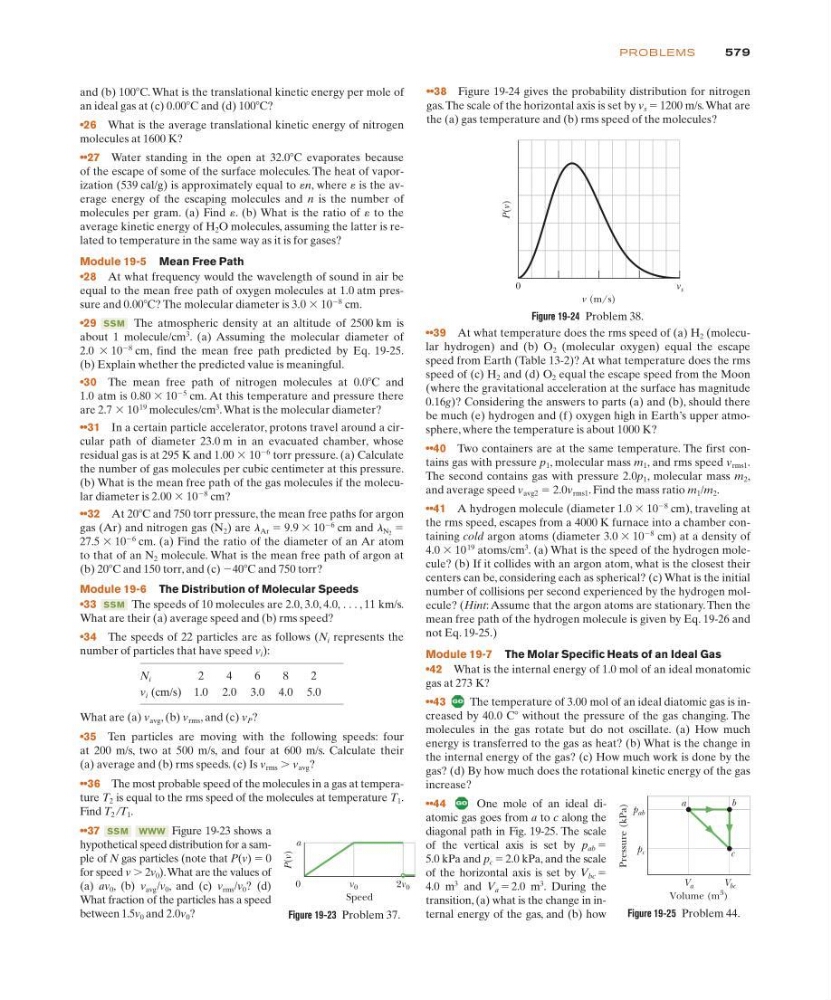
••38 Figure 19-24 gives the probability distribution for nitrogen
gas. The scale of the horizontal axis is set by v s ϭ 1200 m/s. What are
the (a) gas temperature and (b) rms speed of the molecules?
v 0
Speed
2v 0
0
a
P(v)
Figure 19-23 Problem 37.
0
v s
v (m/s)
P(v)
Figure 19-24 Problem 38.
••39 At what temperature does the rms speed of (a) H 2 (molecular hydrogen) and (b) O 2 (molecular oxygen) equal the escape
speed from Earth (Table 13-2)? At what temperature does the rms
speed of (c) H 2 and (d) O 2 equal the escape speed from the Moon
(where the gravitational acceleration at the surface has magnitude
0.16g)? Considering the answers to parts (a) and (b), should there
be much (e) hydrogen and (f) oxygen high in Earth’s upper atmosphere, where the temperature is about 1000 K?
••40 Two containers are at the same temperature. The first contains gas with pressure p 1 , molecular mass m 1 , and rms speed v rms1 .
The second contains gas with pressure 2.0p 1 , molecular mass m 2 ,
and average speed v avg2 ϭ 2.0v rms1 . Find the mass ratio m 1 /m 2 .
••41 A hydrogen molecule (diameter 1.0 ϫ 10
Ϫ8
cm), traveling at
the rms speed, escapes from a 4000 K furnace into a chamber containing cold argon atoms (diameter 3.0 ϫ 10
Ϫ8
cm) at a density of
4.0 ϫ 10
19
atoms/cm
3
. (a) What is the speed of the hydrogen molecule? (b) If it collides with an argon atom, what is the closest their
centers can be, considering each as spherical? (c) What is the initial
number of collisions per second experienced by the hydrogen molecule? (Hint: Assume that the argon atoms are stationary. Then the
mean free path of the hydrogen molecule is given by Eq. 19-26 and
not Eq. 19-25.)
Module 19-7 The Molar Specific Heats of an Ideal Gas
•42 What is the internal energy of 1.0 mol of an ideal monatomic
gas at 273 K?
••43
The temperature of 3.00 mol of an ideal diatomic gas is increased by 40.0 C without the pressure of the gas changing. The
molecules in the gas rotate but do not oscillate. (a) How much
energy is transferred to the gas as heat? (b) What is the change in
the internal energy of the gas? (c) How much work is done by the
gas? (d) By how much does the rotational kinetic energy of the gas
increase?
••44
One mole of an ideal diatomic gas goes from a to c along the
diagonal path in Fig. 19-25. The scale
of the vertical axis is set by p ab ϭ
5.0 kPa and p c ϭ 2.0 kPa, and the scale
of the horizontal axis is set by V bc ϭ
4.0 m
3
and V a ϭ 2.0 m
3
. During the
transition, (a) what is the change in internal energy of the gas, and (b) how
Њ
p ab
p c
V a
V bc
Volume (m
3 )
Pressure (kPa)
a
b
c
Figure 19-25 Problem 44.
PROB LE M S
and (b) 100ЊC. What is the translational kinetic energy per mole of
an ideal gas at (c) 0.00ЊC and (d) 100ЊC?
•26 What is the average translational kinetic energy of nitrogen
molecules at 1600 K?
••27 Water standing in the open at 32.0ЊC evaporates because
of the escape of some of the surface molecules. The heat of vaporization (539 cal/g) is approximately equal to ´n, where ´ is the average energy of the escaping molecules and n is the number of
molecules per gram. (a) Find ´. (b) What is the ratio of ´ to the
average kinetic energy of H 2 O molecules, assuming the latter is related to temperature in the same way as it is for gases?
Module 19-5 Mean Free Path
•28 At what frequency would the wavelength of sound in air be
equal to the mean free path of oxygen molecules at 1.0 atm pressure and 0.00ЊC? The molecular diameter is 3.0 ϫ 10
Ϫ8
cm.
•29
The atmospheric density at an altitude of 2500 km is
about 1 molecule/cm
3
. (a) Assuming the molecular diameter of
2.0 ϫ 10
Ϫ8
cm, find the mean free path predicted by Eq. 19-25.
(b) Explain whether the predicted value is meaningful.
•30 The mean free path of nitrogen molecules at 0.0ЊC and
1.0 atm is 0.80 ϫ 10
Ϫ5
cm. At this temperature and pressure there
are 2.7 ϫ 10
19
molecules/cm
3
.What is the molecular diameter?
••31 In a certain particle accelerator, protons travel around a circular path of diameter 23.0 m in an evacuated chamber, whose
residual gas is at 295 K and 1.00 ϫ 10
Ϫ6
torr pressure. (a) Calculate
the number of gas molecules per cubic centimeter at this pressure.
(b) What is the mean free path of the gas molecules if the molecular diameter is 2.00 ϫ 10
Ϫ8
cm?
••32 At 20ЊC and 750 torr pressure, the mean free paths for argon
gas (Ar) and nitrogen gas (N 2 ) are l Ar ϭ 9.9 ϫ 10
Ϫ6
cm and l N 2 ϭ
27.5 ϫ 10
Ϫ6
cm. (a) Find the ratio of the diameter of an Ar atom
to that of an N 2 molecule. What is the mean free path of argon at
(b) 20ЊC and 150 torr, and (c) Ϫ40ЊC and 750 torr?
Module 19-6 The Distribution of Molecular Speeds
•33
The speeds of 10 molecules are 2.0, 3.0, 4.0, . . . , 11 km/s.
What are their (a) average speed and (b) rms speed?
•34 The speeds of 22 particles are as follows (N i represents the
number of particles that have speed v i ):
N i
2
4
6
8
2
v i (cm/s) 1.0 2.0 3.0 4.0 5.0
What are (a) v avg , (b) v rms , and (c) v P ?
•35 Ten particles are moving with the following speeds: four
at 200 m/s, two at 500 m/s, and four at 600 m/s. Calculate their
(a) average and (b) rms speeds. (c) Is v rms Ͼ v avg ?
••36 The most probable speed of the molecules in a gas at temperature T 2 is equal to the rms speed of the molecules at temperature T 1 .
Find T 2 /T 1 .
••37
Figure 19-23 shows a
hypothetical speed distribution for a sample of N gas particles (note that P(v) ϭ 0
for speed v Ͼ 2v 0 ).What are the values of
(a) av 0 , (b) v avg /v 0 , and (c) v rms /v 0 ? (d)
What fraction of the particles has a speed
between 1.5v 0 and 2.0v 0 ?
WWW
SSM
SSM
SSM
••38 Figure 19-24 gives the probability distribution for nitrogen
gas. The scale of the horizontal axis is set by v s ϭ 1200 m/s. What are
the (a) gas temperature and (b) rms speed of the molecules?
v 0
Speed
2v 0
0
a
P(v)
Figure 19-23 Problem 37.
0
v s
v (m/s)
P(v)
Figure 19-24 Problem 38.
••39 At what temperature does the rms speed of (a) H 2 (molecular hydrogen) and (b) O 2 (molecular oxygen) equal the escape
speed from Earth (Table 13-2)? At what temperature does the rms
speed of (c) H 2 and (d) O 2 equal the escape speed from the Moon
(where the gravitational acceleration at the surface has magnitude
0.16g)? Considering the answers to parts (a) and (b), should there
be much (e) hydrogen and (f) oxygen high in Earth’s upper atmosphere, where the temperature is about 1000 K?
••40 Two containers are at the same temperature. The first contains gas with pressure p 1 , molecular mass m 1 , and rms speed v rms1 .
The second contains gas with pressure 2.0p 1 , molecular mass m 2 ,
and average speed v avg2 ϭ 2.0v rms1 . Find the mass ratio m 1 /m 2 .
••41 A hydrogen molecule (diameter 1.0 ϫ 10
Ϫ8
cm), traveling at
the rms speed, escapes from a 4000 K furnace into a chamber containing cold argon atoms (diameter 3.0 ϫ 10
Ϫ8
cm) at a density of
4.0 ϫ 10
19
atoms/cm
3
. (a) What is the speed of the hydrogen molecule? (b) If it collides with an argon atom, what is the closest their
centers can be, considering each as spherical? (c) What is the initial
number of collisions per second experienced by the hydrogen molecule? (Hint: Assume that the argon atoms are stationary. Then the
mean free path of the hydrogen molecule is given by Eq. 19-26 and
not Eq. 19-25.)
Module 19-7 The Molar Specific Heats of an Ideal Gas
•42 What is the internal energy of 1.0 mol of an ideal monatomic
gas at 273 K?
••43
The temperature of 3.00 mol of an ideal diatomic gas is increased by 40.0 C without the pressure of the gas changing. The
molecules in the gas rotate but do not oscillate. (a) How much
energy is transferred to the gas as heat? (b) What is the change in
the internal energy of the gas? (c) How much work is done by the
gas? (d) By how much does the rotational kinetic energy of the gas
increase?
••44
One mole of an ideal diatomic gas goes from a to c along the
diagonal path in Fig. 19-25. The scale
of the vertical axis is set by p ab ϭ
5.0 kPa and p c ϭ 2.0 kPa, and the scale
of the horizontal axis is set by V bc ϭ
4.0 m
3
and V a ϭ 2.0 m
3
. During the
transition, (a) what is the change in internal energy of the gas, and (b) how
Њ
p ab
p c
V a
V bc
Volume (m
3 )
Pressure (kPa)
a
b
c
Figure 19-25 Problem 44.