

•••16 An air bubble of volume 20 cm
3
is at the bottom of a lake
40 m deep, where the temperature is 4.0ЊC. The bubble rises to the
surface, which is at a temperature of 20ЊC. Take the temperature of
the bubble’s air to be the same as that of the surrounding water.
Just as the bubble reaches the surface, what is its volume?
•••17
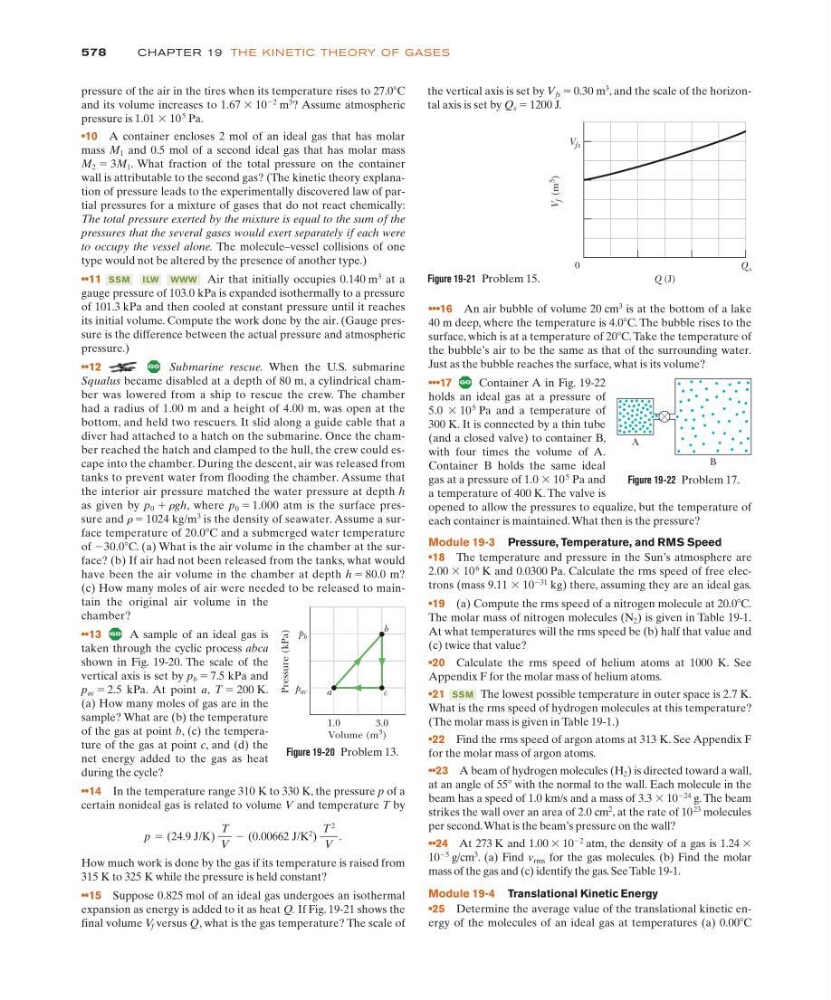
Container A in Fig. 19-22
holds an ideal gas at a pressure of
5.0 ϫ 10
5
Pa and a temperature of
300 K. It is connected by a thin tube
(and a closed valve) to container B,
with four times the volume of A.
Container B holds the same ideal
gas at a pressure of 1.0 ϫ 10
5
Pa and
a temperature of 400 K. The valve is
opened to allow the pressures to equalize, but the temperature of
each container is maintained. What then is the pressure?
Module 19-3 Pressure, Temperature, and RMS Speed
•18 The temperature and pressure in the Sun’s atmosphere are
2.00 ϫ 10
6
K and 0.0300 Pa. Calculate the rms speed of free electrons (mass 9.11 ϫ 10
Ϫ31
kg) there, assuming they are an ideal gas.
•19 (a) Compute the rms speed of a nitrogen molecule at 20.0ЊC.
The molar mass of nitrogen molecules (N 2 ) is given in Table 19-1.
At what temperatures will the rms speed be (b) half that value and
(c) twice that value?
•20 Calculate the rms speed of helium atoms at 1000 K. See
Appendix F for the molar mass of helium atoms.
•21
The lowest possible temperature in outer space is 2.7 K.
What is the rms speed of hydrogen molecules at this temperature?
(The molar mass is given in Table 19-1.)
•22 Find the rms speed of argon atoms at 313 K. See Appendix F
for the molar mass of argon atoms.
••23 A beam of hydrogen molecules (H 2 ) is directed toward a wall,
at an angle of 55Њ with the normal to the wall. Each molecule in the
beam has a speed of 1.0 km/s and a mass of 3.3 ϫ 10
Ϫ24
g. The beam
strikes the wall over an area of 2.0 cm
2
, at the rate of 10
23
molecules
per second.What is the beam’s pressure on the wall?
••24 At 273 K and 1.00 ϫ 10
Ϫ2
atm, the density of a gas is 1.24 ϫ
10
Ϫ5
g/cm
3
. (a) Find v rms for the gas molecules. (b) Find the molar
mass of the gas and (c) identify the gas. See Table 19-1.
Module 19-4 Translational Kinetic Energy
•25 Determine the average value of the translational kinetic energy of the molecules of an ideal gas at temperatures (a) 0.00ЊC
SSM
578
CHAPTE R 19 TH E KI N ETIC TH EORY OF GASES
pressure of the air in the tires when its temperature rises to 27.0ЊC
and its volume increases to 1.67 ϫ 10
Ϫ2
m
3
? Assume atmospheric
pressure is 1.01 ϫ 10
5
Pa.
•10 A container encloses 2 mol of an ideal gas that has molar
mass M 1 and 0.5 mol of a second ideal gas that has molar mass
M 2 ϭ 3M 1 . What fraction of the total pressure on the container
wall is attributable to the second gas? (The kinetic theory explanation of pressure leads to the experimentally discovered law of partial pressures for a mixture of gases that do not react chemically:
The total pressure exerted by the mixture is equal to the sum of the
pressures that the several gases would exert separately if each were
to occupy the vessel alone. The molecule–vessel collisions of one
type would not be altered by the presence of another type.)
••11
Air that initially occupies 0.140 m
3
at a
gauge pressure of 103.0 kPa is expanded isothermally to a pressure
of 101.3 kPa and then cooled at constant pressure until it reaches
its initial volume. Compute the work done by the air. (Gauge pressure is the difference between the actual pressure and atmospheric
pressure.)
••12
Submarine rescue. When the U.S. submarine
Squalus became disabled at a depth of 80 m, a cylindrical chamber was lowered from a ship to rescue the crew. The chamber
had a radius of 1.00 m and a height of 4.00 m, was open at the
bottom, and held two rescuers. It slid along a guide cable that a
diver had attached to a hatch on the submarine. Once the chamber reached the hatch and clamped to the hull, the crew could escape into the chamber. During the descent, air was released from
tanks to prevent water from flooding the chamber. Assume that
the interior air pressure matched the water pressure at depth h
as given by p 0 ϩ rgh, where p 0 ϭ 1.000 atm is the surface pressure and r ϭ 1024 kg/m
3
is the density of seawater. Assume a surface temperature of 20.0ЊC and a submerged water temperature
of Ϫ30.0ЊC. (a) What is the air volume in the chamber at the surface? (b) If air had not been released from the tanks, what would
have been the air volume in the chamber at depth h ϭ 80.0 m?
(c) How many moles of air were needed to be released to maintain the original air volume in the
chamber?
••13
A sample of an ideal gas is
taken through the cyclic process abca
shown in Fig. 19-20. The scale of the
vertical axis is set by p b ϭ 7.5 kPa and
p ac ϭ 2.5 kPa. At point a, T ϭ 200 K.
(a) How many moles of gas are in the
sample? What are (b) the temperature
of the gas at point b, (c) the temperature of the gas at point c, and (d) the
net energy added to the gas as heat
during the cycle?
••14 In the temperature range 310 K to 330 K, the pressure p of a
certain nonideal gas is related to volume V and temperature T by
How much work is done by the gas if its temperature is raised from
315 K to 325 K while the pressure is held constant?
••15 Suppose 0.825 mol of an ideal gas undergoes an isothermal
expansion as energy is added to it as heat Q. If Fig. 19-21 shows the
final volume V f versus Q, what is the gas temperature? The scale of
p ϭ (24.9 J/K)
T
V
Ϫ (0.00662 J/K
2
)
T
2
V
.
WWW
ILW
SSM
the vertical axis is set by V fs ϭ 0.30 m
3
, and the scale of the horizontal axis is set by Q s ϭ 1200 J.
Figure 19-21 Problem 15.
V fs
0
Q (J)
Q s
V
f (m
3
)
p b
p ac
1.0
3.0
Volume (m
3 )
Pressure (kPa)
b
c
a
Figure 19-22 Problem 17.
A
B
Figure 19-20 Problem 13.
3
is at the bottom of a lake
40 m deep, where the temperature is 4.0ЊC. The bubble rises to the
surface, which is at a temperature of 20ЊC. Take the temperature of
the bubble’s air to be the same as that of the surrounding water.
Just as the bubble reaches the surface, what is its volume?
•••17
Container A in Fig. 19-22
holds an ideal gas at a pressure of
5.0 ϫ 10
5
Pa and a temperature of
300 K. It is connected by a thin tube
(and a closed valve) to container B,
with four times the volume of A.
Container B holds the same ideal
gas at a pressure of 1.0 ϫ 10
5
Pa and
a temperature of 400 K. The valve is
opened to allow the pressures to equalize, but the temperature of
each container is maintained. What then is the pressure?
Module 19-3 Pressure, Temperature, and RMS Speed
•18 The temperature and pressure in the Sun’s atmosphere are
2.00 ϫ 10
6
K and 0.0300 Pa. Calculate the rms speed of free electrons (mass 9.11 ϫ 10
Ϫ31
kg) there, assuming they are an ideal gas.
•19 (a) Compute the rms speed of a nitrogen molecule at 20.0ЊC.
The molar mass of nitrogen molecules (N 2 ) is given in Table 19-1.
At what temperatures will the rms speed be (b) half that value and
(c) twice that value?
•20 Calculate the rms speed of helium atoms at 1000 K. See
Appendix F for the molar mass of helium atoms.
•21
The lowest possible temperature in outer space is 2.7 K.
What is the rms speed of hydrogen molecules at this temperature?
(The molar mass is given in Table 19-1.)
•22 Find the rms speed of argon atoms at 313 K. See Appendix F
for the molar mass of argon atoms.
••23 A beam of hydrogen molecules (H 2 ) is directed toward a wall,
at an angle of 55Њ with the normal to the wall. Each molecule in the
beam has a speed of 1.0 km/s and a mass of 3.3 ϫ 10
Ϫ24
g. The beam
strikes the wall over an area of 2.0 cm
2
, at the rate of 10
23
molecules
per second.What is the beam’s pressure on the wall?
••24 At 273 K and 1.00 ϫ 10
Ϫ2
atm, the density of a gas is 1.24 ϫ
10
Ϫ5
g/cm
3
. (a) Find v rms for the gas molecules. (b) Find the molar
mass of the gas and (c) identify the gas. See Table 19-1.
Module 19-4 Translational Kinetic Energy
•25 Determine the average value of the translational kinetic energy of the molecules of an ideal gas at temperatures (a) 0.00ЊC
SSM
578
CHAPTE R 19 TH E KI N ETIC TH EORY OF GASES
pressure of the air in the tires when its temperature rises to 27.0ЊC
and its volume increases to 1.67 ϫ 10
Ϫ2
m
3
? Assume atmospheric
pressure is 1.01 ϫ 10
5
Pa.
•10 A container encloses 2 mol of an ideal gas that has molar
mass M 1 and 0.5 mol of a second ideal gas that has molar mass
M 2 ϭ 3M 1 . What fraction of the total pressure on the container
wall is attributable to the second gas? (The kinetic theory explanation of pressure leads to the experimentally discovered law of partial pressures for a mixture of gases that do not react chemically:
The total pressure exerted by the mixture is equal to the sum of the
pressures that the several gases would exert separately if each were
to occupy the vessel alone. The molecule–vessel collisions of one
type would not be altered by the presence of another type.)
••11
Air that initially occupies 0.140 m
3
at a
gauge pressure of 103.0 kPa is expanded isothermally to a pressure
of 101.3 kPa and then cooled at constant pressure until it reaches
its initial volume. Compute the work done by the air. (Gauge pressure is the difference between the actual pressure and atmospheric
pressure.)
••12
Submarine rescue. When the U.S. submarine
Squalus became disabled at a depth of 80 m, a cylindrical chamber was lowered from a ship to rescue the crew. The chamber
had a radius of 1.00 m and a height of 4.00 m, was open at the
bottom, and held two rescuers. It slid along a guide cable that a
diver had attached to a hatch on the submarine. Once the chamber reached the hatch and clamped to the hull, the crew could escape into the chamber. During the descent, air was released from
tanks to prevent water from flooding the chamber. Assume that
the interior air pressure matched the water pressure at depth h
as given by p 0 ϩ rgh, where p 0 ϭ 1.000 atm is the surface pressure and r ϭ 1024 kg/m
3
is the density of seawater. Assume a surface temperature of 20.0ЊC and a submerged water temperature
of Ϫ30.0ЊC. (a) What is the air volume in the chamber at the surface? (b) If air had not been released from the tanks, what would
have been the air volume in the chamber at depth h ϭ 80.0 m?
(c) How many moles of air were needed to be released to maintain the original air volume in the
chamber?
••13
A sample of an ideal gas is
taken through the cyclic process abca
shown in Fig. 19-20. The scale of the
vertical axis is set by p b ϭ 7.5 kPa and
p ac ϭ 2.5 kPa. At point a, T ϭ 200 K.
(a) How many moles of gas are in the
sample? What are (b) the temperature
of the gas at point b, (c) the temperature of the gas at point c, and (d) the
net energy added to the gas as heat
during the cycle?
••14 In the temperature range 310 K to 330 K, the pressure p of a
certain nonideal gas is related to volume V and temperature T by
How much work is done by the gas if its temperature is raised from
315 K to 325 K while the pressure is held constant?
••15 Suppose 0.825 mol of an ideal gas undergoes an isothermal
expansion as energy is added to it as heat Q. If Fig. 19-21 shows the
final volume V f versus Q, what is the gas temperature? The scale of
p ϭ (24.9 J/K)
T
V
Ϫ (0.00662 J/K
2
)
T
2
V
.
WWW
ILW
SSM
the vertical axis is set by V fs ϭ 0.30 m
3
, and the scale of the horizontal axis is set by Q s ϭ 1200 J.
Figure 19-21 Problem 15.
V fs
0
Q (J)
Q s
V
f (m
3
)
p b
p ac
1.0
3.0
Volume (m
3 )
Pressure (kPa)
b
c
a
Figure 19-22 Problem 17.
A
B
Figure 19-20 Problem 13.