

503
17-8 SU PE RSON IC SPE E DS, SHOCK WAVES
Supersonic Speeds, Shock Waves
If a source is moving toward a stationary detector at a speed v S equal to
the speed of sound v, Eqs. 17-47 and 17-55 predict that the detected frequency fЈ will be infinitely great. This means that the source is moving so
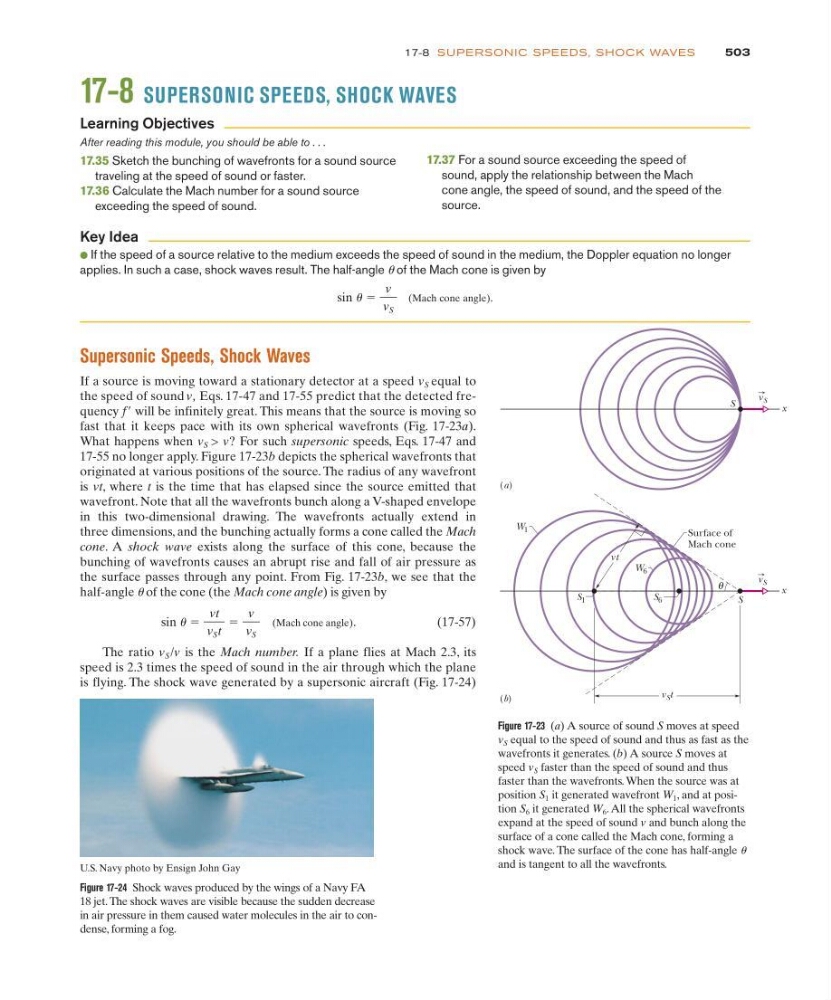
fast that it keeps pace with its own spherical wavefronts (Fig. 17-23a).
What happens when v S > v? For such supersonic speeds, Eqs. 17-47 and
17-55 no longer apply. Figure 17-23b depicts the spherical wavefronts that
originated at various positions of the source. The radius of any wavefront
is vt, where t is the time that has elapsed since the source emitted that
wavefront. Note that all the wavefronts bunch along a V-shaped envelope
in this two-dimensional drawing. The wavefronts actually extend in
three dimensions, and the bunching actually forms a cone called the Mach
cone. A shock wave exists along the surface of this cone, because the
bunching of wavefronts causes an abrupt rise and fall of air pressure as
the surface passes through any point. From Fig. 17-23b, we see that the
half-angle u of the cone (the Mach cone angle) is given by
(Mach cone angle).
( 1 7 - 5 7 )
The ratio v S /v is the Mach number. If a plane flies at Mach 2.3, its
speed is 2.3 times the speed of sound in the air through which the plane
is flying. The shock wave generated by a supersonic aircraft (Fig. 17-24)
sin ϭ
vt
v S t
ϭ
v
v S
17-8 SUPERSONIC SPEEDS, SHOCK WAVES
After reading this module, you should be able to . . .
17.35 Sketch the bunching of wavefronts for a sound source
traveling at the speed of sound or faster.
17.36 Calculate the Mach number for a sound source
exceeding the speed of sound.
17.37 For a sound source exceeding the speed of
sound, apply the relationship between the Mach
cone angle, the speed of sound, and the speed of the
source.
Learning Objectives
● If the speed of a source relative to the medium exceeds the speed of sound in the medium, the Doppler equation no longer
applies. In such a case, shock waves result. The half-angle u of the Mach cone is given by
(Mach cone angle).
sin ϭ
v
v S
Key Idea
Figure 17-24 Shock waves produced by the wings of a Navy FA
18 jet. The shock waves are visible because the sudden decrease
in air pressure in them caused water molecules in the air to condense, forming a fog.
U.S. Navy photo by Ensign John Gay
Figure 17-23 (a) A source of sound S moves at speed
v S equal to the speed of sound and thus as fast as the
wavefronts it generates. (b) A source S moves at
speed v S faster than the speed of sound and thus
faster than the wavefronts. When the source was at
position S 1 it generated wavefront W 1 , and at position S 6 it generated W 6 . All the spherical wavefronts
expand at the speed of sound v and bunch along the
surface of a cone called the Mach cone, forming a
shock wave. The surface of the cone has half-angle u
and is tangent to all the wavefronts.
Surface of
Mach cone
W 6
W 1
x
(b)
S
S 6
S 1
θ
v S
v S t
vt
x
v S
(a)
S
17-8 SU PE RSON IC SPE E DS, SHOCK WAVES
Supersonic Speeds, Shock Waves
If a source is moving toward a stationary detector at a speed v S equal to
the speed of sound v, Eqs. 17-47 and 17-55 predict that the detected frequency fЈ will be infinitely great. This means that the source is moving so
fast that it keeps pace with its own spherical wavefronts (Fig. 17-23a).
What happens when v S > v? For such supersonic speeds, Eqs. 17-47 and
17-55 no longer apply. Figure 17-23b depicts the spherical wavefronts that
originated at various positions of the source. The radius of any wavefront
is vt, where t is the time that has elapsed since the source emitted that
wavefront. Note that all the wavefronts bunch along a V-shaped envelope
in this two-dimensional drawing. The wavefronts actually extend in
three dimensions, and the bunching actually forms a cone called the Mach
cone. A shock wave exists along the surface of this cone, because the
bunching of wavefronts causes an abrupt rise and fall of air pressure as
the surface passes through any point. From Fig. 17-23b, we see that the
half-angle u of the cone (the Mach cone angle) is given by
(Mach cone angle).
( 1 7 - 5 7 )
The ratio v S /v is the Mach number. If a plane flies at Mach 2.3, its
speed is 2.3 times the speed of sound in the air through which the plane
is flying. The shock wave generated by a supersonic aircraft (Fig. 17-24)
sin ϭ
vt
v S t
ϭ
v
v S
17-8 SUPERSONIC SPEEDS, SHOCK WAVES
After reading this module, you should be able to . . .
17.35 Sketch the bunching of wavefronts for a sound source
traveling at the speed of sound or faster.
17.36 Calculate the Mach number for a sound source
exceeding the speed of sound.
17.37 For a sound source exceeding the speed of
sound, apply the relationship between the Mach
cone angle, the speed of sound, and the speed of the
source.
Learning Objectives
● If the speed of a source relative to the medium exceeds the speed of sound in the medium, the Doppler equation no longer
applies. In such a case, shock waves result. The half-angle u of the Mach cone is given by
(Mach cone angle).
sin ϭ
v
v S
Key Idea
Figure 17-24 Shock waves produced by the wings of a Navy FA
18 jet. The shock waves are visible because the sudden decrease
in air pressure in them caused water molecules in the air to condense, forming a fog.
U.S. Navy photo by Ensign John Gay
Figure 17-23 (a) A source of sound S moves at speed
v S equal to the speed of sound and thus as fast as the
wavefronts it generates. (b) A source S moves at
speed v S faster than the speed of sound and thus
faster than the wavefronts. When the source was at
position S 1 it generated wavefront W 1 , and at position S 6 it generated W 6 . All the spherical wavefronts
expand at the speed of sound v and bunch along the
surface of a cone called the Mach cone, forming a
shock wave. The surface of the cone has half-angle u
and is tangent to all the wavefronts.
Surface of
Mach cone
W 6
W 1
x
(b)
S
S 6
S 1
θ
v S
v S t
vt
x
v S
(a)
S