

504
CHAPTE R 17 WAVES—I I
or projectile produces a burst of sound, called a sonic boom, in which the air pressure first suddenly increases and then suddenly decreases below normal before returning to normal. Part of the sound that is heard when a rifle is fired is the sonic
boom produced by the bullet. When a long bull whip is snapped, its tip is moving
faster than sound and produces a small sonic boom — the crack of the whip.
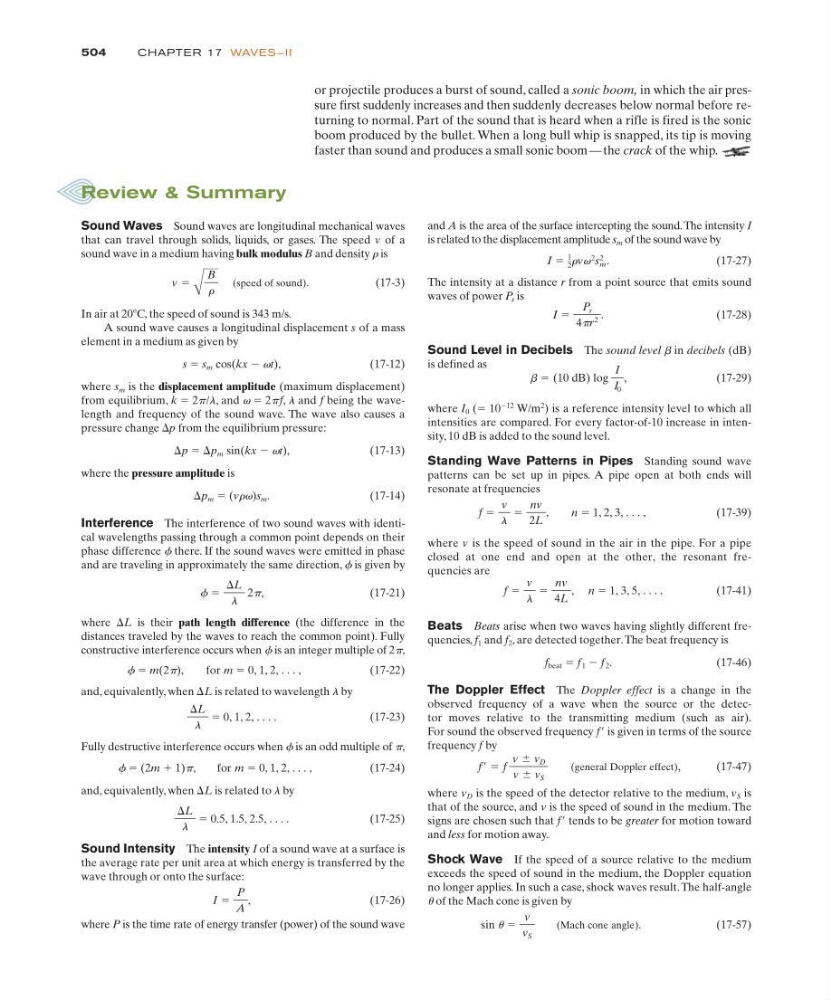
Sound Waves Sound waves are longitudinal mechanical waves
that can travel through solids, liquids, or gases. The speed v of a
sound wave in a medium having bulk modulus B and density r is
(speed of sound).
( 1 7 - 3 )
In air at 20ЊC, the speed of sound is 343 m/s.
A sound wave causes a longitudinal displacement s of a mass
element in a medium as given by
s ϭ s m cos(kx Ϫ vt),
(17-12)
where s m is the displacement amplitude (maximum displacement)
from equilibrium, k ϭ 2p/l, and v ϭ 2pf, l and f being the wavelength and frequency of the sound wave. The wave also causes a
pressure change ⌬p from the equilibrium pressure:
⌬p ϭ ⌬p m sin(kx Ϫ vt),
(17-13)
where the pressure amplitude is
⌬p m ϭ (vrv)s m .
( 1 7 - 1 4 )
Interference The interference of two sound waves with identical wavelengths passing through a common point depends on their
phase difference f there. If the sound waves were emitted in phase
and are traveling in approximately the same direction, f is given by
(17-21)
where ⌬L is their path length difference (the difference in the
distances traveled by the waves to reach the common point). Fully
constructive interference occurs when f is an integer multiple of 2p,
f ϭ m(2p),
for m ϭ 0, 1, 2, . . . ,
(17-22)
and, equivalently, when ⌬L is related to wavelength l by
ϭ 0, 1, 2, . . . .
(17-23)
Fully destructive interference occurs when f is an odd multiple of p,
f ϭ (2m ϩ 1)p,
for m ϭ 0, 1, 2, . . . ,
(17-24)
and, equivalently, when ⌬L is related to l by
ϭ 0.5, 1.5, 2.5, . . . .
(17-25)
Sound Intensity The intensity I of a sound wave at a surface is
the average rate per unit area at which energy is transferred by the
wave through or onto the surface:
,
( 1 7 - 2 6 )
where P is the time rate of energy transfer (power) of the sound wave
I ϭ
P
A
⌬L
l
⌬L
l
f ϭ
⌬L
l
2p,
v ϭ A
B
Review & Summary
and A is the area of the surface intercepting the sound. The intensity I
is related to the displacement amplitude s m of the sound wave by
(17-27)
The intensity at a distance r from a point source that emits sound
waves of power P s is
.
( 1 7 - 2 8 )
Sound Level in Decibels The sound level b in decibels (dB)
is defined as
,
( 1 7 - 2 9 )
where I 0 (ϭ 10
Ϫ12
W/m
2
) is a reference intensity level to which all
intensities are compared. For every factor-of-10 increase in intensity, 10 dB is added to the sound level.
Standing Wave Patterns in Pipes Standing sound wave
patterns can be set up in pipes. A pipe open at both ends will
resonate at frequencies
,
n ϭ 1, 2, 3, . . . ,
(17-39)
where v is the speed of sound in the air in the pipe. For a pipe
closed at one end and open at the other, the resonant frequencies are
, n ϭ 1, 3, 5, . . . .
(17-41)
Beats Beats arise when two waves having slightly different frequencies, f 1 and f 2 , are detected together.The beat frequency is
f beat ϭ f 1 Ϫ f 2 .
(17-46)
The Doppler Effect The Doppler effect is a change in the
observed frequency of a wave when the source or the detector moves relative to the transmitting medium (such as air).
For sound the observed frequency fЈ is given in terms of the source
frequency f by
(general Doppler effect),
(17-47)
where v D is the speed of the detector relative to the medium, v S is
that of the source, and v is the speed of sound in the medium. The
signs are chosen such that fЈ tends to be greater for motion toward
and less for motion away.
Shock Wave If the speed of a source relative to the medium
exceeds the speed of sound in the medium, the Doppler equation
no longer applies. In such a case, shock waves result. The half-angle
u of the Mach cone is given by
(Mach cone angle).
( 1 7 - 5 7 )
sin u ϭ
v
v S
f Ј ϭ f
v Ϯ v D
v Ϯ v S
f ϭ
v
ϭ
nv
4L
f ϭ
v
ϭ
nv
2L
b ϭ (10 dB) log
I
I 0
I ϭ
P s
4pr
2
I ϭ
1
2 vv
2
s
2
m .
CHAPTE R 17 WAVES—I I
or projectile produces a burst of sound, called a sonic boom, in which the air pressure first suddenly increases and then suddenly decreases below normal before returning to normal. Part of the sound that is heard when a rifle is fired is the sonic
boom produced by the bullet. When a long bull whip is snapped, its tip is moving
faster than sound and produces a small sonic boom — the crack of the whip.
Sound Waves Sound waves are longitudinal mechanical waves
that can travel through solids, liquids, or gases. The speed v of a
sound wave in a medium having bulk modulus B and density r is
(speed of sound).
( 1 7 - 3 )
In air at 20ЊC, the speed of sound is 343 m/s.
A sound wave causes a longitudinal displacement s of a mass
element in a medium as given by
s ϭ s m cos(kx Ϫ vt),
(17-12)
where s m is the displacement amplitude (maximum displacement)
from equilibrium, k ϭ 2p/l, and v ϭ 2pf, l and f being the wavelength and frequency of the sound wave. The wave also causes a
pressure change ⌬p from the equilibrium pressure:
⌬p ϭ ⌬p m sin(kx Ϫ vt),
(17-13)
where the pressure amplitude is
⌬p m ϭ (vrv)s m .
( 1 7 - 1 4 )
Interference The interference of two sound waves with identical wavelengths passing through a common point depends on their
phase difference f there. If the sound waves were emitted in phase
and are traveling in approximately the same direction, f is given by
(17-21)
where ⌬L is their path length difference (the difference in the
distances traveled by the waves to reach the common point). Fully
constructive interference occurs when f is an integer multiple of 2p,
f ϭ m(2p),
for m ϭ 0, 1, 2, . . . ,
(17-22)
and, equivalently, when ⌬L is related to wavelength l by
ϭ 0, 1, 2, . . . .
(17-23)
Fully destructive interference occurs when f is an odd multiple of p,
f ϭ (2m ϩ 1)p,
for m ϭ 0, 1, 2, . . . ,
(17-24)
and, equivalently, when ⌬L is related to l by
ϭ 0.5, 1.5, 2.5, . . . .
(17-25)
Sound Intensity The intensity I of a sound wave at a surface is
the average rate per unit area at which energy is transferred by the
wave through or onto the surface:
,
( 1 7 - 2 6 )
where P is the time rate of energy transfer (power) of the sound wave
I ϭ
P
A
⌬L
l
⌬L
l
f ϭ
⌬L
l
2p,
v ϭ A
B
Review & Summary
and A is the area of the surface intercepting the sound. The intensity I
is related to the displacement amplitude s m of the sound wave by
(17-27)
The intensity at a distance r from a point source that emits sound
waves of power P s is
.
( 1 7 - 2 8 )
Sound Level in Decibels The sound level b in decibels (dB)
is defined as
,
( 1 7 - 2 9 )
where I 0 (ϭ 10
Ϫ12
W/m
2
) is a reference intensity level to which all
intensities are compared. For every factor-of-10 increase in intensity, 10 dB is added to the sound level.
Standing Wave Patterns in Pipes Standing sound wave
patterns can be set up in pipes. A pipe open at both ends will
resonate at frequencies
,
n ϭ 1, 2, 3, . . . ,
(17-39)
where v is the speed of sound in the air in the pipe. For a pipe
closed at one end and open at the other, the resonant frequencies are
, n ϭ 1, 3, 5, . . . .
(17-41)
Beats Beats arise when two waves having slightly different frequencies, f 1 and f 2 , are detected together.The beat frequency is
f beat ϭ f 1 Ϫ f 2 .
(17-46)
The Doppler Effect The Doppler effect is a change in the
observed frequency of a wave when the source or the detector moves relative to the transmitting medium (such as air).
For sound the observed frequency fЈ is given in terms of the source
frequency f by
(general Doppler effect),
(17-47)
where v D is the speed of the detector relative to the medium, v S is
that of the source, and v is the speed of sound in the medium. The
signs are chosen such that fЈ tends to be greater for motion toward
and less for motion away.
Shock Wave If the speed of a source relative to the medium
exceeds the speed of sound in the medium, the Doppler equation
no longer applies. In such a case, shock waves result. The half-angle
u of the Mach cone is given by
(Mach cone angle).
( 1 7 - 5 7 )
sin u ϭ
v
v S
f Ј ϭ f
v Ϯ v D
v Ϯ v S
f ϭ
v
ϭ
nv
4L
f ϭ
v
ϭ
nv
2L
b ϭ (10 dB) log
I
I 0
I ϭ
P s
4pr
2
I ϭ
1
2 vv
2
s
2
m .