

502
CHAPTE R 17 WAVES—I I
numerator, we choose the minus sign to meet that tendency
(the numerator becomes smaller). These reasoning steps
are shown in Table 17 -3.
We have the speed of the bat in the denominator of
Eq. 17 -56. The bat moves toward the moth, which tends to
increase the detected frequency. Because the speed is in the
denominator, we choose the minus sign to meet that tendency (the denominator becomes smaller).
With these substitutions and decisions, we have
(Answer)
Detection of echo by bat: In the echo back to the bat, the
moth acts as a source of sound, emitting at the frequency f md
we just calculated. So now the moth is the source (moving
away) and the bat is the detector (moving toward). The reasoning steps are shown in Table 17 -3. To find the frequency
f bd detected by the bat, we write Eq. 17 -56 as
(Answer)
Some moths evade bats by “jamming” the detection system
with ultrasonic clicks.
ϭ 83.00 kHz Ϸ 83.0 kHz.
ϭ (82.767 kHz)
343 m/s ϩ 9.00 m/s
343 m/s ϩ 8.00 m/s
f bd ϭ f md
v ϩ v b
v ϩ v m
ϭ 82.767 kHz Ϸ 82.8 kHz.
ϭ (82.52 kHz)
343 m/s Ϫ 8.00 m/s
343 m/s Ϫ 9.00 m/s
f md ϭ f be
v Ϫ v m
v Ϫ v b
Sample Problem 17.07 Double Doppler shift in the echoes used by bats
Bats navigate and search out prey by emitting, and then detecting reflections of, ultrasonic waves, which are sound
waves with frequencies greater than can be heard by a human. Suppose a bat emits ultrasound at frequency f be ϭ 82.52
kHz while flying with velocity
as it chases a
moth that flies with velocity
. What frequency f md does the moth detect? What frequency f bd does the
bat detect in the returning echo from the moth?
KEY IDEAS
The frequency is shifted by the relative motion of the bat and
moth. Because they move along a single axis, the shifted frequency is given by Eq. 17-47. Motion toward tends to shift the
frequency up, and motion away tends to shift it down.
Detection by moth: The general Doppler equation is
(17-56)
Here, the detected frequency fЈ that we want to find is the frequency f md detected by the moth. On the right side, the emitted
frequency f is the bat’s emission frequency f be ϭ 82.52 kHz, the
speed of sound is v ϭ 343 m/s, the speed v D of the detector is
the moth’s speed v m ϭ 8.00 m/s, and the speed v S of the
source is the bat’s speed v b ϭ 9.00 m/s.
The decisions about the plus and minus signs can be
tricky. Think in terms of toward and away. We have the
speed of the moth (the detector) in the numerator of
Eq. 17 -56. The moth moves away from the bat, which tends
to lower the detected frequency. Because the speed is in the
fЈ ϭ f
v Ϯ v D
v Ϯ v S
.
v
:
m ϭ (8.00 m/s)i ˆ
v
:
b ϭ (9.00 m/s)i ˆ
Additional examples, video, and practice available at WileyPLUS
Table 17-3
Bat to Moth
Detector
Source
moth
bat
speed v D ϭ v m
speed v S ϭ v b
away
toward
shift down
shift up
numerator
denominator
minus
minus
Echo Back to Bat
Detector
Source
bat
moth
speed v D ϭ v b
speed v S ϭ v m
toward
away
shift up
shift down
numerator
denominator
plus
plus
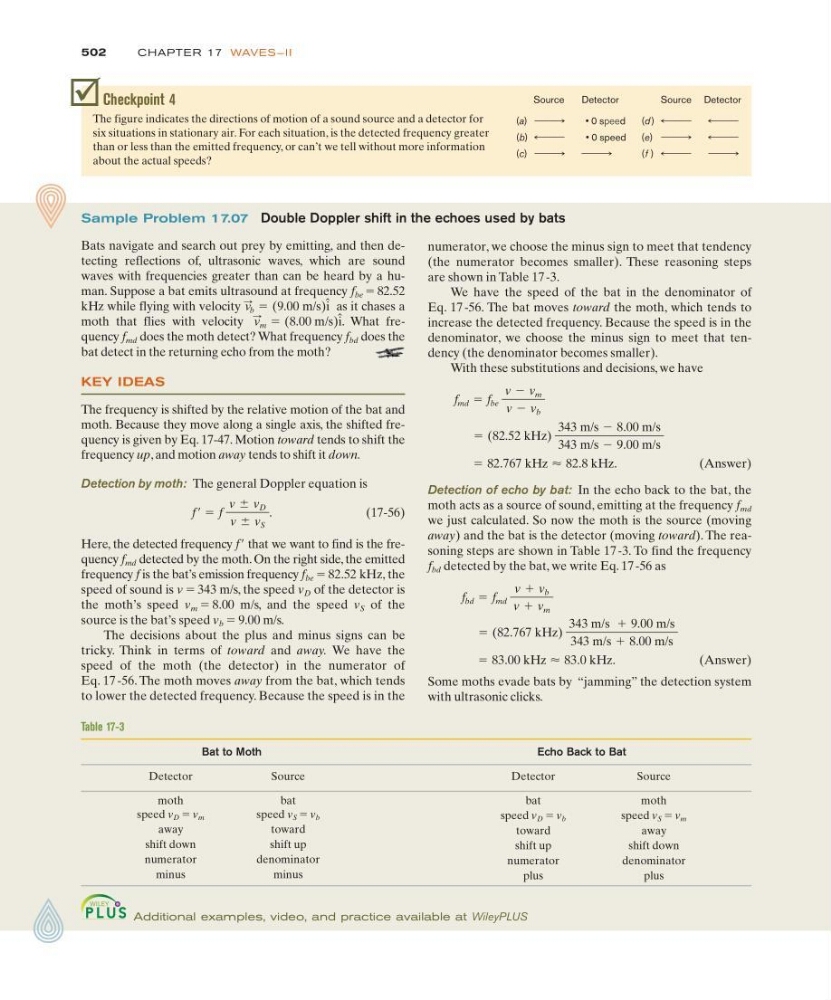
Checkpoint 4
The figure indicates the directions of motion of a sound source and a detector for
six situations in stationary air. For each situation, is the detected frequency greater
than or less than the emitted frequency, or can’t we tell without more information
about the actual speeds?
Source
Detector
Source Detector
(a) 99:
• 0 speed
(d ) ;99
;99
(b) ;99
• 0 speed
(e) 99:
;99
(c) 99:
99:
(f ) ;99
99:
CHAPTE R 17 WAVES—I I
numerator, we choose the minus sign to meet that tendency
(the numerator becomes smaller). These reasoning steps
are shown in Table 17 -3.
We have the speed of the bat in the denominator of
Eq. 17 -56. The bat moves toward the moth, which tends to
increase the detected frequency. Because the speed is in the
denominator, we choose the minus sign to meet that tendency (the denominator becomes smaller).
With these substitutions and decisions, we have
(Answer)
Detection of echo by bat: In the echo back to the bat, the
moth acts as a source of sound, emitting at the frequency f md
we just calculated. So now the moth is the source (moving
away) and the bat is the detector (moving toward). The reasoning steps are shown in Table 17 -3. To find the frequency
f bd detected by the bat, we write Eq. 17 -56 as
(Answer)
Some moths evade bats by “jamming” the detection system
with ultrasonic clicks.
ϭ 83.00 kHz Ϸ 83.0 kHz.
ϭ (82.767 kHz)
343 m/s ϩ 9.00 m/s
343 m/s ϩ 8.00 m/s
f bd ϭ f md
v ϩ v b
v ϩ v m
ϭ 82.767 kHz Ϸ 82.8 kHz.
ϭ (82.52 kHz)
343 m/s Ϫ 8.00 m/s
343 m/s Ϫ 9.00 m/s
f md ϭ f be
v Ϫ v m
v Ϫ v b
Sample Problem 17.07 Double Doppler shift in the echoes used by bats
Bats navigate and search out prey by emitting, and then detecting reflections of, ultrasonic waves, which are sound
waves with frequencies greater than can be heard by a human. Suppose a bat emits ultrasound at frequency f be ϭ 82.52
kHz while flying with velocity
as it chases a
moth that flies with velocity
. What frequency f md does the moth detect? What frequency f bd does the
bat detect in the returning echo from the moth?
KEY IDEAS
The frequency is shifted by the relative motion of the bat and
moth. Because they move along a single axis, the shifted frequency is given by Eq. 17-47. Motion toward tends to shift the
frequency up, and motion away tends to shift it down.
Detection by moth: The general Doppler equation is
(17-56)
Here, the detected frequency fЈ that we want to find is the frequency f md detected by the moth. On the right side, the emitted
frequency f is the bat’s emission frequency f be ϭ 82.52 kHz, the
speed of sound is v ϭ 343 m/s, the speed v D of the detector is
the moth’s speed v m ϭ 8.00 m/s, and the speed v S of the
source is the bat’s speed v b ϭ 9.00 m/s.
The decisions about the plus and minus signs can be
tricky. Think in terms of toward and away. We have the
speed of the moth (the detector) in the numerator of
Eq. 17 -56. The moth moves away from the bat, which tends
to lower the detected frequency. Because the speed is in the
fЈ ϭ f
v Ϯ v D
v Ϯ v S
.
v
:
m ϭ (8.00 m/s)i ˆ
v
:
b ϭ (9.00 m/s)i ˆ
Additional examples, video, and practice available at WileyPLUS
Table 17-3
Bat to Moth
Detector
Source
moth
bat
speed v D ϭ v m
speed v S ϭ v b
away
toward
shift down
shift up
numerator
denominator
minus
minus
Echo Back to Bat
Detector
Source
bat
moth
speed v D ϭ v b
speed v S ϭ v m
toward
away
shift up
shift down
numerator
denominator
plus
plus
Checkpoint 4
The figure indicates the directions of motion of a sound source and a detector for
six situations in stationary air. For each situation, is the detected frequency greater
than or less than the emitted frequency, or can’t we tell without more information
about the actual speeds?
Source
Detector
Source Detector
(a) 99:
• 0 speed
(d ) ;99
;99
(b) ;99
• 0 speed
(e) 99:
;99
(c) 99:
99:
(f ) ;99
99: