

501
17-7 TH E DOPPLE R E FFECT
Source Moving, Detector Stationary
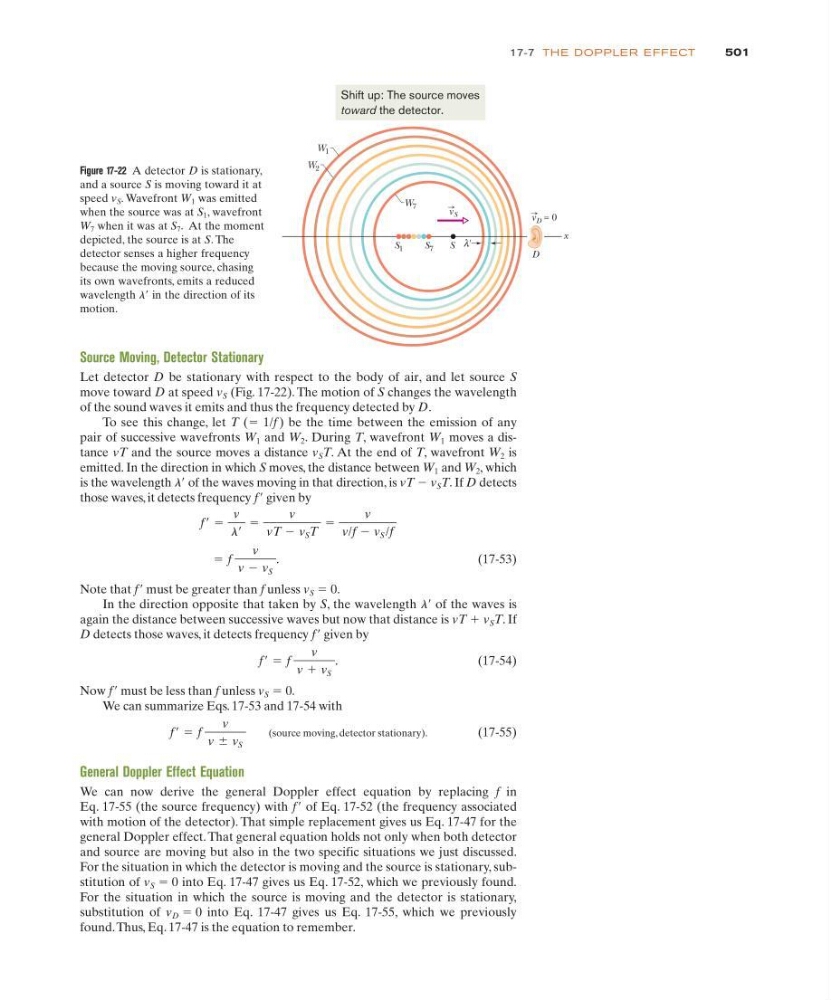
Let detector D be stationary with respect to the body of air, and let source S
move toward D at speed v S (Fig. 17-22). The motion of S changes the wavelength
of the sound waves it emits and thus the frequency detected by D.
To see this change, let T (ϭ 1/f ) be the time between the emission of any
pair of successive wavefronts W 1 and W 2 . During T, wavefront W 1 moves a distance vT and the source moves a distance v S T. At the end of T, wavefront W 2 is
emitted. In the direction in which S moves, the distance between W 1 and W 2 , which
is the wavelength lЈ of the waves moving in that direction, is vT Ϫ v S T. If D detects
those waves, it detects frequency fЈ given by
.
( 1 7 - 5 3 )
Note that fЈ must be greater than f unless v S ϭ 0.
In the direction opposite that taken by S, the wavelength lЈ of the waves is
again the distance between successive waves but now that distance is vT ϩ v S T. If
D detects those waves, it detects frequency fЈ given by
.
( 1 7 - 5 4 )
Now fЈ must be less than f unless v S ϭ 0.
We can summarize Eqs. 17-53 and 17-54 with
(source moving, detector stationary).
(17-55)
General Doppler Effect Equation
We can now derive the general Doppler effect equation by replacing f in
Eq. 17-55 (the source frequency) with fЈ of Eq. 17-52 (the frequency associated
with motion of the detector). That simple replacement gives us Eq. 17-47 for the
general Doppler effect. That general equation holds not only when both detector
and source are moving but also in the two specific situations we just discussed.
For the situation in which the detector is moving and the source is stationary, substitution of v S ϭ 0 into Eq. 17-47 gives us Eq. 17-52, which we previously found.
For the situation in which the source is moving and the detector is stationary,
substitution of v D ϭ 0 into Eq. 17-47 gives us Eq. 17-55, which we previously
found. Thus, Eq. 17-47 is the equation to remember.
fЈ ϭ f
v
v Ϯ v S
fЈ ϭ f
v
v ϩ v S
ϭ f
v
v Ϫ v S
fЈ ϭ
v
Ј
ϭ
v
vT Ϫ v S T
ϭ
v
v/f Ϫ v S /f
Figure 17-22 A detector D is stationary,
and a source S is moving toward it at
speed v S . Wavefront W 1 was emitted
when the source was at S 1 , wavefront
W 7 when it was at S 7 . At the moment
depicted, the source is at S. The
detector senses a higher frequency
because the moving source, chasing
its own wavefronts, emits a reduced
wavelength lЈ in the direction of its
motion.
W 1
x
λ '
S
S 7
S 1
v S
W 7
W 2
v D = 0
D
Shift up: The source moves
toward the detector.
17-7 TH E DOPPLE R E FFECT
Source Moving, Detector Stationary
Let detector D be stationary with respect to the body of air, and let source S
move toward D at speed v S (Fig. 17-22). The motion of S changes the wavelength
of the sound waves it emits and thus the frequency detected by D.
To see this change, let T (ϭ 1/f ) be the time between the emission of any
pair of successive wavefronts W 1 and W 2 . During T, wavefront W 1 moves a distance vT and the source moves a distance v S T. At the end of T, wavefront W 2 is
emitted. In the direction in which S moves, the distance between W 1 and W 2 , which
is the wavelength lЈ of the waves moving in that direction, is vT Ϫ v S T. If D detects
those waves, it detects frequency fЈ given by
.
( 1 7 - 5 3 )
Note that fЈ must be greater than f unless v S ϭ 0.
In the direction opposite that taken by S, the wavelength lЈ of the waves is
again the distance between successive waves but now that distance is vT ϩ v S T. If
D detects those waves, it detects frequency fЈ given by
.
( 1 7 - 5 4 )
Now fЈ must be less than f unless v S ϭ 0.
We can summarize Eqs. 17-53 and 17-54 with
(source moving, detector stationary).
(17-55)
General Doppler Effect Equation
We can now derive the general Doppler effect equation by replacing f in
Eq. 17-55 (the source frequency) with fЈ of Eq. 17-52 (the frequency associated
with motion of the detector). That simple replacement gives us Eq. 17-47 for the
general Doppler effect. That general equation holds not only when both detector
and source are moving but also in the two specific situations we just discussed.
For the situation in which the detector is moving and the source is stationary, substitution of v S ϭ 0 into Eq. 17-47 gives us Eq. 17-52, which we previously found.
For the situation in which the source is moving and the detector is stationary,
substitution of v D ϭ 0 into Eq. 17-47 gives us Eq. 17-55, which we previously
found. Thus, Eq. 17-47 is the equation to remember.
fЈ ϭ f
v
v Ϯ v S
fЈ ϭ f
v
v ϩ v S
ϭ f
v
v Ϫ v S
fЈ ϭ
v
Ј
ϭ
v
vT Ϫ v S T
ϭ
v
v/f Ϫ v S /f
Figure 17-22 A detector D is stationary,
and a source S is moving toward it at
speed v S . Wavefront W 1 was emitted
when the source was at S 1 , wavefront
W 7 when it was at S 7 . At the moment
depicted, the source is at S. The
detector senses a higher frequency
because the moving source, chasing
its own wavefronts, emits a reduced
wavelength lЈ in the direction of its
motion.
W 1
x
λ '
S
S 7
S 1
v S
W 7
W 2
v D = 0
D
Shift up: The source moves
toward the detector.