

500
CHAPTE R 17 WAVES—I I
Detector Moving, Source Stationary
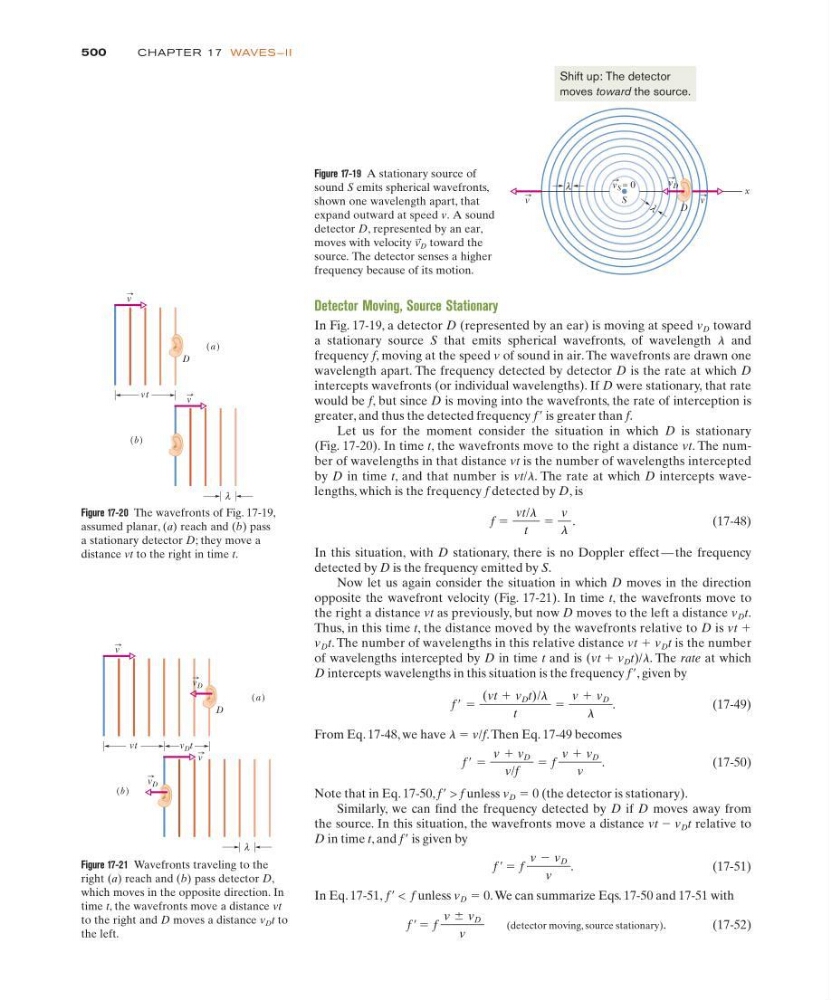
In Fig. 17-19, a detector D (represented by an ear) is moving at speed v D toward
a stationary source S that emits spherical wavefronts, of wavelength l and
frequency f, moving at the speed v of sound in air. The wavefronts are drawn one
wavelength apart. The frequency detected by detector D is the rate at which D
intercepts wavefronts (or individual wavelengths). If D were stationary, that rate
would be f, but since D is moving into the wavefronts, the rate of interception is
greater, and thus the detected frequency fЈ is greater than f.
Let us for the moment consider the situation in which D is stationary
(Fig. 17-20). In time t, the wavefronts move to the right a distance vt. The number of wavelengths in that distance vt is the number of wavelengths intercepted
by D in time t, and that number is vt/l. The rate at which D intercepts wavelengths, which is the frequency f detected by D, is
(17-48)
In this situation, with D stationary, there is no Doppler effect — the frequency
detected by D is the frequency emitted by S.
Now let us again consider the situation in which D moves in the direction
opposite the wavefront velocity (Fig. 17-21). In time t, the wavefronts move to
the right a distance vt as previously, but now D moves to the left a distance v D t.
Thus, in this time t, the distance moved by the wavefronts relative to D is vt ϩ
v D t. The number of wavelengths in this relative distance vt ϩ v D t is the number
of wavelengths intercepted by D in time t and is (vt ϩ v D t)/l. The rate at which
D intercepts wavelengths in this situation is the frequency fЈ, given by
.
( 1 7 - 4 9 )
From Eq. 17-48, we have l ϭ v/f.Then Eq. 17-49 becomes
.
(17-50)
Note that in Eq. 17-50, fЈ > f unless v D ϭ 0 (the detector is stationary).
Similarly, we can find the frequency detected by D if D moves away from
the source. In this situation, the wavefronts move a distance vt Ϫ v D t relative to
D in time t, and fЈ is given by
.
( 1 7 - 5 1 )
In Eq. 17-51, fЈ < f unless v D ϭ 0. We can summarize Eqs. 17-50 and 17-51 with
(detector moving, source stationary).
( 1 7 - 5 2 )
f Ј ϭ f
v Ϯ v D
v
f Ј ϭ f
v Ϫ v D
v
f Ј ϭ
v ϩ v D
v/f
ϭ f
v ϩ v D
v
f Ј ϭ
(vt ϩ v D t)/
t
ϭ
v ϩ v D
f ϭ
vt/l
t
ϭ
v
l
.
Figure 17-19 A stationary source of
sound S emits spherical wavefronts,
shown one wavelength apart, that
expand outward at speed v. A sound
detector D, represented by an ear,
moves with velocity
toward the
source. The detector senses a higher
frequency because of its motion.
v
:
D
λ
v S = 0
S
x
D
λ
v D
v
v
Shift up: The detector
moves toward the source.
Figure 17-20 The wavefronts of Fig. 17-19,
assumed planar, (a) reach and (b) pass
a stationary detector D; they move a
distance vt to the right in time t.
v
v
D
vt
(a )
(b )
λ
Figure 17-21 Wavefronts traveling to the
right (a) reach and (b) pass detector D,
which moves in the opposite direction. In
time t, the wavefronts move a distance vt
to the right and D moves a distance v D t to
the left.
v
v
vt
(a )
(b )
λ
D
v D t
v D
v D
CHAPTE R 17 WAVES—I I
Detector Moving, Source Stationary
In Fig. 17-19, a detector D (represented by an ear) is moving at speed v D toward
a stationary source S that emits spherical wavefronts, of wavelength l and
frequency f, moving at the speed v of sound in air. The wavefronts are drawn one
wavelength apart. The frequency detected by detector D is the rate at which D
intercepts wavefronts (or individual wavelengths). If D were stationary, that rate
would be f, but since D is moving into the wavefronts, the rate of interception is
greater, and thus the detected frequency fЈ is greater than f.
Let us for the moment consider the situation in which D is stationary
(Fig. 17-20). In time t, the wavefronts move to the right a distance vt. The number of wavelengths in that distance vt is the number of wavelengths intercepted
by D in time t, and that number is vt/l. The rate at which D intercepts wavelengths, which is the frequency f detected by D, is
(17-48)
In this situation, with D stationary, there is no Doppler effect — the frequency
detected by D is the frequency emitted by S.
Now let us again consider the situation in which D moves in the direction
opposite the wavefront velocity (Fig. 17-21). In time t, the wavefronts move to
the right a distance vt as previously, but now D moves to the left a distance v D t.
Thus, in this time t, the distance moved by the wavefronts relative to D is vt ϩ
v D t. The number of wavelengths in this relative distance vt ϩ v D t is the number
of wavelengths intercepted by D in time t and is (vt ϩ v D t)/l. The rate at which
D intercepts wavelengths in this situation is the frequency fЈ, given by
.
( 1 7 - 4 9 )
From Eq. 17-48, we have l ϭ v/f.Then Eq. 17-49 becomes
.
(17-50)
Note that in Eq. 17-50, fЈ > f unless v D ϭ 0 (the detector is stationary).
Similarly, we can find the frequency detected by D if D moves away from
the source. In this situation, the wavefronts move a distance vt Ϫ v D t relative to
D in time t, and fЈ is given by
.
( 1 7 - 5 1 )
In Eq. 17-51, fЈ < f unless v D ϭ 0. We can summarize Eqs. 17-50 and 17-51 with
(detector moving, source stationary).
( 1 7 - 5 2 )
f Ј ϭ f
v Ϯ v D
v
f Ј ϭ f
v Ϫ v D
v
f Ј ϭ
v ϩ v D
v/f
ϭ f
v ϩ v D
v
f Ј ϭ
(vt ϩ v D t)/
t
ϭ
v ϩ v D
f ϭ
vt/l
t
ϭ
v
l
.
Figure 17-19 A stationary source of
sound S emits spherical wavefronts,
shown one wavelength apart, that
expand outward at speed v. A sound
detector D, represented by an ear,
moves with velocity
toward the
source. The detector senses a higher
frequency because of its motion.
v
:
D
λ
v S = 0
S
x
D
λ
v D
v
v
Shift up: The detector
moves toward the source.
Figure 17-20 The wavefronts of Fig. 17-19,
assumed planar, (a) reach and (b) pass
a stationary detector D; they move a
distance vt to the right in time t.
v
v
D
vt
(a )
(b )
λ
Figure 17-21 Wavefronts traveling to the
right (a) reach and (b) pass detector D,
which moves in the opposite direction. In
time t, the wavefronts move a distance vt
to the right and D moves a distance v D t to
the left.
v
v
vt
(a )
(b )
λ
D
v D t
v D
v D