

490
CHAPTE R 17 WAVES—I I
The Decibel Scale
The displacement amplitude at the human ear ranges from about 10
Ϫ5
m for
the loudest tolerable sound to about 10
Ϫ11
m for the faintest detectable sound,
a ratio of 10
6
. From Eq. 17-27 we see that the intensity of a sound varies as the
square of its amplitude, so the ratio of intensities at these two limits of the human auditory system is 10
12
. Humans can hear over an enormous range of
intensities.
We deal with such an enormous range of values by using logarithms.
Consider the relation
y ϭ log x,
in which x and y are variables. It is a property of this equation that if we multiply
x by 10, then y increases by 1. To see this, we write
yЈ ϭ log(10x) ϭ log 10 ϩ log x ϭ 1 ϩ y.
Similarly, if we multiply x by 10
12
, y increases by only 12.
Thus, instead of speaking of the intensity I of a sound wave, it is much more
convenient to speak of its sound level b, defined as
(17-29)
Here dB is the abbreviation for decibel, the unit of sound level, a name that was
chosen to recognize the work of Alexander Graham Bell. I 0 in Eq. 17-29 is a
standard reference intensity (ϭ 10
Ϫ12
W/m
2
), chosen because it is near the lower
limit of the human range of hearing. For I ϭ I 0 , Eq. 17-29 gives b ϭ 10 log 1 ϭ 0,
so our standard reference level corresponds to zero decibels. Then b increases
by 10 dB every time the sound intensity increases by an order of magnitude
(a factor of 10). Thus, b ϭ 40 corresponds to an intensity that is 10
4
times
the standard reference level. Table 17-2 lists the sound levels for a variety of
environments.
Derivation of Eq. 17-27
Consider, in Fig. 17-4a, a thin slice of air of thickness dx, area A, and mass dm,
oscillating back and forth as the sound wave of Eq. 17-12 passes through it. The
kinetic energy dK of the slice of air is
(17-30)
Here v s is not the speed of the wave but the speed of the oscillating element of air,
obtained from Eq. 17-12 as
Using this relation and putting dm ϭ rA dx allow us to rewrite Eq. 17-30 as
dK ϭ (rA dx)(Ϫvs m )
2
sin
2
(kx Ϫ vt).
(17-31)
Dividing Eq. 17-31 by dt gives the rate at which kinetic energy moves along with
the wave. As we saw in Chapter 16 for transverse waves, dx/dt is the wave speed
v, so we have
rAvv
2
s
2
m sin
2
(kx Ϫ vt).
(17-32)
dK
dt
ϭ
1
2
1
2
v s ϭ
Ѩs
Ѩt
ϭ Ϫvs m sin(kx Ϫ vt).
dK ϭ
1
2 dm v
2
s .
b ϭ (10 dB) log
I
I 0
.
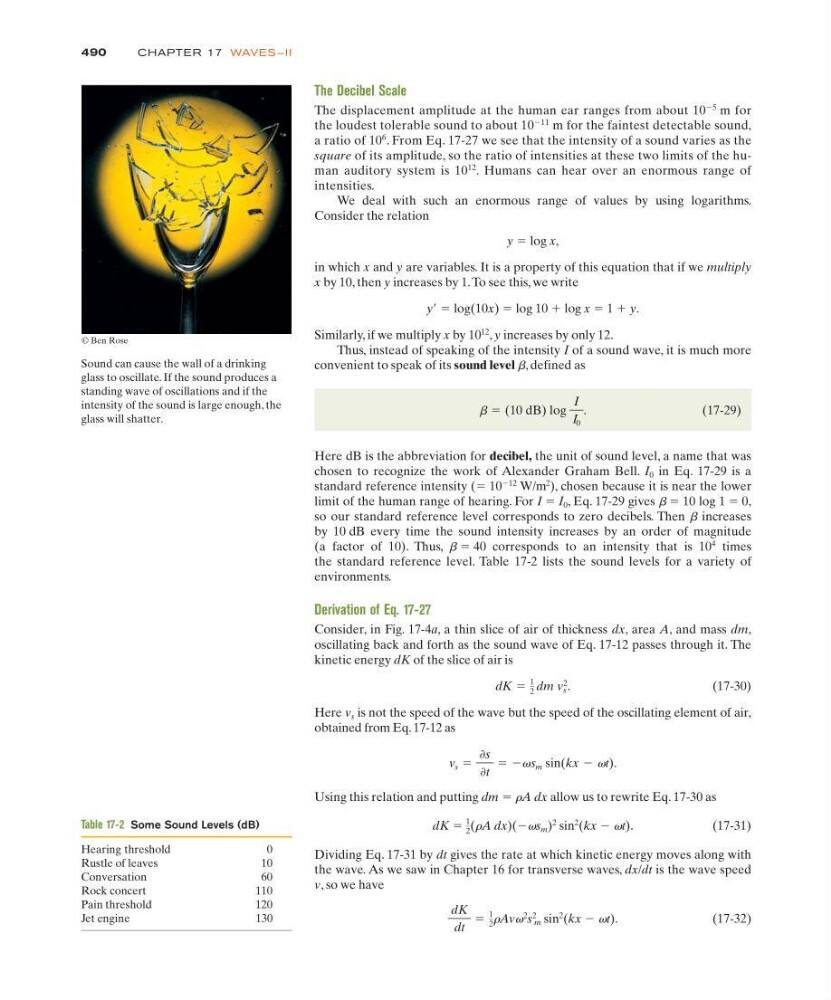
Sound can cause the wall of a drinking
glass to oscillate. If the sound produces a
standing wave of oscillations and if the
intensity of the sound is large enough, the
glass will shatter.
© Ben Rose
Table 17-2 Some Sound Levels (dB)
Hearing threshold
0
Rustle of leaves
10
Conversation
60
Rock concert
110
Pain threshold
120
Jet engine
130
CHAPTE R 17 WAVES—I I
The Decibel Scale
The displacement amplitude at the human ear ranges from about 10
Ϫ5
m for
the loudest tolerable sound to about 10
Ϫ11
m for the faintest detectable sound,
a ratio of 10
6
. From Eq. 17-27 we see that the intensity of a sound varies as the
square of its amplitude, so the ratio of intensities at these two limits of the human auditory system is 10
12
. Humans can hear over an enormous range of
intensities.
We deal with such an enormous range of values by using logarithms.
Consider the relation
y ϭ log x,
in which x and y are variables. It is a property of this equation that if we multiply
x by 10, then y increases by 1. To see this, we write
yЈ ϭ log(10x) ϭ log 10 ϩ log x ϭ 1 ϩ y.
Similarly, if we multiply x by 10
12
, y increases by only 12.
Thus, instead of speaking of the intensity I of a sound wave, it is much more
convenient to speak of its sound level b, defined as
(17-29)
Here dB is the abbreviation for decibel, the unit of sound level, a name that was
chosen to recognize the work of Alexander Graham Bell. I 0 in Eq. 17-29 is a
standard reference intensity (ϭ 10
Ϫ12
W/m
2
), chosen because it is near the lower
limit of the human range of hearing. For I ϭ I 0 , Eq. 17-29 gives b ϭ 10 log 1 ϭ 0,
so our standard reference level corresponds to zero decibels. Then b increases
by 10 dB every time the sound intensity increases by an order of magnitude
(a factor of 10). Thus, b ϭ 40 corresponds to an intensity that is 10
4
times
the standard reference level. Table 17-2 lists the sound levels for a variety of
environments.
Derivation of Eq. 17-27
Consider, in Fig. 17-4a, a thin slice of air of thickness dx, area A, and mass dm,
oscillating back and forth as the sound wave of Eq. 17-12 passes through it. The
kinetic energy dK of the slice of air is
(17-30)
Here v s is not the speed of the wave but the speed of the oscillating element of air,
obtained from Eq. 17-12 as
Using this relation and putting dm ϭ rA dx allow us to rewrite Eq. 17-30 as
dK ϭ (rA dx)(Ϫvs m )
2
sin
2
(kx Ϫ vt).
(17-31)
Dividing Eq. 17-31 by dt gives the rate at which kinetic energy moves along with
the wave. As we saw in Chapter 16 for transverse waves, dx/dt is the wave speed
v, so we have
rAvv
2
s
2
m sin
2
(kx Ϫ vt).
(17-32)
dK
dt
ϭ
1
2
1
2
v s ϭ
Ѩs
Ѩt
ϭ Ϫvs m sin(kx Ϫ vt).
dK ϭ
1
2 dm v
2
s .
b ϭ (10 dB) log
I
I 0
.
Sound can cause the wall of a drinking
glass to oscillate. If the sound produces a
standing wave of oscillations and if the
intensity of the sound is large enough, the
glass will shatter.
© Ben Rose
Table 17-2 Some Sound Levels (dB)
Hearing threshold
0
Rustle of leaves
10
Conversation
60
Rock concert
110
Pain threshold
120
Jet engine
130