

491
17-4 INTENSITY AND SOUND LEVEL
The average rate at which kinetic energy is transported is
(17-33)
To obtain this equation, we have used the fact that the average value of the
square of a sine (or a cosine) function over one full oscillation is .
We assume that potential energy is carried along with the wave at this
same average rate. The wave intensity I, which is the average rate per unit area
at which energy of both kinds is transmitted by the wave, is then, from
Eq. 17-33,
which is Eq. 17-27, the equation we set out to derive.
I ϭ
2(dK/dt) avg
A
ϭ
1
2 rvv
2
s
2
m ,
1
2
ϭ
1
4 rAvv
2
s
2
m .
dK
dt avg
ϭ
1
2 rAvv
2
s
2
m [sin
2
(kx Ϫ vt)] avg
Calculations: Putting these ideas together and noting that the
area of the cylindrical surface is A ϭ 2prL,we have
.
( 1 7 - 3 4 )
This tells us that the intensity of the sound from a line
source decreases with distance r (and not with the square of
distance r as for a point source). Substituting the given data,
we find
(Answer)
(b) At what time rate P d is sound energy intercepted by an
acoustic detector of area A d ϭ 2.0 cm
2
, aimed at the spark
and located a distance r ϭ 12 m from the spark?
Calculations: We know that the intensity of sound at the
detector is the ratio of the energy transfer rate P d there to
the detector’s area A d :
(17-35)
We can imagine that the detector lies on the cylindrical
surface of (a). Then the sound intensity at the detector is the
intensity I (ϭ 21.2 W/m
2
) at the cylindrical surface. Solving
Eq. 17-35 for P d gives us
P d ϭ (21.2 W/m
2
)(2.0 ϫ 10
Ϫ4
m
2
) ϭ 4.2 mW. (Answer)
I ϭ
P d
A d
.
ϭ 21.2 W/m
2
Ϸ 21 W/m
2
.
I ϭ
1.6 ϫ 10
4
W
2p(12 m)(10 m)
I ϭ
P
A
ϭ
P s
2prL
Sample Problem 17.03 Intensity change with distance, cylindrical sound wave
An electric spark jumps along a straight line of length
L ϭ 10 m, emitting a pulse of sound that travels radially
outward from the spark. (The spark is said to be a line
source of sound.) The power of this acoustic emission is
P s ϭ 1.6 ϫ 10
4
W.
(a) What is the intensity I of the sound when it reaches a distance r ϭ 12 m from the spark?
KEY IDEAS
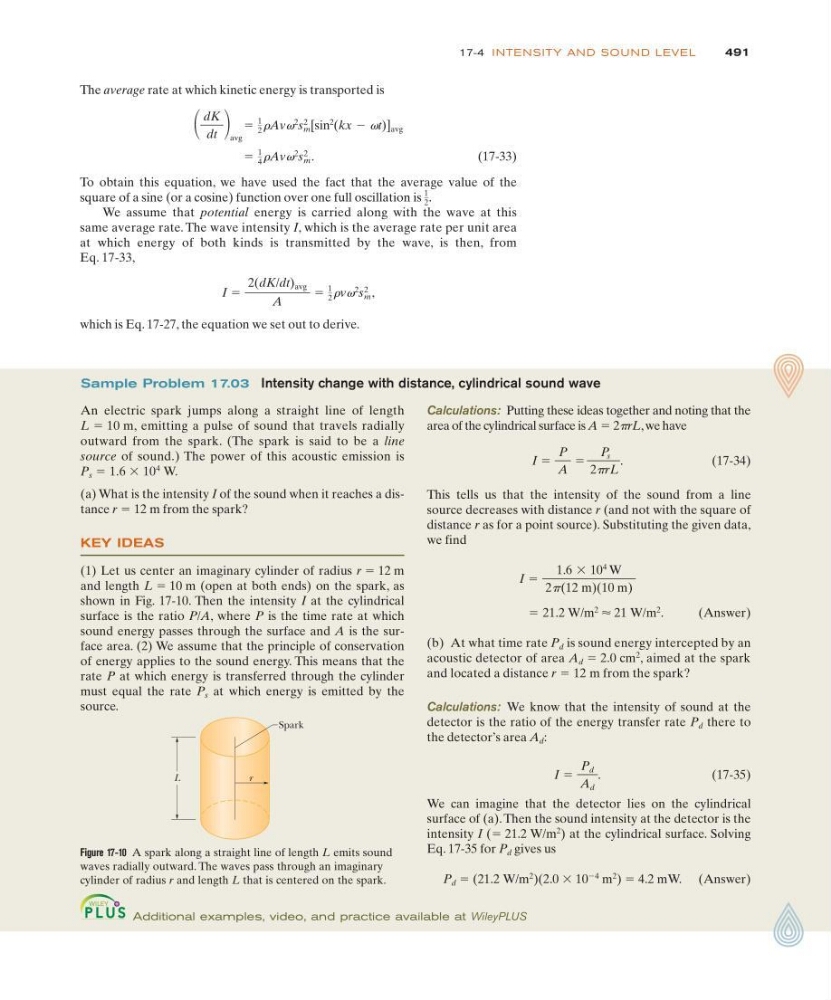
(1) Let us center an imaginary cylinder of radius r ϭ 12 m
and length L ϭ 10 m (open at both ends) on the spark, as
shown in Fig. 17-10. Then the intensity I at the cylindrical
surface is the ratio P/A, where P is the time rate at which
sound energy passes through the surface and A is the surface area. (2) We assume that the principle of conservation
of energy applies to the sound energy. This means that the
rate P at which energy is transferred through the cylinder
must equal the rate P s at which energy is emitted by the
source.
Additional examples, video, and practice available at WileyPLUS
r
L
Spark
Figure 17-10 A spark along a straight line of length L emits sound
waves radially outward. The waves pass through an imaginary
cylinder of radius r and length L that is centered on the spark.
17-4 INTENSITY AND SOUND LEVEL
The average rate at which kinetic energy is transported is
(17-33)
To obtain this equation, we have used the fact that the average value of the
square of a sine (or a cosine) function over one full oscillation is .
We assume that potential energy is carried along with the wave at this
same average rate. The wave intensity I, which is the average rate per unit area
at which energy of both kinds is transmitted by the wave, is then, from
Eq. 17-33,
which is Eq. 17-27, the equation we set out to derive.
I ϭ
2(dK/dt) avg
A
ϭ
1
2 rvv
2
s
2
m ,
1
2
ϭ
1
4 rAvv
2
s
2
m .
dK
dt avg
ϭ
1
2 rAvv
2
s
2
m [sin
2
(kx Ϫ vt)] avg
Calculations: Putting these ideas together and noting that the
area of the cylindrical surface is A ϭ 2prL,we have
.
( 1 7 - 3 4 )
This tells us that the intensity of the sound from a line
source decreases with distance r (and not with the square of
distance r as for a point source). Substituting the given data,
we find
(Answer)
(b) At what time rate P d is sound energy intercepted by an
acoustic detector of area A d ϭ 2.0 cm
2
, aimed at the spark
and located a distance r ϭ 12 m from the spark?
Calculations: We know that the intensity of sound at the
detector is the ratio of the energy transfer rate P d there to
the detector’s area A d :
(17-35)
We can imagine that the detector lies on the cylindrical
surface of (a). Then the sound intensity at the detector is the
intensity I (ϭ 21.2 W/m
2
) at the cylindrical surface. Solving
Eq. 17-35 for P d gives us
P d ϭ (21.2 W/m
2
)(2.0 ϫ 10
Ϫ4
m
2
) ϭ 4.2 mW. (Answer)
I ϭ
P d
A d
.
ϭ 21.2 W/m
2
Ϸ 21 W/m
2
.
I ϭ
1.6 ϫ 10
4
W
2p(12 m)(10 m)
I ϭ
P
A
ϭ
P s
2prL
Sample Problem 17.03 Intensity change with distance, cylindrical sound wave
An electric spark jumps along a straight line of length
L ϭ 10 m, emitting a pulse of sound that travels radially
outward from the spark. (The spark is said to be a line
source of sound.) The power of this acoustic emission is
P s ϭ 1.6 ϫ 10
4
W.
(a) What is the intensity I of the sound when it reaches a distance r ϭ 12 m from the spark?
KEY IDEAS
(1) Let us center an imaginary cylinder of radius r ϭ 12 m
and length L ϭ 10 m (open at both ends) on the spark, as
shown in Fig. 17-10. Then the intensity I at the cylindrical
surface is the ratio P/A, where P is the time rate at which
sound energy passes through the surface and A is the surface area. (2) We assume that the principle of conservation
of energy applies to the sound energy. This means that the
rate P at which energy is transferred through the cylinder
must equal the rate P s at which energy is emitted by the
source.
Additional examples, video, and practice available at WileyPLUS
r
L
Spark
Figure 17-10 A spark along a straight line of length L emits sound
waves radially outward. The waves pass through an imaginary
cylinder of radius r and length L that is centered on the spark.