

489
17-4 INTENSITY AND SOUND LEVEL
S
r
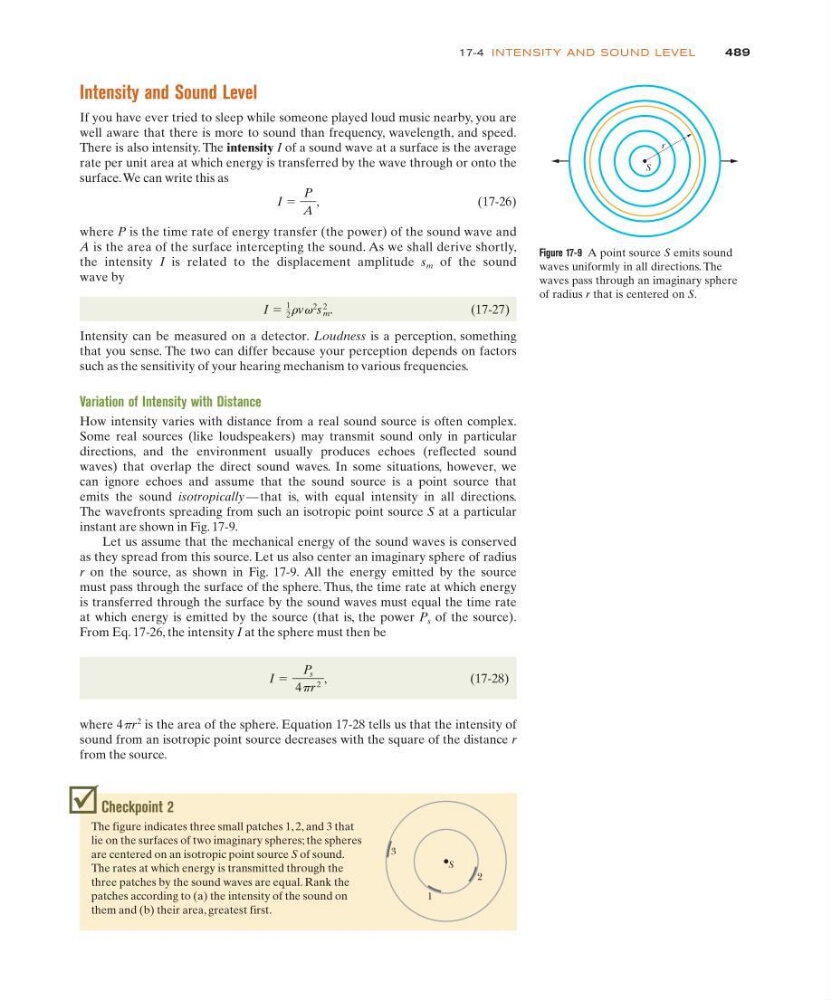
Figure 17-9 A point source S emits sound
waves uniformly in all directions. The
waves pass through an imaginary sphere
of radius r that is centered on S.
Checkpoint 2
The figure indicates three small patches 1, 2, and 3 that
lie on the surfaces of two imaginary spheres; the spheres
are centered on an isotropic point source S of sound.
The rates at which energy is transmitted through the
three patches by the sound waves are equal. Rank the
patches according to (a) the intensity of the sound on
them and (b) their area, greatest first.
S
3
1
2
Intensity and Sound Level
If you have ever tried to sleep while someone played loud music nearby, you are
well aware that there is more to sound than frequency, wavelength, and speed.
There is also intensity. The intensity I of a sound wave at a surface is the average
rate per unit area at which energy is transferred by the wave through or onto the
surface. We can write this as
,
( 1 7 - 2 6 )
where P is the time rate of energy transfer (the power) of the sound wave and
A is the area of the surface intercepting the sound. As we shall derive shortly,
the intensity I is related to the displacement amplitude s m of the sound
wave by
.
(17-27)
Intensity can be measured on a detector. Loudness is a perception, something
that you sense. The two can differ because your perception depends on factors
such as the sensitivity of your hearing mechanism to various frequencies.
Variation of Intensity with Distance
How intensity varies with distance from a real sound source is often complex.
Some real sources (like loudspeakers) may transmit sound only in particular
directions, and the environment usually produces echoes (reflected sound
waves) that overlap the direct sound waves. In some situations, however, we
can ignore echoes and assume that the sound source is a point source that
emits the sound isotropically — that is, with equal intensity in all directions.
The wavefronts spreading from such an isotropic point source S at a particular
instant are shown in Fig. 17-9.
Let us assume that the mechanical energy of the sound waves is conserved
as they spread from this source. Let us also center an imaginary sphere of radius
r on the source, as shown in Fig. 17-9. All the energy emitted by the source
must pass through the surface of the sphere. Thus, the time rate at which energy
is transferred through the surface by the sound waves must equal the time rate
at which energy is emitted by the source (that is, the power P s of the source).
From Eq. 17-26, the intensity I at the sphere must then be
,
( 1 7 - 2 8 )
where 4pr
2
is the area of the sphere. Equation 17-28 tells us that the intensity of
sound from an isotropic point source decreases with the square of the distance r
from the source.
I ϭ
P s
4pr
2
I ϭ
1
2 rvv
2
s
2
m
I ϭ
P
A
17-4 INTENSITY AND SOUND LEVEL
S
r
Figure 17-9 A point source S emits sound
waves uniformly in all directions. The
waves pass through an imaginary sphere
of radius r that is centered on S.
Checkpoint 2
The figure indicates three small patches 1, 2, and 3 that
lie on the surfaces of two imaginary spheres; the spheres
are centered on an isotropic point source S of sound.
The rates at which energy is transmitted through the
three patches by the sound waves are equal. Rank the
patches according to (a) the intensity of the sound on
them and (b) their area, greatest first.
S
3
1
2
Intensity and Sound Level
If you have ever tried to sleep while someone played loud music nearby, you are
well aware that there is more to sound than frequency, wavelength, and speed.
There is also intensity. The intensity I of a sound wave at a surface is the average
rate per unit area at which energy is transferred by the wave through or onto the
surface. We can write this as
,
( 1 7 - 2 6 )
where P is the time rate of energy transfer (the power) of the sound wave and
A is the area of the surface intercepting the sound. As we shall derive shortly,
the intensity I is related to the displacement amplitude s m of the sound
wave by
.
(17-27)
Intensity can be measured on a detector. Loudness is a perception, something
that you sense. The two can differ because your perception depends on factors
such as the sensitivity of your hearing mechanism to various frequencies.
Variation of Intensity with Distance
How intensity varies with distance from a real sound source is often complex.
Some real sources (like loudspeakers) may transmit sound only in particular
directions, and the environment usually produces echoes (reflected sound
waves) that overlap the direct sound waves. In some situations, however, we
can ignore echoes and assume that the sound source is a point source that
emits the sound isotropically — that is, with equal intensity in all directions.
The wavefronts spreading from such an isotropic point source S at a particular
instant are shown in Fig. 17-9.
Let us assume that the mechanical energy of the sound waves is conserved
as they spread from this source. Let us also center an imaginary sphere of radius
r on the source, as shown in Fig. 17-9. All the energy emitted by the source
must pass through the surface of the sphere. Thus, the time rate at which energy
is transferred through the surface by the sound waves must equal the time rate
at which energy is emitted by the source (that is, the power P s of the source).
From Eq. 17-26, the intensity I at the sphere must then be
,
( 1 7 - 2 8 )
where 4pr
2
is the area of the sphere. Equation 17-28 tells us that the intensity of
sound from an isotropic point source decreases with the square of the distance r
from the source.
I ϭ
P s
4pr
2
I ϭ
1
2 rvv
2
s
2
m
I ϭ
P
A