

488
CHAPTE R 17 WAVES—I I
17-4 INTENSITY AND SOUND LEVEL
After reading this module, you should be able to . . .
17.17 Calculate the sound intensity I at a surface as the ratio of
the power P to the surface area A.
17.18 Apply the relationship between the sound intensity I and
the displacement amplitude s m of the sound wave.
17.19 Identify an isotropic point source of sound.
17.20 For an isotropic point source, apply the relationship involving the emitting power P s , the distance r to a detector,
and the sound intensity I at the detector.
17.21 Apply the relationship between the sound level b,
the sound intensity I, and the standard reference
intensity I 0 .
17.22 Evaluate a logarithm function (log) and an antilogarithm
function (log
Ϫ1
).
17.23 Relate the change in a sound level to the change in sound
intensity.
● The intensity I of a sound wave at a surface is the average
rate per unit area at which energy is transferred by the wave
through or onto the surface:
,
where P is the time rate of energy transfer (power) of the
sound wave and A is the area of the surface intercepting
the sound. The intensity I is related to the displacement
amplitude s m of the sound wave by
I ϭ
1
2 vv
2
s
2
m .
I ϭ
P
A
● The intensity at a distance r from a point source that
emits sound waves of power P s equally in all directions
(isotropically) is
.
● The sound level b in decibels (dB) is defined as
,
where I 0 (ϭ 10
Ϫ12
W/m
2
) is a reference intensity level to
which all intensities are compared. For every factor-of-10
increase in intensity, 10 dB is added to the sound level.
b ϭ (10 dB) log
I
I 0
I ϭ
P s
4pr
2
Learning Objectives
Key Ideas
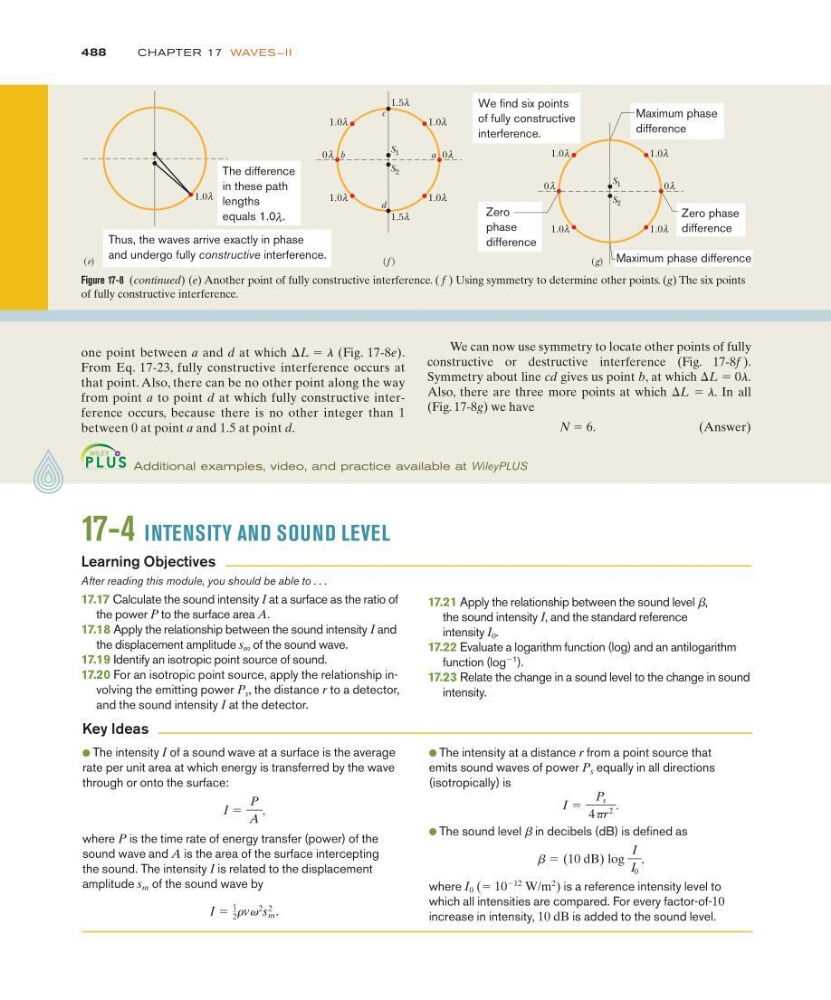
one point between a and d at which ⌬L ϭ l (Fig. 17-8e).
From Eq. 17-23, fully constructive interference occurs at
that point. Also, there can be no other point along the way
from point a to point d at which fully constructive interference occurs, because there is no other integer than 1
between 0 at point a and 1.5 at point d.
We can now use symmetry to locate other points of fully
constructive or destructive interference (Fig. 17-8f ).
Symmetry about line cd gives us point b, at which ⌬L ϭ 0l.
Also, there are three more points at which ⌬L ϭ l. In all
(Fig. 17-8g) we have
N ϭ 6.
(Answer)
Additional examples, video, and practice available at WileyPLUS
Figure 17-8 (continued) (e) Another point of fully constructive interference. ( f ) Using symmetry to determine other points. (g) The six points
of fully constructive interference.
The difference
in these path
lengths
equals 1.0 .
0
0
1.0λ
λ
λ
1.0λ
1.0λ
1.0λ
S 2
S 1
(e)
λ
0 b
a 0
1.5λ
1.5λ
1.0λ
λ
λ
1.0λ
1.0λ
1.0λ
S 2
S 1
d
c
(f )
( g)
1.0λ
Thus, the waves arrive exactly in phase
and undergo fully constructive interference.
We find six points
of fully constructive
interference.
Maximum phase
difference
Maximum phase difference
Zero phase
difference
Zero
phase
difference
CHAPTE R 17 WAVES—I I
17-4 INTENSITY AND SOUND LEVEL
After reading this module, you should be able to . . .
17.17 Calculate the sound intensity I at a surface as the ratio of
the power P to the surface area A.
17.18 Apply the relationship between the sound intensity I and
the displacement amplitude s m of the sound wave.
17.19 Identify an isotropic point source of sound.
17.20 For an isotropic point source, apply the relationship involving the emitting power P s , the distance r to a detector,
and the sound intensity I at the detector.
17.21 Apply the relationship between the sound level b,
the sound intensity I, and the standard reference
intensity I 0 .
17.22 Evaluate a logarithm function (log) and an antilogarithm
function (log
Ϫ1
).
17.23 Relate the change in a sound level to the change in sound
intensity.
● The intensity I of a sound wave at a surface is the average
rate per unit area at which energy is transferred by the wave
through or onto the surface:
,
where P is the time rate of energy transfer (power) of the
sound wave and A is the area of the surface intercepting
the sound. The intensity I is related to the displacement
amplitude s m of the sound wave by
I ϭ
1
2 vv
2
s
2
m .
I ϭ
P
A
● The intensity at a distance r from a point source that
emits sound waves of power P s equally in all directions
(isotropically) is
.
● The sound level b in decibels (dB) is defined as
,
where I 0 (ϭ 10
Ϫ12
W/m
2
) is a reference intensity level to
which all intensities are compared. For every factor-of-10
increase in intensity, 10 dB is added to the sound level.
b ϭ (10 dB) log
I
I 0
I ϭ
P s
4pr
2
Learning Objectives
Key Ideas
one point between a and d at which ⌬L ϭ l (Fig. 17-8e).
From Eq. 17-23, fully constructive interference occurs at
that point. Also, there can be no other point along the way
from point a to point d at which fully constructive interference occurs, because there is no other integer than 1
between 0 at point a and 1.5 at point d.
We can now use symmetry to locate other points of fully
constructive or destructive interference (Fig. 17-8f ).
Symmetry about line cd gives us point b, at which ⌬L ϭ 0l.
Also, there are three more points at which ⌬L ϭ l. In all
(Fig. 17-8g) we have
N ϭ 6.
(Answer)
Additional examples, video, and practice available at WileyPLUS
Figure 17-8 (continued) (e) Another point of fully constructive interference. ( f ) Using symmetry to determine other points. (g) The six points
of fully constructive interference.
The difference
in these path
lengths
equals 1.0 .
0
0
1.0λ
λ
λ
1.0λ
1.0λ
1.0λ
S 2
S 1
(e)
λ
0 b
a 0
1.5λ
1.5λ
1.0λ
λ
λ
1.0λ
1.0λ
1.0λ
S 2
S 1
d
c
(f )
( g)
1.0λ
Thus, the waves arrive exactly in phase
and undergo fully constructive interference.
We find six points
of fully constructive
interference.
Maximum phase
difference
Maximum phase difference
Zero phase
difference
Zero
phase
difference