

487
17-3 INTERFERENCE
From Eq. 17-21, this occurs when the ratio ⌬L/l is
ϭ 0.5, 1.5, 2.5, . . . (fully destructive interference).
( 1 7 - 2 5 )
For example, if the path length difference ⌬L ϭ |L 2 Ϫ L 1 | in Fig. 17-7a is equal to
2.5l, then ⌬L/l ϭ 2.5 and the waves undergo fully destructive interference at
point P (Fig. 17-7c). The interference is fully destructive because the wave from
S 2 is phase-shifted relative to the wave from S 1 by 2.5 wavelengths, which puts the
two waves exactly out of phase at P.
Of course, two waves could produce intermediate interference as, say, when
⌬L/l ϭ 1.2. This would be closer to fully constructive interference (⌬L/l ϭ 1.0)
than to fully destructive interference (⌬L/l ϭ 1.5).
⌬L
l
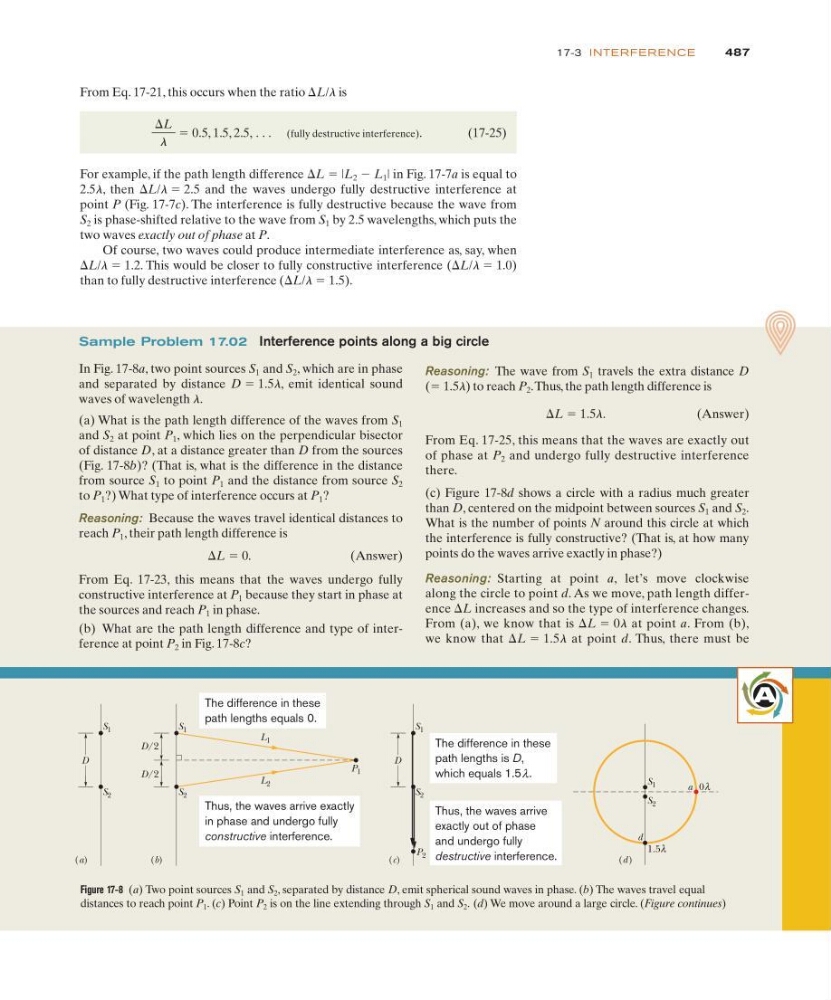
Reasoning: The wave from S 1 travels the extra distance D
(ϭ 1.5l) to reach P 2 .Thus, the path length difference is
⌬L ϭ 1.5l.
( A n s w e r )
From Eq. 17-25, this means that the waves are exactly out
of phase at P 2 and undergo fully destructive interference
there.
(c) Figure 17-8d shows a circle with a radius much greater
than D, centered on the midpoint between sources S 1 and S 2 .
What is the number of points N around this circle at which
the interference is fully constructive? (That is, at how many
points do the waves arrive exactly in phase?)
Reasoning: Starting at point a, let’s move clockwise
along the circle to point d. As we move, path length difference ⌬L increases and so the type of interference changes.
From (a), we know that is ⌬L ϭ 0l at point a. From (b),
we know that ⌬L ϭ 1.5l at point d. Thus, there must be
Sample Problem 17.02 Interference points along a big circle
In Fig. 17-8a, two point sources S 1 and S 2 , which are in phase
and separated by distance D ϭ 1.5l, emit identical sound
waves of wavelength l.
(a) What is the path length difference of the waves from S 1
and S 2 at point P 1 , which lies on the perpendicular bisector
of distance D, at a distance greater than D from the sources
(Fig. 17-8b)? (That is, what is the difference in the distance
from source S 1 to point P 1 and the distance from source S 2
to P 1 ?) What type of interference occurs at P 1 ?
Reasoning: Because the waves travel identical distances to
reach P 1 , their path length difference is
⌬L ϭ 0.
(Answer)
From Eq. 17-23, this means that the waves undergo fully
constructive interference at P 1 because they start in phase at
the sources and reach P 1 in phase.
(b) What are the path length difference and type of interference at point P 2 in Fig. 17-8c?
A
D/2
D/2
S 1
L 1
L 2
S 2
P 1
(b)
S 1
S 2
P 2
(c)
D
S 1
S 2
(a)
a 0
1.5λ
λ
S 2
S 1
d
(d )
D
The difference in these
path lengths equals 0.
The difference in these
path lengths is D,
which equals 1.5 .
Thus, the waves arrive exactly
in phase and undergo fully
constructive interference.
Thus, the waves arrive
exactly out of phase
and undergo fully
destructive interference.
λ
Figure 17-8 (a) Two point sources S 1 and S 2 , separated by distance D, emit spherical sound waves in phase. (b) The waves travel equal
distances to reach point P 1 . (c) Point P 2 is on the line extending through S 1 and S 2 . (d) We move around a large circle. (Figure continues)
17-3 INTERFERENCE
From Eq. 17-21, this occurs when the ratio ⌬L/l is
ϭ 0.5, 1.5, 2.5, . . . (fully destructive interference).
( 1 7 - 2 5 )
For example, if the path length difference ⌬L ϭ |L 2 Ϫ L 1 | in Fig. 17-7a is equal to
2.5l, then ⌬L/l ϭ 2.5 and the waves undergo fully destructive interference at
point P (Fig. 17-7c). The interference is fully destructive because the wave from
S 2 is phase-shifted relative to the wave from S 1 by 2.5 wavelengths, which puts the
two waves exactly out of phase at P.
Of course, two waves could produce intermediate interference as, say, when
⌬L/l ϭ 1.2. This would be closer to fully constructive interference (⌬L/l ϭ 1.0)
than to fully destructive interference (⌬L/l ϭ 1.5).
⌬L
l
Reasoning: The wave from S 1 travels the extra distance D
(ϭ 1.5l) to reach P 2 .Thus, the path length difference is
⌬L ϭ 1.5l.
( A n s w e r )
From Eq. 17-25, this means that the waves are exactly out
of phase at P 2 and undergo fully destructive interference
there.
(c) Figure 17-8d shows a circle with a radius much greater
than D, centered on the midpoint between sources S 1 and S 2 .
What is the number of points N around this circle at which
the interference is fully constructive? (That is, at how many
points do the waves arrive exactly in phase?)
Reasoning: Starting at point a, let’s move clockwise
along the circle to point d. As we move, path length difference ⌬L increases and so the type of interference changes.
From (a), we know that is ⌬L ϭ 0l at point a. From (b),
we know that ⌬L ϭ 1.5l at point d. Thus, there must be
Sample Problem 17.02 Interference points along a big circle
In Fig. 17-8a, two point sources S 1 and S 2 , which are in phase
and separated by distance D ϭ 1.5l, emit identical sound
waves of wavelength l.
(a) What is the path length difference of the waves from S 1
and S 2 at point P 1 , which lies on the perpendicular bisector
of distance D, at a distance greater than D from the sources
(Fig. 17-8b)? (That is, what is the difference in the distance
from source S 1 to point P 1 and the distance from source S 2
to P 1 ?) What type of interference occurs at P 1 ?
Reasoning: Because the waves travel identical distances to
reach P 1 , their path length difference is
⌬L ϭ 0.
(Answer)
From Eq. 17-23, this means that the waves undergo fully
constructive interference at P 1 because they start in phase at
the sources and reach P 1 in phase.
(b) What are the path length difference and type of interference at point P 2 in Fig. 17-8c?
A
D/2
D/2
S 1
L 1
L 2
S 2
P 1
(b)
S 1
S 2
P 2
(c)
D
S 1
S 2
(a)
a 0
1.5λ
λ
S 2
S 1
d
(d )
D
The difference in these
path lengths equals 0.
The difference in these
path lengths is D,
which equals 1.5 .
Thus, the waves arrive exactly
in phase and undergo fully
constructive interference.
Thus, the waves arrive
exactly out of phase
and undergo fully
destructive interference.
λ
Figure 17-8 (a) Two point sources S 1 and S 2 , separated by distance D, emit spherical sound waves in phase. (b) The waves travel equal
distances to reach point P 1 . (c) Point P 2 is on the line extending through S 1 and S 2 . (d) We move around a large circle. (Figure continues)