

458
CHAPTE R 16 WAVES—I
The Principle of Superposition for Waves
It often happens that two or more waves pass simultaneously through the same
region. When we listen to a concert, for example, sound waves from many instruments fall simultaneously on our eardrums. The electrons in the antennas of our
radio and television receivers are set in motion by the net effect of many electromagnetic waves from many different broadcasting centers. The water of a lake or
harbor may be churned up by waves in the wakes of many boats.
Suppose that two waves travel simultaneously along the same stretched
string. Let y 1 (x, t) and y 2 (x, t) be the displacements that the string would
experience if each wave traveled alone. The displacement of the string when the
waves overlap is then the algebraic sum
yЈ(x, t) ϭ y 1 (x, t) ϩ y 2 (x, t).
(16-46)
This summation of displacements along the string means that
This is another example of the principle of superposition, which says that when
several effects occur simultaneously, their net effect is the sum of the individual
effects. (We should be thankful that only a simple sum is needed. If two effects
somehow amplified each other, the resulting nonlinear world would be very difficult to manage and understand.)
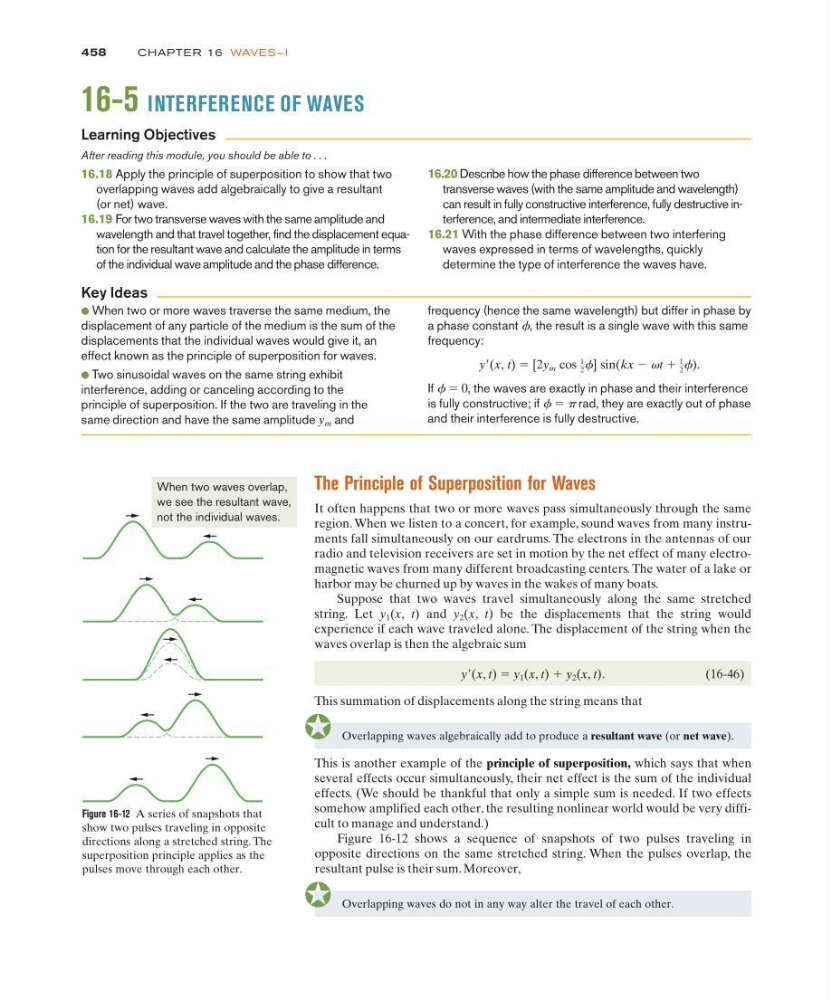
Figure 16-12 shows a sequence of snapshots of two pulses traveling in
opposite directions on the same stretched string. When the pulses overlap, the
resultant pulse is their sum. Moreover,
Overlapping waves algebraically add to produce a resultant wave (or net wave).
Overlapping waves do not in any way alter the travel of each other.
Figure 16-12 A series of snapshots that
show two pulses traveling in opposite
directions along a stretched string. The
superposition principle applies as the
pulses move through each other.
When two waves overlap,
we see the resultant wave,
not the individual waves.
● When two or more waves traverse the same medium, the
displacement of any particle of the medium is the sum of the
displacements that the individual waves would give it, an
effect known as the principle of superposition for waves.
● Two sinusoidal waves on the same string exhibit
interference, adding or canceling according to the
principle of superposition. If the two are traveling in the
same direction and have the same amplitude y m and
frequency (hence the same wavelength) but differ in phase by
a phase constant f, the result is a single wave with this same
frequency:
yЈ(x, t) ϭ [2y m cos f] sin(kx Ϫ vt ϩ f).
If f ϭ 0, the waves are exactly in phase and their interference
is fully constructive; if f ϭ p rad, they are exactly out of phase
and their interference is fully destructive.
1
2
1
2
Key Ideas
16-5 INTERFERENCE OF WAVES
After reading this module, you should be able to . . .
16.18 Apply the principle of superposition to show that two
overlapping waves add algebraically to give a resultant
(or net) wave.
16.19 For two transverse waves with the same amplitude and
wavelength and that travel together, find the displacement equation for the resultant wave and calculate the amplitude in terms
of the individual wave amplitude and the phase difference.
16.20 Describe how the phase difference between two
transverse waves (with the same amplitude and wavelength)
can result in fully constructive interference, fully destructive interference, and intermediate interference.
16.21 With the phase difference between two interfering
waves expressed in terms of wavelengths, quickly
determine the type of interference the waves have.
Learning Objectives
CHAPTE R 16 WAVES—I
The Principle of Superposition for Waves
It often happens that two or more waves pass simultaneously through the same
region. When we listen to a concert, for example, sound waves from many instruments fall simultaneously on our eardrums. The electrons in the antennas of our
radio and television receivers are set in motion by the net effect of many electromagnetic waves from many different broadcasting centers. The water of a lake or
harbor may be churned up by waves in the wakes of many boats.
Suppose that two waves travel simultaneously along the same stretched
string. Let y 1 (x, t) and y 2 (x, t) be the displacements that the string would
experience if each wave traveled alone. The displacement of the string when the
waves overlap is then the algebraic sum
yЈ(x, t) ϭ y 1 (x, t) ϩ y 2 (x, t).
(16-46)
This summation of displacements along the string means that
This is another example of the principle of superposition, which says that when
several effects occur simultaneously, their net effect is the sum of the individual
effects. (We should be thankful that only a simple sum is needed. If two effects
somehow amplified each other, the resulting nonlinear world would be very difficult to manage and understand.)
Figure 16-12 shows a sequence of snapshots of two pulses traveling in
opposite directions on the same stretched string. When the pulses overlap, the
resultant pulse is their sum. Moreover,
Overlapping waves algebraically add to produce a resultant wave (or net wave).
Overlapping waves do not in any way alter the travel of each other.
Figure 16-12 A series of snapshots that
show two pulses traveling in opposite
directions along a stretched string. The
superposition principle applies as the
pulses move through each other.
When two waves overlap,
we see the resultant wave,
not the individual waves.
● When two or more waves traverse the same medium, the
displacement of any particle of the medium is the sum of the
displacements that the individual waves would give it, an
effect known as the principle of superposition for waves.
● Two sinusoidal waves on the same string exhibit
interference, adding or canceling according to the
principle of superposition. If the two are traveling in the
same direction and have the same amplitude y m and
frequency (hence the same wavelength) but differ in phase by
a phase constant f, the result is a single wave with this same
frequency:
yЈ(x, t) ϭ [2y m cos f] sin(kx Ϫ vt ϩ f).
If f ϭ 0, the waves are exactly in phase and their interference
is fully constructive; if f ϭ p rad, they are exactly out of phase
and their interference is fully destructive.
1
2
1
2
Key Ideas
16-5 INTERFERENCE OF WAVES
After reading this module, you should be able to . . .
16.18 Apply the principle of superposition to show that two
overlapping waves add algebraically to give a resultant
(or net) wave.
16.19 For two transverse waves with the same amplitude and
wavelength and that travel together, find the displacement equation for the resultant wave and calculate the amplitude in terms
of the individual wave amplitude and the phase difference.
16.20 Describe how the phase difference between two
transverse waves (with the same amplitude and wavelength)
can result in fully constructive interference, fully destructive interference, and intermediate interference.
16.21 With the phase difference between two interfering
waves expressed in terms of wavelengths, quickly
determine the type of interference the waves have.
Learning Objectives