

459
16-5 INTERFERENCE OF WAVES
Interference of Waves
Suppose we send two sinusoidal waves of the same wavelength and amplitude in
the same direction along a stretched string. The superposition principle applies.
What resultant wave does it predict for the string?
The resultant wave depends on the extent to which the waves are in phase
(in step) with respect to each other — that is, how much one wave form is
shifted from the other wave form. If the waves are exactly in phase (so that the
peaks and valleys of one are exactly aligned with those of the other), they combine to double the displacement of either wave acting alone. If they are exactly
out of phase (the peaks of one are exactly aligned with the valleys of the other),
they combine to cancel everywhere, and the string remains straight. We call this
phenomenon of combining waves interference, and the waves are said to
interfere. (These terms refer only to the wave displacements; the travel of the
waves is unaffected.)
Let one wave traveling along a stretched string be given by
y 1 (x, t) ϭ y m sin(kx Ϫ vt)
( 1 6 - 4 7 )
and another, shifted from the first, by
y 2 (x, t) ϭ y m sin(kx Ϫ vt ϩ f).
(16-48)
These waves have the same angular frequency v (and thus the same frequency
f ), the same angular wave number k (and thus the same wavelength l), and the
same amplitude y m . They both travel in the positive direction of the x axis, with
the same speed, given by Eq. 16-26. They differ only by a constant angle f, the
phase constant. These waves are said to be out of phase by f or to have a phase
difference of f, or one wave is said to be phase-shifted from the other by f.
From the principle of superposition (Eq. 16-46), the resultant wave is the
algebraic sum of the two interfering waves and has displacement
yЈ(x, t) ϭ y 1 (x, t) ϩ y 2 (x, t)
ϭ y m sin(kx Ϫ vt) ϩ y m sin(kx Ϫ vt ϩ f).
(16-49)
In Appendix E we see that we can write the sum of the sines of two angles a and b as
sin a ϩ sin b ϭ 2 sin (a ϩ b) cos (a Ϫ b).
(16-50)
Applying this relation to Eq. 16-49 leads to
yЈ(x, t) ϭ [2y m cos f] sin(kx Ϫ vt ϩ f).
(16-51)
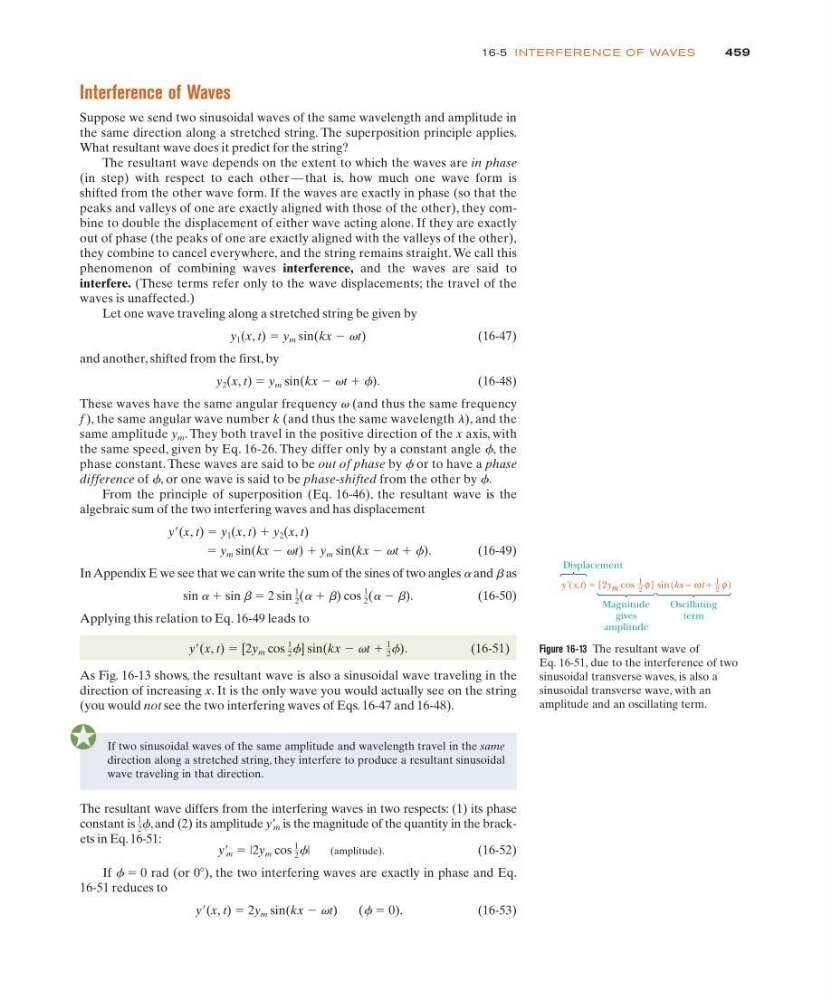
As Fig. 16-13 shows, the resultant wave is also a sinusoidal wave traveling in the
direction of increasing x. It is the only wave you would actually see on the string
(you would not see the two interfering waves of Eqs. 16-47 and 16-48).
1
2
1
2
1
2
1
2
If two sinusoidal waves of the same amplitude and wavelength travel in the same
direction along a stretched string, they interfere to produce a resultant sinusoidal
wave traveling in that direction.
Figure 16-13 The resultant wave of
Eq. 16-51, due to the interference of two
sinusoidal transverse waves, is also a
sinusoidal transverse wave, with an
amplitude and an oscillating term.
Displacement
Magnitude
gives
amplitude
y'(x,t) = [2y m cos
] sin(kx – t +
)
φ
ω
φ
Oscillating
term
1
__
2
1
__
2
The resultant wave differs from the interfering waves in two respects: (1) its phase
constant is f, and (2) its amplitude yЈ m is the magnitude of the quantity in the brackets in Eq. 16-51:
yЈ m ϭ |2y m cos f|
(amplitude).
(16-52)
If f ϭ 0 rad (or 0Њ), the two interfering waves are exactly in phase and Eq.
16-51 reduces to
yЈ(x, t) ϭ 2y m sin(kx Ϫ vt)
(f ϭ 0).
(16-53)
1
2
1
2
16-5 INTERFERENCE OF WAVES
Interference of Waves
Suppose we send two sinusoidal waves of the same wavelength and amplitude in
the same direction along a stretched string. The superposition principle applies.
What resultant wave does it predict for the string?
The resultant wave depends on the extent to which the waves are in phase
(in step) with respect to each other — that is, how much one wave form is
shifted from the other wave form. If the waves are exactly in phase (so that the
peaks and valleys of one are exactly aligned with those of the other), they combine to double the displacement of either wave acting alone. If they are exactly
out of phase (the peaks of one are exactly aligned with the valleys of the other),
they combine to cancel everywhere, and the string remains straight. We call this
phenomenon of combining waves interference, and the waves are said to
interfere. (These terms refer only to the wave displacements; the travel of the
waves is unaffected.)
Let one wave traveling along a stretched string be given by
y 1 (x, t) ϭ y m sin(kx Ϫ vt)
( 1 6 - 4 7 )
and another, shifted from the first, by
y 2 (x, t) ϭ y m sin(kx Ϫ vt ϩ f).
(16-48)
These waves have the same angular frequency v (and thus the same frequency
f ), the same angular wave number k (and thus the same wavelength l), and the
same amplitude y m . They both travel in the positive direction of the x axis, with
the same speed, given by Eq. 16-26. They differ only by a constant angle f, the
phase constant. These waves are said to be out of phase by f or to have a phase
difference of f, or one wave is said to be phase-shifted from the other by f.
From the principle of superposition (Eq. 16-46), the resultant wave is the
algebraic sum of the two interfering waves and has displacement
yЈ(x, t) ϭ y 1 (x, t) ϩ y 2 (x, t)
ϭ y m sin(kx Ϫ vt) ϩ y m sin(kx Ϫ vt ϩ f).
(16-49)
In Appendix E we see that we can write the sum of the sines of two angles a and b as
sin a ϩ sin b ϭ 2 sin (a ϩ b) cos (a Ϫ b).
(16-50)
Applying this relation to Eq. 16-49 leads to
yЈ(x, t) ϭ [2y m cos f] sin(kx Ϫ vt ϩ f).
(16-51)
As Fig. 16-13 shows, the resultant wave is also a sinusoidal wave traveling in the
direction of increasing x. It is the only wave you would actually see on the string
(you would not see the two interfering waves of Eqs. 16-47 and 16-48).
1
2
1
2
1
2
1
2
If two sinusoidal waves of the same amplitude and wavelength travel in the same
direction along a stretched string, they interfere to produce a resultant sinusoidal
wave traveling in that direction.
Figure 16-13 The resultant wave of
Eq. 16-51, due to the interference of two
sinusoidal transverse waves, is also a
sinusoidal transverse wave, with an
amplitude and an oscillating term.
Displacement
Magnitude
gives
amplitude
y'(x,t) = [2y m cos
] sin(kx – t +
)
φ
ω
φ
Oscillating
term
1
__
2
1
__
2
The resultant wave differs from the interfering waves in two respects: (1) its phase
constant is f, and (2) its amplitude yЈ m is the magnitude of the quantity in the brackets in Eq. 16-51:
yЈ m ϭ |2y m cos f|
(amplitude).
(16-52)
If f ϭ 0 rad (or 0Њ), the two interfering waves are exactly in phase and Eq.
16-51 reduces to
yЈ(x, t) ϭ 2y m sin(kx Ϫ vt)
(f ϭ 0).
(16-53)
1
2
1
2