

322
CHAPTE R 11 ROLLI NG, TORQU E, AN D ANG U L AR M OM E NTU M
position vector
.What
are (a) the torque on the particle about
the origin, in unit-vector notation, and (b)
the angle between the directions of
and ?
Module 11-5 Angular Momentum
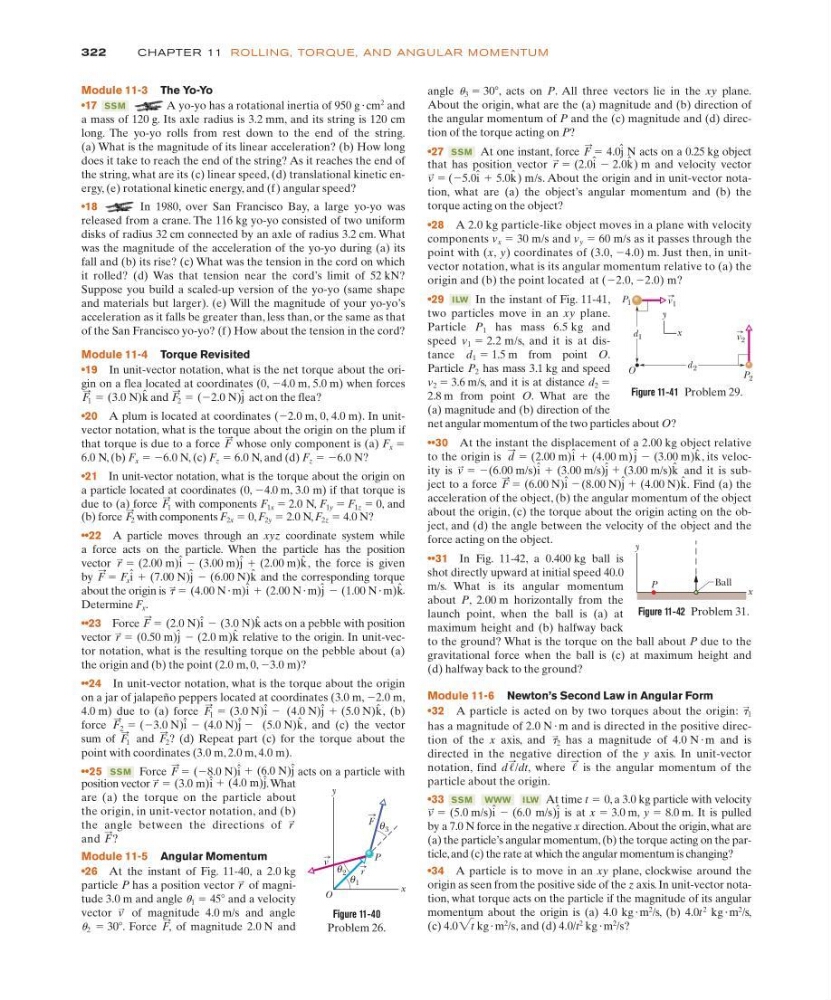
•26 At the instant of Fig. 11-40, a 2.0 kg
particle P has a position vector of magnitude 3.0 m and angle u 1 ϭ 45Њ and a velocity
vector
of magnitude 4.0 m/s and angle
u 2 ϭ 30Њ. Force
of magnitude 2.0 N and
F
:
,
v
:
r
:
F
:
r
:
r
: ϭ (3.0 m)i ˆ ϩ (4.0 m)j ˆ
(b) force with components F 2x ϭ 0, F 2y ϭ 2.0 N, F 2z ϭ 4.0 N?
••22 A particle moves through an xyz coordinate system while
a force acts on the particle. When the particle has the position
vector
the force is given
by
and the corresponding torque
about the origin is
Determine F x .
••23 Force
acts on a pebble with position
vector
relative to the origin. In unit-vector notation, what is the resulting torque on the pebble about (a)
the origin and (b) the point (2.0 m, 0, Ϫ3.0 m)?
••24 In unit-vector notation, what is the torque about the origin
on a jar of jalapeño peppers located at coordinates (3.0 m, Ϫ2.0 m,
4.0 m) due to (a) force
(b)
force
and (c) the vector
sum of
and ? (d) Repeat part (c) for the torque about the
point with coordinates (3.0 m, 2.0 m, 4.0 m).
••25
Force
acts on a particle with
F
: ϭ (Ϫ8.0 N)i ˆ ϩ (6.0 N)j ˆ
SSM
F
:
2
F
:
1
(5.0 N)k ˆ ,
F
:
2 ϭ (Ϫ3.0 N)i ˆ Ϫ (4.0 N)j ˆ Ϫ
(4.0 N)j ˆ ϩ (5.0 N)k ˆ ,
F
:
1 ϭ (3.0 N)i ˆ Ϫ
r
: ϭ (0.50 m)j ˆ Ϫ (2.0 m)k ˆ
F
: ϭ (2.0 N)i ˆ Ϫ (3.0 N)k ˆ
(2.00 Nиm)j ˆ Ϫ (1.00 Nиm)k ˆ .
t
: ϭ (4.00 Nиm)i ˆ ϩ
F
: ϭ F x i ˆ ϩ (7.00 N)j ˆ Ϫ (6.00 N)k ˆ
r
: ϭ (2.00 m)i ˆ Ϫ (3.00 m)j ˆ ϩ (2.00 m)k ˆ ,
F
:
2
Module 11-3 The Yo-Yo
•17
A yo-yo has a rotational inertia of 950 g иcm
2
and
a mass of 120 g. Its axle radius is 3.2 mm, and its string is 120 cm
long. The yo-yo rolls from rest down to the end of the string.
(a) What is the magnitude of its linear acceleration? (b) How long
does it take to reach the end of the string? As it reaches the end of
the string, what are its (c) linear speed, (d) translational kinetic energy, (e) rotational kinetic energy, and (f) angular speed?
•18
In 1980, over San Francisco Bay, a large yo-yo was
released from a crane. The 116 kg yo-yo consisted of two uniform
disks of radius 32 cm connected by an axle of radius 3.2 cm. What
was the magnitude of the acceleration of the yo-yo during (a) its
fall and (b) its rise? (c) What was the tension in the cord on which
it rolled? (d) Was that tension near the cord’s limit of 52 kN?
Suppose you build a scaled-up version of the yo-yo (same shape
and materials but larger). (e) Will the magnitude of your yo-yo’s
acceleration as it falls be greater than, less than, or the same as that
of the San Francisco yo-yo? (f) How about the tension in the cord?
Module 11-4 Torque Revisited
•19 In unit-vector notation, what is the net torque about the origin on a flea located at coordinates (0, Ϫ4.0 m, 5.0 m) when forces
and
act on the flea?
•20 A plum is located at coordinates (Ϫ2.0 m, 0, 4.0 m). In unitvector notation, what is the torque about the origin on the plum if
that torque is due to a force whose only component is (a) F x ϭ
6.0 N, (b) F x ϭ Ϫ6.0 N, (c) F z ϭ 6.0 N, and (d) F z ϭ Ϫ6.0 N?
•21 In unit-vector notation, what is the torque about the origin on
a particle located at coordinates (0, Ϫ4.0 m, 3.0 m) if that torque is
due to (a) force
with components F 1x ϭ 2.0 N, F 1y ϭ F 1z ϭ 0, and
F
:
1
F
:
F
:
2 ϭ (Ϫ2.0 N)j ˆ
F
:
1 ϭ (3.0 N)k ˆ
SSM
that has position vector
and velocity vector
. About the origin and in unit-vector notation, what are (a) the object’s angular momentum and (b) the
torque acting on the object?
•28 A 2.0 kg particle-like object moves in a plane with velocity
components v x ϭ 30 m/s and v y ϭ 60 m/s as it passes through the
point with (x, y) coordinates of (3.0, Ϫ4.0) m. Just then, in unitvector notation, what is its angular momentum relative to (a) the
origin and (b) the point located at (Ϫ2.0, Ϫ2.0) m?
•29
In the instant of Fig. 11-41,
two particles move in an xy plane.
Particle P 1 has mass 6.5 kg and
speed v 1 ϭ 2.2 m/s, and it is at distance d 1 ϭ 1.5 m from point O.
Particle P 2 has mass 3.1 kg and speed
v 2 ϭ 3.6 m/s, and it is at distance d 2 ϭ
2.8 m from point O. What are the
(a) magnitude and (b) direction of the
net angular momentum of the two particles about O?
••30 At the instant the displacement of a 2.00 kg object relative
to the origin is
its velocity is
and it is subject to a force
Find (a) the
acceleration of the object, (b) the angular momentum of the object
about the origin, (c) the torque about the origin acting on the object, and (d) the angle between the velocity of the object and the
force acting on the object.
••31 In Fig. 11-42, a 0.400 kg ball is
shot directly upward at initial speed 40.0
m/s. What is its angular momentum
about P, 2.00 m horizontally from the
launch point, when the ball is (a) at
maximum height and (b) halfway back
to the ground? What is the torque on the ball about P due to the
gravitational force when the ball is (c) at maximum height and
(d) halfway back to the ground?
Module 11-6 Newton’s Second Law in Angular Form
•32 A particle is acted on by two torques about the origin:
:
1
(4.00 N)k ˆ .
(8.00 N)j ˆ ϩ
F
: ϭ (6.00 N)i ˆ Ϫ
(3.00 m/s)k ˆ
v
: ϭ Ϫ(6.00 m/s)i ˆ ϩ (3.00 m/s)j ˆ ϩ
d
: ϭ (2.00 m)i ˆ ϩ (4.00 m) j ˆ Ϫ (3.00 m)k ˆ ,
ILW
v
: ϭ (Ϫ5.0i ˆ ϩ 5.0k ˆ ) m/s
r
: ϭ (2.0i ˆ Ϫ 2.0k ˆ ) m
Figure 11-40
Problem 26.
y
x
O
1
P
F
v
r
θ
2
θ
3
θ
Figure 11-41 Problem 29.
P 2
O
d 2
d 1
v 2
v 1
P 1
y
x
Ball
P
y
x
Figure 11-42 Problem 31.
has a magnitude of 2.0 N иm and is directed in the positive direction of the x axis, and
has a magnitude of 4.0 N иm and is
directed in the negative direction of the y axis. In unit-vector
notation, find
where
is the angular momentum of the
particle about the origin.
•33
At time t 0, a 3.0 kg particle with velocity
ϭ
ILW
WWW
SSM
ᐉ
:
d ᐉ
:
/dt,
t
:
2
angle u 3 ϭ 30Њ, acts on P. All three vectors lie in the xy plane.
About the origin, what are the (a) magnitude and (b) direction of
the angular momentum of P and the (c) magnitude and (d) direction of the torque acting on P?
•27
At one instant, force
acts on a 0.25 kg object
F
: ϭ 4.0j ˆ N
SSM
is at x 3.0 m, y 8.0 m. It is pulled
by a 7.0 N force in the negative x direction.About the origin, what are
(a) the particle’s angular momentum, (b) the torque acting on the particle, and (c) the rate at which the angular momentum is changing?
•34 A particle is to move in an xy plane, clockwise around the
origin as seen from the positive side of the z axis. In unit-vector notation, what torque acts on the particle if the magnitude of its angular
momentum about the origin is (a) 4.0 kg иm
2
/s, (b) 4.0t
2
kg иm
2
/s,
(c)
and (d) 4.0/t
2
kg иm
2
/s?
4.0 2t kgиm
2
/s,
ϭ
ϭ
m/s)j ˆ
v
: ϭ (5.0 m/s)i ˆ Ϫ (6.0
CHAPTE R 11 ROLLI NG, TORQU E, AN D ANG U L AR M OM E NTU M
position vector
.What
are (a) the torque on the particle about
the origin, in unit-vector notation, and (b)
the angle between the directions of
and ?
Module 11-5 Angular Momentum
•26 At the instant of Fig. 11-40, a 2.0 kg
particle P has a position vector of magnitude 3.0 m and angle u 1 ϭ 45Њ and a velocity
vector
of magnitude 4.0 m/s and angle
u 2 ϭ 30Њ. Force
of magnitude 2.0 N and
F
:
,
v
:
r
:
F
:
r
:
r
: ϭ (3.0 m)i ˆ ϩ (4.0 m)j ˆ
(b) force with components F 2x ϭ 0, F 2y ϭ 2.0 N, F 2z ϭ 4.0 N?
••22 A particle moves through an xyz coordinate system while
a force acts on the particle. When the particle has the position
vector
the force is given
by
and the corresponding torque
about the origin is
Determine F x .
••23 Force
acts on a pebble with position
vector
relative to the origin. In unit-vector notation, what is the resulting torque on the pebble about (a)
the origin and (b) the point (2.0 m, 0, Ϫ3.0 m)?
••24 In unit-vector notation, what is the torque about the origin
on a jar of jalapeño peppers located at coordinates (3.0 m, Ϫ2.0 m,
4.0 m) due to (a) force
(b)
force
and (c) the vector
sum of
and ? (d) Repeat part (c) for the torque about the
point with coordinates (3.0 m, 2.0 m, 4.0 m).
••25
Force
acts on a particle with
F
: ϭ (Ϫ8.0 N)i ˆ ϩ (6.0 N)j ˆ
SSM
F
:
2
F
:
1
(5.0 N)k ˆ ,
F
:
2 ϭ (Ϫ3.0 N)i ˆ Ϫ (4.0 N)j ˆ Ϫ
(4.0 N)j ˆ ϩ (5.0 N)k ˆ ,
F
:
1 ϭ (3.0 N)i ˆ Ϫ
r
: ϭ (0.50 m)j ˆ Ϫ (2.0 m)k ˆ
F
: ϭ (2.0 N)i ˆ Ϫ (3.0 N)k ˆ
(2.00 Nиm)j ˆ Ϫ (1.00 Nиm)k ˆ .
t
: ϭ (4.00 Nиm)i ˆ ϩ
F
: ϭ F x i ˆ ϩ (7.00 N)j ˆ Ϫ (6.00 N)k ˆ
r
: ϭ (2.00 m)i ˆ Ϫ (3.00 m)j ˆ ϩ (2.00 m)k ˆ ,
F
:
2
Module 11-3 The Yo-Yo
•17
A yo-yo has a rotational inertia of 950 g иcm
2
and
a mass of 120 g. Its axle radius is 3.2 mm, and its string is 120 cm
long. The yo-yo rolls from rest down to the end of the string.
(a) What is the magnitude of its linear acceleration? (b) How long
does it take to reach the end of the string? As it reaches the end of
the string, what are its (c) linear speed, (d) translational kinetic energy, (e) rotational kinetic energy, and (f) angular speed?
•18
In 1980, over San Francisco Bay, a large yo-yo was
released from a crane. The 116 kg yo-yo consisted of two uniform
disks of radius 32 cm connected by an axle of radius 3.2 cm. What
was the magnitude of the acceleration of the yo-yo during (a) its
fall and (b) its rise? (c) What was the tension in the cord on which
it rolled? (d) Was that tension near the cord’s limit of 52 kN?
Suppose you build a scaled-up version of the yo-yo (same shape
and materials but larger). (e) Will the magnitude of your yo-yo’s
acceleration as it falls be greater than, less than, or the same as that
of the San Francisco yo-yo? (f) How about the tension in the cord?
Module 11-4 Torque Revisited
•19 In unit-vector notation, what is the net torque about the origin on a flea located at coordinates (0, Ϫ4.0 m, 5.0 m) when forces
and
act on the flea?
•20 A plum is located at coordinates (Ϫ2.0 m, 0, 4.0 m). In unitvector notation, what is the torque about the origin on the plum if
that torque is due to a force whose only component is (a) F x ϭ
6.0 N, (b) F x ϭ Ϫ6.0 N, (c) F z ϭ 6.0 N, and (d) F z ϭ Ϫ6.0 N?
•21 In unit-vector notation, what is the torque about the origin on
a particle located at coordinates (0, Ϫ4.0 m, 3.0 m) if that torque is
due to (a) force
with components F 1x ϭ 2.0 N, F 1y ϭ F 1z ϭ 0, and
F
:
1
F
:
F
:
2 ϭ (Ϫ2.0 N)j ˆ
F
:
1 ϭ (3.0 N)k ˆ
SSM
that has position vector
and velocity vector
. About the origin and in unit-vector notation, what are (a) the object’s angular momentum and (b) the
torque acting on the object?
•28 A 2.0 kg particle-like object moves in a plane with velocity
components v x ϭ 30 m/s and v y ϭ 60 m/s as it passes through the
point with (x, y) coordinates of (3.0, Ϫ4.0) m. Just then, in unitvector notation, what is its angular momentum relative to (a) the
origin and (b) the point located at (Ϫ2.0, Ϫ2.0) m?
•29
In the instant of Fig. 11-41,
two particles move in an xy plane.
Particle P 1 has mass 6.5 kg and
speed v 1 ϭ 2.2 m/s, and it is at distance d 1 ϭ 1.5 m from point O.
Particle P 2 has mass 3.1 kg and speed
v 2 ϭ 3.6 m/s, and it is at distance d 2 ϭ
2.8 m from point O. What are the
(a) magnitude and (b) direction of the
net angular momentum of the two particles about O?
••30 At the instant the displacement of a 2.00 kg object relative
to the origin is
its velocity is
and it is subject to a force
Find (a) the
acceleration of the object, (b) the angular momentum of the object
about the origin, (c) the torque about the origin acting on the object, and (d) the angle between the velocity of the object and the
force acting on the object.
••31 In Fig. 11-42, a 0.400 kg ball is
shot directly upward at initial speed 40.0
m/s. What is its angular momentum
about P, 2.00 m horizontally from the
launch point, when the ball is (a) at
maximum height and (b) halfway back
to the ground? What is the torque on the ball about P due to the
gravitational force when the ball is (c) at maximum height and
(d) halfway back to the ground?
Module 11-6 Newton’s Second Law in Angular Form
•32 A particle is acted on by two torques about the origin:
:
1
(4.00 N)k ˆ .
(8.00 N)j ˆ ϩ
F
: ϭ (6.00 N)i ˆ Ϫ
(3.00 m/s)k ˆ
v
: ϭ Ϫ(6.00 m/s)i ˆ ϩ (3.00 m/s)j ˆ ϩ
d
: ϭ (2.00 m)i ˆ ϩ (4.00 m) j ˆ Ϫ (3.00 m)k ˆ ,
ILW
v
: ϭ (Ϫ5.0i ˆ ϩ 5.0k ˆ ) m/s
r
: ϭ (2.0i ˆ Ϫ 2.0k ˆ ) m
Figure 11-40
Problem 26.
y
x
O
1
P
F
v
r
θ
2
θ
3
θ
Figure 11-41 Problem 29.
P 2
O
d 2
d 1
v 2
v 1
P 1
y
x
Ball
P
y
x
Figure 11-42 Problem 31.
has a magnitude of 2.0 N иm and is directed in the positive direction of the x axis, and
has a magnitude of 4.0 N иm and is
directed in the negative direction of the y axis. In unit-vector
notation, find
where
is the angular momentum of the
particle about the origin.
•33
At time t 0, a 3.0 kg particle with velocity
ϭ
ILW
WWW
SSM
ᐉ
:
d ᐉ
:
/dt,
t
:
2
angle u 3 ϭ 30Њ, acts on P. All three vectors lie in the xy plane.
About the origin, what are the (a) magnitude and (b) direction of
the angular momentum of P and the (c) magnitude and (d) direction of the torque acting on P?
•27
At one instant, force
acts on a 0.25 kg object
F
: ϭ 4.0j ˆ N
SSM
is at x 3.0 m, y 8.0 m. It is pulled
by a 7.0 N force in the negative x direction.About the origin, what are
(a) the particle’s angular momentum, (b) the torque acting on the particle, and (c) the rate at which the angular momentum is changing?
•34 A particle is to move in an xy plane, clockwise around the
origin as seen from the positive side of the z axis. In unit-vector notation, what torque acts on the particle if the magnitude of its angular
momentum about the origin is (a) 4.0 kg иm
2
/s, (b) 4.0t
2
kg иm
2
/s,
(c)
and (d) 4.0/t
2
kg иm
2
/s?
4.0 2t kgиm
2
/s,
ϭ
ϭ
m/s)j ˆ
v
: ϭ (5.0 m/s)i ˆ Ϫ (6.0