

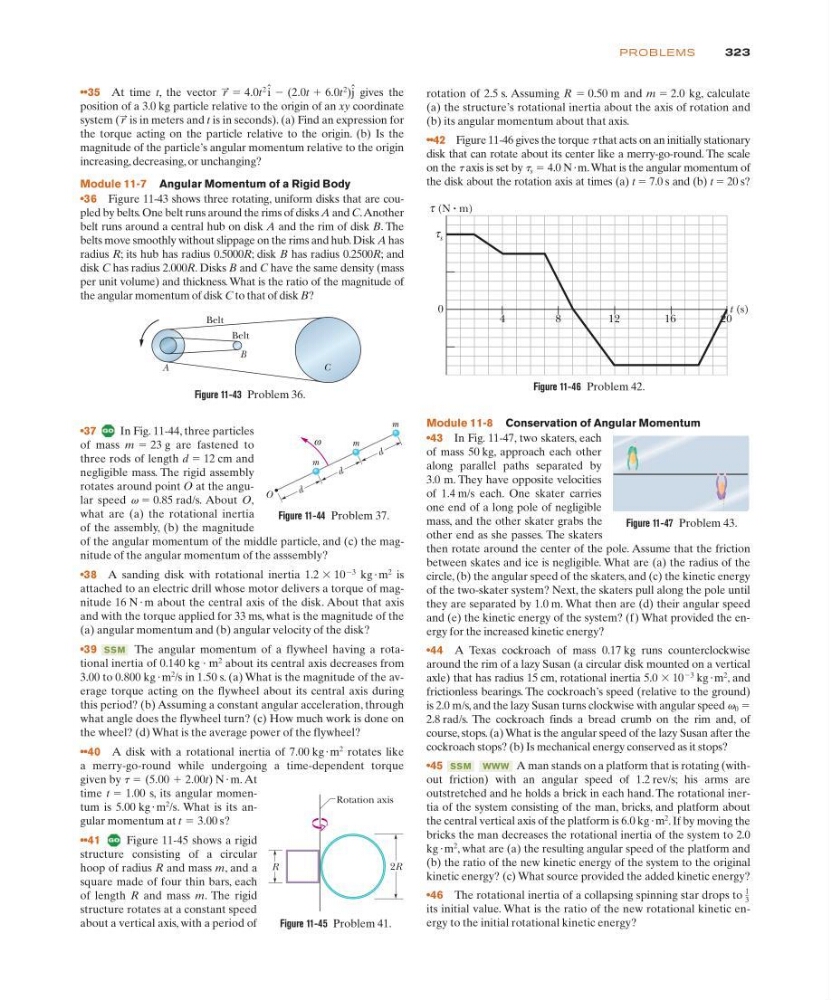
323
PROB LE M S
Module 11-8 Conservation of Angular Momentum
•43 In Fig. 11-47, two skaters, each
of mass 50 kg, approach each other
along parallel paths separated by
3.0 m. They have opposite velocities
of 1.4 m/s each. One skater carries
one end of a long pole of negligible
mass, and the other skater grabs the
other end as she passes. The skaters
then rotate around the center of the pole. Assume that the friction
between skates and ice is negligible. What are (a) the radius of the
circle, (b) the angular speed of the skaters, and (c) the kinetic energy
of the two-skater system? Next, the skaters pull along the pole until
they are separated by 1.0 m. What then are (d) their angular speed
and (e) the kinetic energy of the system? (f) What provided the energy for the increased kinetic energy?
•44 A Texas cockroach of mass 0.17 kg runs counterclockwise
around the rim of a lazy Susan (a circular disk mounted on a vertical
axle) that has radius 15 cm, rotational inertia 5.0 ϫ 10
Ϫ3
kg иm
2
, and
frictionless bearings. The cockroach’s speed (relative to the ground)
is 2.0 m/s, and the lazy Susan turns clockwise with angular speed v 0 ϭ
2.8 rad/s. The cockroach finds a bread crumb on the rim and, of
course, stops. (a) What is the angular speed of the lazy Susan after the
cockroach stops? (b) Is mechanical energy conserved as it stops?
•45
A man stands on a platform that is rotating (without friction) with an angular speed of 1.2 rev/s; his arms are
outstretched and he holds a brick in each hand. The rotational inertia of the system consisting of the man, bricks, and platform about
the central vertical axis of the platform is 6.0 kg иm
2
. If by moving the
bricks the man decreases the rotational inertia of the system to 2.0
kg иm
2
, what are (a) the resulting angular speed of the platform and
(b) the ratio of the new kinetic energy of the system to the original
kinetic energy? (c) What source provided the added kinetic energy?
•46 The rotational inertia of a collapsing spinning star drops to
its initial value. What is the ratio of the new rotational kinetic energy to the initial rotational kinetic energy?
1
3
WWW
SSM
•37
In Fig. 11-44, three particles
of mass m 23 g are fastened to
three rods of length d ϭ 12 cm and
negligible mass. The rigid assembly
rotates around point O at the angular speed v ϭ 0.85 rad/s. About O,
what are (a) the rotational inertia
of the assembly, (b) the magnitude
of the angular momentum of the middle particle, and (c) the magnitude of the angular momentum of the asssembly?
•38 A sanding disk with rotational inertia 1.2 ϫ 10
Ϫ3
kg иm
2
is
attached to an electric drill whose motor delivers a torque of magnitude 16 N иm about the central axis of the disk. About that axis
and with the torque applied for 33 ms, what is the magnitude of the
(a) angular momentum and (b) angular velocity of the disk?
•39
The angular momentum of a flywheel having a rotational inertia of 0.140 kg m
2
about its central axis decreases from
3.00 to 0.800 kg иm
2
/s in 1.50 s. (a) What is the magnitude of the average torque acting on the flywheel about its central axis during
this period? (b) Assuming a constant angular acceleration, through
what angle does the flywheel turn? (c) How much work is done on
the wheel? (d) What is the average power of the flywheel?
••40 A disk with a rotational inertia of
rotates like
a merry-go-round while undergoing a time-dependent torque
given by
. At
time
1.00 s, its angular momentum is
. What is its angular momentum at
s?
••41
Figure 11-45 shows a rigid
structure consisting of a circular
hoop of radius R and mass m, and a
square made of four thin bars, each
of length R and mass m. The rigid
structure rotates at a constant speed
about a vertical axis, with a period of
t ϭ 3.00
5.00 kgиm
2
/s
t ϭ
(5.00 ϩ 2.00t) Nиm
t ϭ
7.00 kgиm
2
и
SSM
ϭ
••35 At time t, the vector
gives the
position of a 3.0 kg particle relative to the origin of an xy coordinate
system ( is in meters and t is in seconds). (a) Find an expression for
the torque acting on the particle relative to the origin. (b) Is the
magnitude of the particle’s angular momentum relative to the origin
increasing, decreasing, or unchanging?
Module 11-7 Angular Momentum of a Rigid Body
•36 Figure 11-43 shows three rotating, uniform disks that are coupled by belts. One belt runs around the rims of disks A and C.Another
belt runs around a central hub on disk A and the rim of disk B. The
belts move smoothly without slippage on the rims and hub. Disk A has
radius R; its hub has radius 0.5000R; disk B has radius 0.2500R; and
disk C has radius 2.000R. Disks B and C have the same density (mass
per unit volume) and thickness. What is the ratio of the magnitude of
the angular momentum of disk C to that of disk B?
r
:
r
: ϭ 4.0t
2
i ˆ Ϫ (2.0t ϩ 6.0t
2
)j ˆ
rotation of 2.5 s. Assuming R ϭ 0.50 m and m ϭ 2.0 kg, calculate
(a) the structure’s rotational inertia about the axis of rotation and
(b) its angular momentum about that axis.
••42 Figure 11-46 gives the torque t that acts on an initially stationary
disk that can rotate about its center like a merry-go-round. The scale
on the t axis is set by t s ϭ 4.0 Nиm.What is the angular momentum of
the disk about the rotation axis at times (a) t ϭ 7.0 s and (b) t ϭ 20 s?
Belt
Belt
A
B
C
O
m
m
m
d
ω
d
d
Rotation axis
R
2R
Figure 11-43 Problem 36.
Figure 11-44 Problem 37.
Figure 11-45 Problem 41.
0
4
8
12
16
20
t (s)
s
τ
τ (N • m)
Figure 11-46 Problem 42.
Figure 11-47 Problem 43.
PROB LE M S
Module 11-8 Conservation of Angular Momentum
•43 In Fig. 11-47, two skaters, each
of mass 50 kg, approach each other
along parallel paths separated by
3.0 m. They have opposite velocities
of 1.4 m/s each. One skater carries
one end of a long pole of negligible
mass, and the other skater grabs the
other end as she passes. The skaters
then rotate around the center of the pole. Assume that the friction
between skates and ice is negligible. What are (a) the radius of the
circle, (b) the angular speed of the skaters, and (c) the kinetic energy
of the two-skater system? Next, the skaters pull along the pole until
they are separated by 1.0 m. What then are (d) their angular speed
and (e) the kinetic energy of the system? (f) What provided the energy for the increased kinetic energy?
•44 A Texas cockroach of mass 0.17 kg runs counterclockwise
around the rim of a lazy Susan (a circular disk mounted on a vertical
axle) that has radius 15 cm, rotational inertia 5.0 ϫ 10
Ϫ3
kg иm
2
, and
frictionless bearings. The cockroach’s speed (relative to the ground)
is 2.0 m/s, and the lazy Susan turns clockwise with angular speed v 0 ϭ
2.8 rad/s. The cockroach finds a bread crumb on the rim and, of
course, stops. (a) What is the angular speed of the lazy Susan after the
cockroach stops? (b) Is mechanical energy conserved as it stops?
•45
A man stands on a platform that is rotating (without friction) with an angular speed of 1.2 rev/s; his arms are
outstretched and he holds a brick in each hand. The rotational inertia of the system consisting of the man, bricks, and platform about
the central vertical axis of the platform is 6.0 kg иm
2
. If by moving the
bricks the man decreases the rotational inertia of the system to 2.0
kg иm
2
, what are (a) the resulting angular speed of the platform and
(b) the ratio of the new kinetic energy of the system to the original
kinetic energy? (c) What source provided the added kinetic energy?
•46 The rotational inertia of a collapsing spinning star drops to
its initial value. What is the ratio of the new rotational kinetic energy to the initial rotational kinetic energy?
1
3
WWW
SSM
•37
In Fig. 11-44, three particles
of mass m 23 g are fastened to
three rods of length d ϭ 12 cm and
negligible mass. The rigid assembly
rotates around point O at the angular speed v ϭ 0.85 rad/s. About O,
what are (a) the rotational inertia
of the assembly, (b) the magnitude
of the angular momentum of the middle particle, and (c) the magnitude of the angular momentum of the asssembly?
•38 A sanding disk with rotational inertia 1.2 ϫ 10
Ϫ3
kg иm
2
is
attached to an electric drill whose motor delivers a torque of magnitude 16 N иm about the central axis of the disk. About that axis
and with the torque applied for 33 ms, what is the magnitude of the
(a) angular momentum and (b) angular velocity of the disk?
•39
The angular momentum of a flywheel having a rotational inertia of 0.140 kg m
2
about its central axis decreases from
3.00 to 0.800 kg иm
2
/s in 1.50 s. (a) What is the magnitude of the average torque acting on the flywheel about its central axis during
this period? (b) Assuming a constant angular acceleration, through
what angle does the flywheel turn? (c) How much work is done on
the wheel? (d) What is the average power of the flywheel?
••40 A disk with a rotational inertia of
rotates like
a merry-go-round while undergoing a time-dependent torque
given by
. At
time
1.00 s, its angular momentum is
. What is its angular momentum at
s?
••41
Figure 11-45 shows a rigid
structure consisting of a circular
hoop of radius R and mass m, and a
square made of four thin bars, each
of length R and mass m. The rigid
structure rotates at a constant speed
about a vertical axis, with a period of
t ϭ 3.00
5.00 kgиm
2
/s
t ϭ
(5.00 ϩ 2.00t) Nиm
t ϭ
7.00 kgиm
2
и
SSM
ϭ
••35 At time t, the vector
gives the
position of a 3.0 kg particle relative to the origin of an xy coordinate
system ( is in meters and t is in seconds). (a) Find an expression for
the torque acting on the particle relative to the origin. (b) Is the
magnitude of the particle’s angular momentum relative to the origin
increasing, decreasing, or unchanging?
Module 11-7 Angular Momentum of a Rigid Body
•36 Figure 11-43 shows three rotating, uniform disks that are coupled by belts. One belt runs around the rims of disks A and C.Another
belt runs around a central hub on disk A and the rim of disk B. The
belts move smoothly without slippage on the rims and hub. Disk A has
radius R; its hub has radius 0.5000R; disk B has radius 0.2500R; and
disk C has radius 2.000R. Disks B and C have the same density (mass
per unit volume) and thickness. What is the ratio of the magnitude of
the angular momentum of disk C to that of disk B?
r
:
r
: ϭ 4.0t
2
i ˆ Ϫ (2.0t ϩ 6.0t
2
)j ˆ
rotation of 2.5 s. Assuming R ϭ 0.50 m and m ϭ 2.0 kg, calculate
(a) the structure’s rotational inertia about the axis of rotation and
(b) its angular momentum about that axis.
••42 Figure 11-46 gives the torque t that acts on an initially stationary
disk that can rotate about its center like a merry-go-round. The scale
on the t axis is set by t s ϭ 4.0 Nиm.What is the angular momentum of
the disk about the rotation axis at times (a) t ϭ 7.0 s and (b) t ϭ 20 s?
Belt
Belt
A
B
C
O
m
m
m
d
ω
d
d
Rotation axis
R
2R
Figure 11-43 Problem 36.
Figure 11-44 Problem 37.
Figure 11-45 Problem 41.
0
4
8
12
16
20
t (s)
s
τ
τ (N • m)
Figure 11-46 Problem 42.
Figure 11-47 Problem 43.