

321
PROB LE M S
bowling ball of radius R ϭ 11 cm
along a lane. The ball (Fig. 11-38)
slides on the lane with initial speed
v com,0 ϭ 8.5 m/s and initial angular
speed v 0 ϭ 0. The coefficient of kinetic friction between the ball and the lane is 0.21. The kinetic frictional force
acting on the ball causes a linear acceleration of the
ball while producing a torque that causes an angular acceleration
of the ball. When speed v com has decreased enough and angular
speed v has increased enough, the ball stops sliding and then rolls
smoothly. (a) What then is v com in terms of v? During the sliding,
what are the ball’s (b) linear acceleration and (c) angular acceleration? (d) How long does the ball slide? (e) How far does the ball
slide? (f) What is the linear speed of the ball when smooth rolling
begins?
•••16
Nonuniform cylindrical object. In Fig. 11-39, a cylindrical
object of mass M and radius R rolls smoothly from rest down a
ramp and onto a horizontal section. From there it rolls off the ramp
and onto the floor, landing a horizontal distance d ϭ 0.506 m from
the end of the ramp. The initial height of the object is H ϭ 0.90 m;
the end of the ramp is at height h ϭ 0.10 m. The object consists of
an outer cylindrical shell (of a certain uniform density) that is
glued to a central cylinder (of a different uniform density). The rotational inertia of the object can be expressed in the general form
I ϭ bMR
2
, but b is not 0.5 as it is for a cylinder of uniform density.
Determine b.
f
:
k
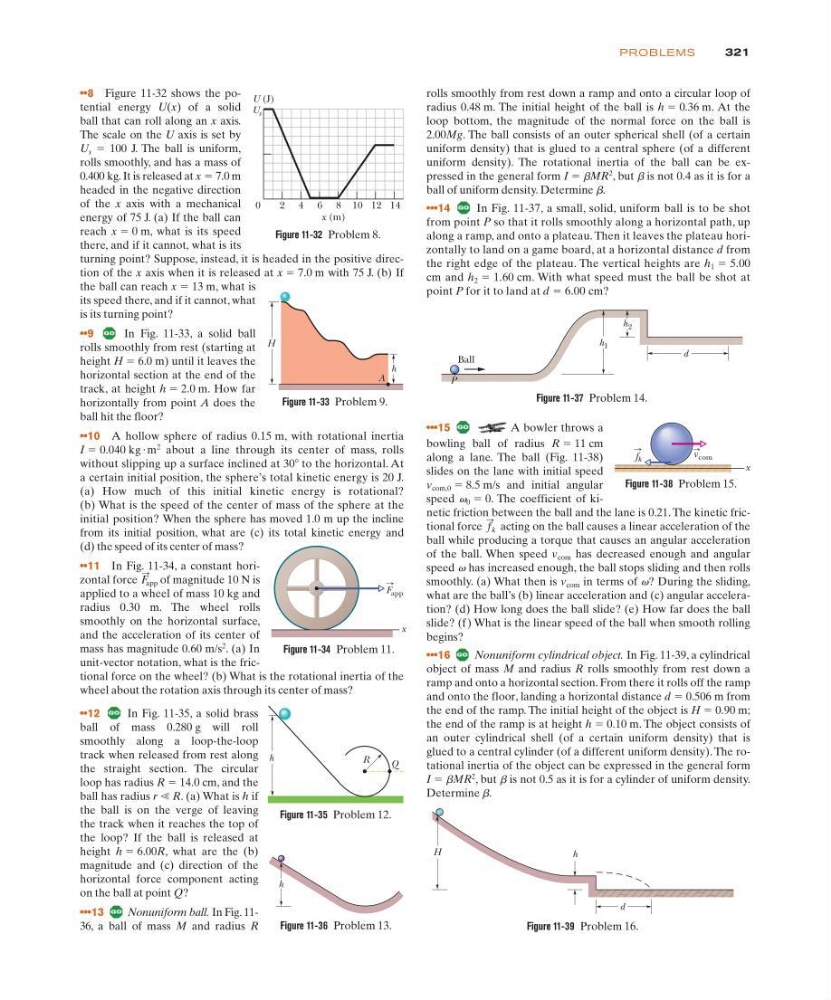
••8 Figure 11-32 shows the potential energy U(x) of a solid
ball that can roll along an x axis.
The scale on the U axis is set by
U s ϭ 100 J. The ball is uniform,
rolls smoothly, and has a mass of
0.400 kg. It is released at x ϭ 7.0 m
headed in the negative direction
of the x axis with a mechanical
energy of 75 J. (a) If the ball can
reach x ϭ 0 m, what is its speed
there, and if it cannot, what is its
turning point? Suppose, instead, it is headed in the positive direction of the x axis when it is released at x ϭ 7.0 m with 75 J. (b) If
the ball can reach x ϭ 13 m, what is
its speed there, and if it cannot, what
is its turning point?
••9
In Fig. 11-33, a solid ball
rolls smoothly from rest (starting at
height H ϭ 6.0 m) until it leaves the
horizontal section at the end of the
track, at height h ϭ 2.0 m. How far
horizontally from point A does the
ball hit the floor?
••10 A hollow sphere of radius 0.15 m, with rotational inertia
I ϭ 0.040 kg иm
2
about a line through its center of mass, rolls
without slipping up a surface inclined at 30Њ to the horizontal. At
a certain initial position, the sphere’s total kinetic energy is 20 J.
(a) How much of this initial kinetic energy is rotational?
(b) What is the speed of the center of mass of the sphere at the
initial position? When the sphere has moved 1.0 m up the incline
from its initial position, what are (c) its total kinetic energy and
(d) the speed of its center of mass?
••11 In Fig. 11-34, a constant horizontal force
of magnitude 10 N is
applied to a wheel of mass 10 kg and
radius 0.30 m. The wheel rolls
smoothly on the horizontal surface,
and the acceleration of its center of
mass has magnitude 0.60 m/s
2
. (a) In
unit-vector notation, what is the frictional force on the wheel? (b) What is the rotational inertia of the
wheel about the rotation axis through its center of mass?
F
:
app
rolls smoothly from rest down a ramp and onto a circular loop of
radius 0.48 m. The initial height of the ball is h ϭ 0.36 m. At the
loop bottom, the magnitude of the normal force on the ball is
2.00Mg. The ball consists of an outer spherical shell (of a certain
uniform density) that is glued to a central sphere (of a different
uniform density). The rotational inertia of the ball can be expressed in the general form I ϭ bMR
2
, but b is not 0.4 as it is for a
ball of uniform density. Determine b.
•••14
In Fig. 11-37, a small, solid, uniform ball is to be shot
from point P so that it rolls smoothly along a horizontal path, up
along a ramp, and onto a plateau. Then it leaves the plateau horizontally to land on a game board, at a horizontal distance d from
the right edge of the plateau. The vertical heights are h 1 ϭ 5.00
cm and h 2 ϭ 1.60 cm. With what speed must the ball be shot at
point P for it to land at d ϭ 6.00 cm?
Figure 11-32 Problem 8.
Figure 11-33 Problem 9.
H
h
A
0
2 4 6 8 10 12 14
U s
U (J)
x (m)
Figure 11-37 Problem 14.
Figure 11-36 Problem 13.
Figure 11-35 Problem 12.
h
R
Q
h
Ball
P
h 1
d
h 2
Figure 11-34 Problem 11.
F app
x
•••15
A bowler throws a
Figure 11-39 Problem 16.
H
h
d
x
f k
v com
Figure 11-38 Problem 15.
••12
In Fig. 11-35, a solid brass
ball of mass 0.280 g will roll
smoothly along a loop-the-loop
track when released from rest along
the straight section. The circular
loop has radius R ϭ 14.0 cm, and the
ball has radius r Ӷ R. (a) What is h if
the ball is on the verge of leaving
the track when it reaches the top of
the loop? If the ball is released at
height h ϭ 6.00R, what are the (b)
magnitude and (c) direction of the
horizontal force component acting
on the ball at point Q?
•••13
Nonuniform ball. In Fig. 1136, a ball of mass M and radius R
PROB LE M S
bowling ball of radius R ϭ 11 cm
along a lane. The ball (Fig. 11-38)
slides on the lane with initial speed
v com,0 ϭ 8.5 m/s and initial angular
speed v 0 ϭ 0. The coefficient of kinetic friction between the ball and the lane is 0.21. The kinetic frictional force
acting on the ball causes a linear acceleration of the
ball while producing a torque that causes an angular acceleration
of the ball. When speed v com has decreased enough and angular
speed v has increased enough, the ball stops sliding and then rolls
smoothly. (a) What then is v com in terms of v? During the sliding,
what are the ball’s (b) linear acceleration and (c) angular acceleration? (d) How long does the ball slide? (e) How far does the ball
slide? (f) What is the linear speed of the ball when smooth rolling
begins?
•••16
Nonuniform cylindrical object. In Fig. 11-39, a cylindrical
object of mass M and radius R rolls smoothly from rest down a
ramp and onto a horizontal section. From there it rolls off the ramp
and onto the floor, landing a horizontal distance d ϭ 0.506 m from
the end of the ramp. The initial height of the object is H ϭ 0.90 m;
the end of the ramp is at height h ϭ 0.10 m. The object consists of
an outer cylindrical shell (of a certain uniform density) that is
glued to a central cylinder (of a different uniform density). The rotational inertia of the object can be expressed in the general form
I ϭ bMR
2
, but b is not 0.5 as it is for a cylinder of uniform density.
Determine b.
f
:
k
••8 Figure 11-32 shows the potential energy U(x) of a solid
ball that can roll along an x axis.
The scale on the U axis is set by
U s ϭ 100 J. The ball is uniform,
rolls smoothly, and has a mass of
0.400 kg. It is released at x ϭ 7.0 m
headed in the negative direction
of the x axis with a mechanical
energy of 75 J. (a) If the ball can
reach x ϭ 0 m, what is its speed
there, and if it cannot, what is its
turning point? Suppose, instead, it is headed in the positive direction of the x axis when it is released at x ϭ 7.0 m with 75 J. (b) If
the ball can reach x ϭ 13 m, what is
its speed there, and if it cannot, what
is its turning point?
••9
In Fig. 11-33, a solid ball
rolls smoothly from rest (starting at
height H ϭ 6.0 m) until it leaves the
horizontal section at the end of the
track, at height h ϭ 2.0 m. How far
horizontally from point A does the
ball hit the floor?
••10 A hollow sphere of radius 0.15 m, with rotational inertia
I ϭ 0.040 kg иm
2
about a line through its center of mass, rolls
without slipping up a surface inclined at 30Њ to the horizontal. At
a certain initial position, the sphere’s total kinetic energy is 20 J.
(a) How much of this initial kinetic energy is rotational?
(b) What is the speed of the center of mass of the sphere at the
initial position? When the sphere has moved 1.0 m up the incline
from its initial position, what are (c) its total kinetic energy and
(d) the speed of its center of mass?
••11 In Fig. 11-34, a constant horizontal force
of magnitude 10 N is
applied to a wheel of mass 10 kg and
radius 0.30 m. The wheel rolls
smoothly on the horizontal surface,
and the acceleration of its center of
mass has magnitude 0.60 m/s
2
. (a) In
unit-vector notation, what is the frictional force on the wheel? (b) What is the rotational inertia of the
wheel about the rotation axis through its center of mass?
F
:
app
rolls smoothly from rest down a ramp and onto a circular loop of
radius 0.48 m. The initial height of the ball is h ϭ 0.36 m. At the
loop bottom, the magnitude of the normal force on the ball is
2.00Mg. The ball consists of an outer spherical shell (of a certain
uniform density) that is glued to a central sphere (of a different
uniform density). The rotational inertia of the ball can be expressed in the general form I ϭ bMR
2
, but b is not 0.4 as it is for a
ball of uniform density. Determine b.
•••14
In Fig. 11-37, a small, solid, uniform ball is to be shot
from point P so that it rolls smoothly along a horizontal path, up
along a ramp, and onto a plateau. Then it leaves the plateau horizontally to land on a game board, at a horizontal distance d from
the right edge of the plateau. The vertical heights are h 1 ϭ 5.00
cm and h 2 ϭ 1.60 cm. With what speed must the ball be shot at
point P for it to land at d ϭ 6.00 cm?
Figure 11-32 Problem 8.
Figure 11-33 Problem 9.
H
h
A
0
2 4 6 8 10 12 14
U s
U (J)
x (m)
Figure 11-37 Problem 14.
Figure 11-36 Problem 13.
Figure 11-35 Problem 12.
h
R
Q
h
Ball
P
h 1
d
h 2
Figure 11-34 Problem 11.
F app
x
•••15
A bowler throws a
Figure 11-39 Problem 16.
H
h
d
x
f k
v com
Figure 11-38 Problem 15.
••12
In Fig. 11-35, a solid brass
ball of mass 0.280 g will roll
smoothly along a loop-the-loop
track when released from rest along
the straight section. The circular
loop has radius R ϭ 14.0 cm, and the
ball has radius r Ӷ R. (a) What is h if
the ball is on the verge of leaving
the track when it reaches the top of
the loop? If the ball is released at
height h ϭ 6.00R, what are the (b)
magnitude and (c) direction of the
horizontal force component acting
on the ball at point Q?
•••13
Nonuniform ball. In Fig. 1136, a ball of mass M and radius R