

316
CHAPTE R 11 ROLLI NG, TORQU E, AN D ANG U L AR M OM E NTU M
Calculations: The conservation of
is represented with
vectors in Fig. 11-20c. We can also write this conservation in
terms of components along a vertical axis as
L b,f ϩ L wh,f ϭ L b,i ϩ L wh,i ,
( 1 1 - 3 5 )
where i and f refer to the initial state (before inversion of
the wheel) and the final state (after inversion). Because
inversion of the wheel inverted the angular momentum
vector of the wheel’s rotation, we substitute ϪL wh,i for
L wh,f . Then, if we set L b,i ϭ 0 (because the student,
the stool, and the wheel’s center were initially at rest),
Eq. 11-35 yields
L b,f ϭ 2L wh,i .
L
:
tot
The rotational inertia of a disk rotating about its central
axis is given by Table 10-2c as
. Substituting 6.00m for
the mass M, our disk here has rotational inertia
.
( 1 1 - 3 6 )
(We don’t have values for m and R, but we shall continue
with physics courage.)
From Eq. 10-33, we know that the rotational inertia of
the cockroach (a particle) is equal to mr
2
. Substituting the
cockroach’s initial radius (
) and final radius
(
),we find that its initial rotational inertia about the
rotation axis is
(11-37)
and its final rotational inertia about the rotation axis is
.
( 1 1 - 3 8 )
So, the cockroach–disk system initially has the rotational
inertia
,
( 1 1 - 3 9 )
and finally has the rotational inertia
.
( 1 1 - 4 0 )
Next, we use Eq. 11-31 (
) to write the fact that
the system’s final angular momentum L f is equal to the system’s initial angular momentum L i :
or
.
After canceling the unknowns m and R, we come to
.
( A n s w e r )
Note that v decreased because part of the mass moved outward, thus increasing that system’s rotational inertia.
v f ϭ 1.37 rad/s
4.00mR
2 v f ϭ 3.64mR
2
(1.50 rad/s)
I f v f ϭ I i v i
L ϭ Iv
I f ϭ I d ϩ I cf ϭ 4.00mR
2
I i ϭ I d ϩ I ci ϭ 3.64mR
2
I cf ϭ mR
2
I ci ϭ 0.64mR
2
r ϭ R
r ϭ 0.800R
I d ϭ 3.00mR
2
1
2 MR
2
Sample Problem 11.06 Conservation of angular momentum, cockroach on disk
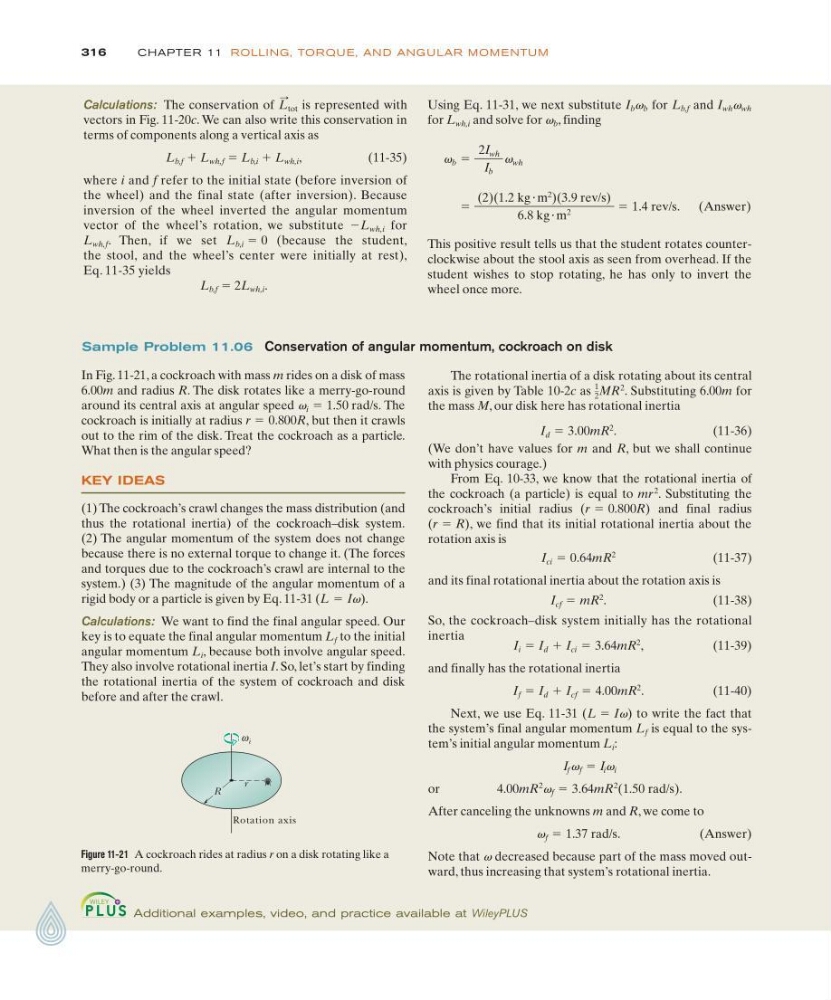
In Fig. 11-21, a cockroach with mass m rides on a disk of mass
6.00m and radius R. The disk rotates like a merry-go-round
around its central axis at angular speed
The
cockroach is initially at radius
, but then it crawls
out to the rim of the disk. Treat the cockroach as a particle.
What then is the angular speed?
KEY IDEAS
(1) The cockroach’s crawl changes the mass distribution (and
thus the rotational inertia) of the cockroach–disk system.
(2) The angular momentum of the system does not change
because there is no external torque to change it. (The forces
and torques due to the cockroach’s crawl are internal to the
system.) (3) The magnitude of the angular momentum of a
rigid body or a particle is given by Eq. 11-31 (
).
Calculations: We want to find the final angular speed. Our
key is to equate the final angular momentum L f to the initial
angular momentum L i , because both involve angular speed.
They also involve rotational inertia I. So, let’s start by finding
the rotational inertia of the system of cockroach and disk
before and after the crawl.
L ϭ Iv
r ϭ 0.800R
v i ϭ 1.50 rad/s.
Additional examples, video, and practice available at WileyPLUS
Figure 11-21 A cockroach rides at radius r on a disk rotating like a
merry-go-round.
Rotation axis
R
r
i
ω
Using Eq. 11-31, we next substitute I b v b for L b,f and I wh v wh
for L wh,i and solve for v b , finding
(Answer)
This positive result tells us that the student rotates counterclockwise about the stool axis as seen from overhead. If the
student wishes to stop rotating, he has only to invert the
wheel once more.
ϭ
(2)(1.2 kg иm
2
)(3.9 rev/s)
6.8 kgиm
2
ϭ 1.4 rev/s.
b ϭ
2I wh
I b
v wh
CHAPTE R 11 ROLLI NG, TORQU E, AN D ANG U L AR M OM E NTU M
Calculations: The conservation of
is represented with
vectors in Fig. 11-20c. We can also write this conservation in
terms of components along a vertical axis as
L b,f ϩ L wh,f ϭ L b,i ϩ L wh,i ,
( 1 1 - 3 5 )
where i and f refer to the initial state (before inversion of
the wheel) and the final state (after inversion). Because
inversion of the wheel inverted the angular momentum
vector of the wheel’s rotation, we substitute ϪL wh,i for
L wh,f . Then, if we set L b,i ϭ 0 (because the student,
the stool, and the wheel’s center were initially at rest),
Eq. 11-35 yields
L b,f ϭ 2L wh,i .
L
:
tot
The rotational inertia of a disk rotating about its central
axis is given by Table 10-2c as
. Substituting 6.00m for
the mass M, our disk here has rotational inertia
.
( 1 1 - 3 6 )
(We don’t have values for m and R, but we shall continue
with physics courage.)
From Eq. 10-33, we know that the rotational inertia of
the cockroach (a particle) is equal to mr
2
. Substituting the
cockroach’s initial radius (
) and final radius
(
),we find that its initial rotational inertia about the
rotation axis is
(11-37)
and its final rotational inertia about the rotation axis is
.
( 1 1 - 3 8 )
So, the cockroach–disk system initially has the rotational
inertia
,
( 1 1 - 3 9 )
and finally has the rotational inertia
.
( 1 1 - 4 0 )
Next, we use Eq. 11-31 (
) to write the fact that
the system’s final angular momentum L f is equal to the system’s initial angular momentum L i :
or
.
After canceling the unknowns m and R, we come to
.
( A n s w e r )
Note that v decreased because part of the mass moved outward, thus increasing that system’s rotational inertia.
v f ϭ 1.37 rad/s
4.00mR
2 v f ϭ 3.64mR
2
(1.50 rad/s)
I f v f ϭ I i v i
L ϭ Iv
I f ϭ I d ϩ I cf ϭ 4.00mR
2
I i ϭ I d ϩ I ci ϭ 3.64mR
2
I cf ϭ mR
2
I ci ϭ 0.64mR
2
r ϭ R
r ϭ 0.800R
I d ϭ 3.00mR
2
1
2 MR
2
Sample Problem 11.06 Conservation of angular momentum, cockroach on disk
In Fig. 11-21, a cockroach with mass m rides on a disk of mass
6.00m and radius R. The disk rotates like a merry-go-round
around its central axis at angular speed
The
cockroach is initially at radius
, but then it crawls
out to the rim of the disk. Treat the cockroach as a particle.
What then is the angular speed?
KEY IDEAS
(1) The cockroach’s crawl changes the mass distribution (and
thus the rotational inertia) of the cockroach–disk system.
(2) The angular momentum of the system does not change
because there is no external torque to change it. (The forces
and torques due to the cockroach’s crawl are internal to the
system.) (3) The magnitude of the angular momentum of a
rigid body or a particle is given by Eq. 11-31 (
).
Calculations: We want to find the final angular speed. Our
key is to equate the final angular momentum L f to the initial
angular momentum L i , because both involve angular speed.
They also involve rotational inertia I. So, let’s start by finding
the rotational inertia of the system of cockroach and disk
before and after the crawl.
L ϭ Iv
r ϭ 0.800R
v i ϭ 1.50 rad/s.
Additional examples, video, and practice available at WileyPLUS
Figure 11-21 A cockroach rides at radius r on a disk rotating like a
merry-go-round.
Rotation axis
R
r
i
ω
Using Eq. 11-31, we next substitute I b v b for L b,f and I wh v wh
for L wh,i and solve for v b , finding
(Answer)
This positive result tells us that the student rotates counterclockwise about the stool axis as seen from overhead. If the
student wishes to stop rotating, he has only to invert the
wheel once more.
ϭ
(2)(1.2 kg иm
2
)(3.9 rev/s)
6.8 kgиm
2
ϭ 1.4 rev/s.
b ϭ
2I wh
I b
v wh