

315
11-8 CONSE RVATION OF ANG U L AR M OM E NTU M
Checkpoint 7
A rhinoceros beetle rides the rim of a small disk that rotates like a merry-go-round.
If the beetle crawls toward the center of the disk, do the following (each relative to
the central axis) increase, decrease, or remain the same for the beetle–disk system:
(a) rotational inertia, (b) angular momentum, and (c) angular speed?
to the audience. As the performer ascends, the outstretched leg is brought
down and the other leg is brought up, with both ending up at angle u to the
body (Fig. 11-19b). The motion is graceful, but it also serves to increase the
rotation because bringing in the initially outstretched leg decreases the performer’s rotational inertia. Since no external torque acts on the airborne
performer, the angular momentum cannot change. Thus, with a decrease in
rotational inertia, the angular speed must increase. When the jump is well
executed, the performer seems to suddenly begin to spin and rotates 180Њ
before the initial leg orientations are reversed in preparation for the landing.
Once a leg is again outstretched, the rotation seems to vanish.
Sample Problem 11.05 Conservation of angular momentum, rotating wheel demo
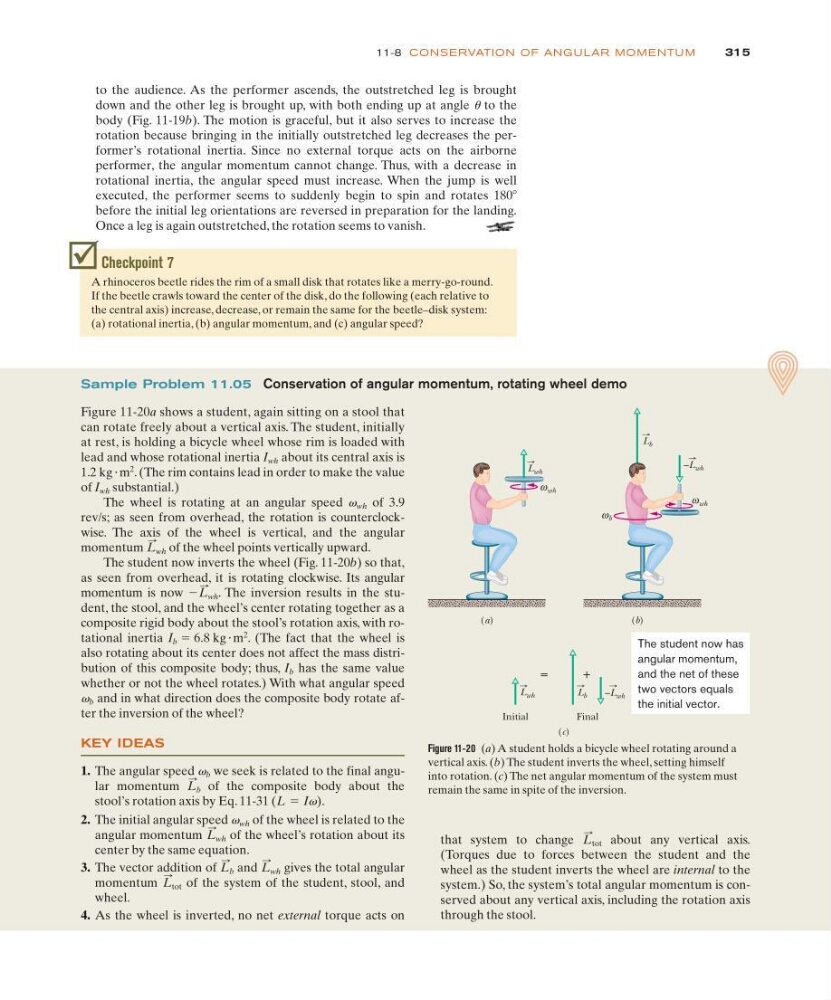
Figure 11-20a shows a student, again sitting on a stool that
can rotate freely about a vertical axis. The student, initially
at rest, is holding a bicycle wheel whose rim is loaded with
lead and whose rotational inertia I wh about its central axis is
1.2 kg иm
2
. (The rim contains lead in order to make the value
of I wh substantial.)
The wheel is rotating at an angular speed v wh of 3.9
rev/s; as seen from overhead, the rotation is counterclockwise. The axis of the wheel is vertical, and the angular
momentum
of the wheel points vertically upward.
The student now inverts the wheel (Fig. 11-20b) so that,
as seen from overhead, it is rotating clockwise. Its angular
momentum is now
. The inversion results in the student, the stool, and the wheel’s center rotating together as a
composite rigid body about the stool’s rotation axis, with rotational inertia I b ϭ 6.8 kg иm
2
. (The fact that the wheel is
also rotating about its center does not affect the mass distribution of this composite body; thus, I b has the same value
whether or not the wheel rotates.) With what angular speed
v b and in what direction does the composite body rotate after the inversion of the wheel?
KEY IDEAS
1. The angular speed v b we seek is related to the final angular momentum
of the composite body about the
stool’s rotation axis by Eq. 11-31 (L Iv).
2. The initial angular speed v wh of the wheel is related to the
angular momentum
of the wheel’s rotation about its
center by the same equation.
3. The vector addition of
and
gives the total angular
momentum
of the system of the student, stool, and
wheel.
4. As the wheel is inverted, no net external torque acts on
L
:
tot
L
:
wh
L
:
b
L
:
wh
ϭ
L
:
b
ϪL
:
wh
L
:
wh
Figure 11-20 (a) A student holds a bicycle wheel rotating around a
vertical axis. (b) The student inverts the wheel, setting himself
into rotation. (c) The net angular momentum of the system must
remain the same in spite of the inversion.
L b
wh
(a)
(b)
L wh
–L wh
ω
wh
ω
ω
L b
L wh
–L wh
=
+
(c)
Initial
Final
b
The student now has
angular momentum,
and the net of these
two vectors equals
the initial vector.
that system to change
about any vertical axis.
(Torques due to forces between the student and the
wheel as the student inverts the wheel are internal to the
system.) So, the system’s total angular momentum is conserved about any vertical axis, including the rotation axis
through the stool.
L
:
tot
11-8 CONSE RVATION OF ANG U L AR M OM E NTU M
Checkpoint 7
A rhinoceros beetle rides the rim of a small disk that rotates like a merry-go-round.
If the beetle crawls toward the center of the disk, do the following (each relative to
the central axis) increase, decrease, or remain the same for the beetle–disk system:
(a) rotational inertia, (b) angular momentum, and (c) angular speed?
to the audience. As the performer ascends, the outstretched leg is brought
down and the other leg is brought up, with both ending up at angle u to the
body (Fig. 11-19b). The motion is graceful, but it also serves to increase the
rotation because bringing in the initially outstretched leg decreases the performer’s rotational inertia. Since no external torque acts on the airborne
performer, the angular momentum cannot change. Thus, with a decrease in
rotational inertia, the angular speed must increase. When the jump is well
executed, the performer seems to suddenly begin to spin and rotates 180Њ
before the initial leg orientations are reversed in preparation for the landing.
Once a leg is again outstretched, the rotation seems to vanish.
Sample Problem 11.05 Conservation of angular momentum, rotating wheel demo
Figure 11-20a shows a student, again sitting on a stool that
can rotate freely about a vertical axis. The student, initially
at rest, is holding a bicycle wheel whose rim is loaded with
lead and whose rotational inertia I wh about its central axis is
1.2 kg иm
2
. (The rim contains lead in order to make the value
of I wh substantial.)
The wheel is rotating at an angular speed v wh of 3.9
rev/s; as seen from overhead, the rotation is counterclockwise. The axis of the wheel is vertical, and the angular
momentum
of the wheel points vertically upward.
The student now inverts the wheel (Fig. 11-20b) so that,
as seen from overhead, it is rotating clockwise. Its angular
momentum is now
. The inversion results in the student, the stool, and the wheel’s center rotating together as a
composite rigid body about the stool’s rotation axis, with rotational inertia I b ϭ 6.8 kg иm
2
. (The fact that the wheel is
also rotating about its center does not affect the mass distribution of this composite body; thus, I b has the same value
whether or not the wheel rotates.) With what angular speed
v b and in what direction does the composite body rotate after the inversion of the wheel?
KEY IDEAS
1. The angular speed v b we seek is related to the final angular momentum
of the composite body about the
stool’s rotation axis by Eq. 11-31 (L Iv).
2. The initial angular speed v wh of the wheel is related to the
angular momentum
of the wheel’s rotation about its
center by the same equation.
3. The vector addition of
and
gives the total angular
momentum
of the system of the student, stool, and
wheel.
4. As the wheel is inverted, no net external torque acts on
L
:
tot
L
:
wh
L
:
b
L
:
wh
ϭ
L
:
b
ϪL
:
wh
L
:
wh
Figure 11-20 (a) A student holds a bicycle wheel rotating around a
vertical axis. (b) The student inverts the wheel, setting himself
into rotation. (c) The net angular momentum of the system must
remain the same in spite of the inversion.
L b
wh
(a)
(b)
L wh
–L wh
ω
wh
ω
ω
L b
L wh
–L wh
=
+
(c)
Initial
Final
b
The student now has
angular momentum,
and the net of these
two vectors equals
the initial vector.
that system to change
about any vertical axis.
(Torques due to forces between the student and the
wheel as the student inverts the wheel are internal to the
system.) So, the system’s total angular momentum is conserved about any vertical axis, including the rotation axis
through the stool.
L
:
tot