

317
11-9 PR ECESSION OF A GYROSCOPE
Precession of a Gyroscope
A simple gyroscope consists of a wheel fixed to a shaft and free to spin about the
axis of the shaft. If one end of the shaft of a nonspinning gyroscope is placed on a
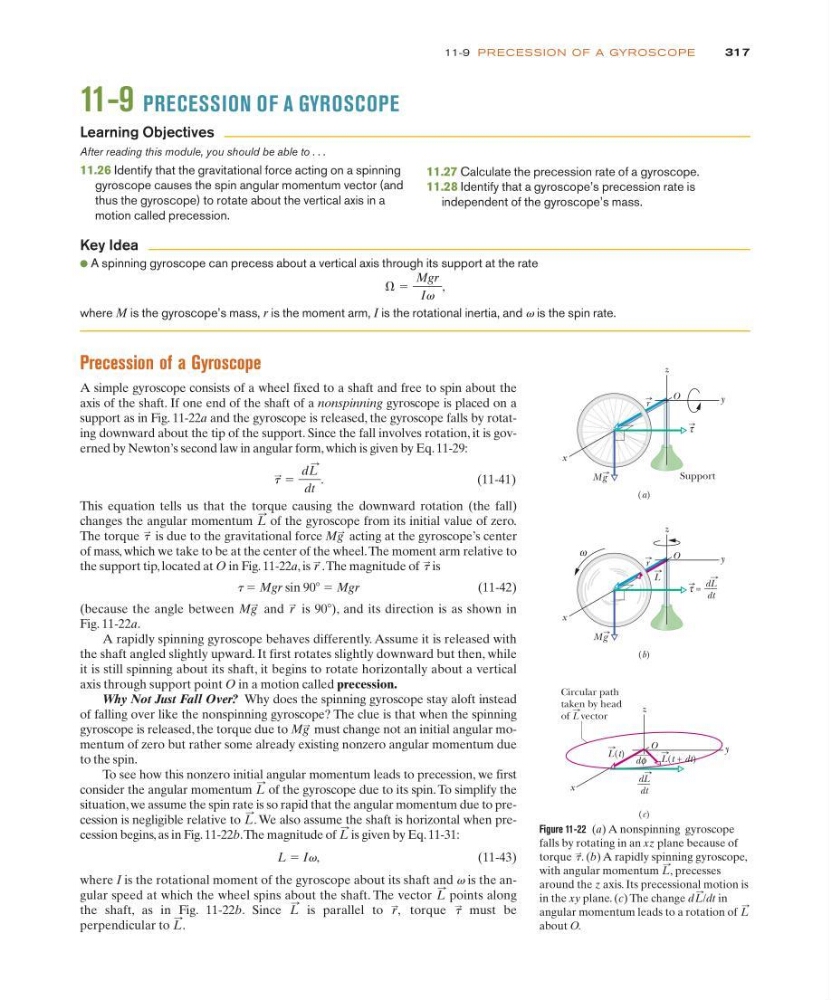
support as in Fig. 11-22a and the gyroscope is released, the gyroscope falls by rotating downward about the tip of the support. Since the fall involves rotation, it is governed by Newton’s second law in angular form, which is given by Eq. 11-29:
(11-41)
This equation tells us that the torque causing the downward rotation (the fall)
changes the angular momentum of the gyroscope from its initial value of zero.
The torque is due to the gravitational force
acting at the gyroscope’s center
of mass, which we take to be at the center of the wheel.The moment arm relative to
the support tip, located at O in Fig. 11-22a, is .The magnitude of is
t ϭ Mgr sin 90Њ ϭ Mgr
(11-42)
(because the angle between
and is 90Њ), and its direction is as shown in
Fig. 11-22a.
A rapidly spinning gyroscope behaves differently. Assume it is released with
the shaft angled slightly upward. It first rotates slightly downward but then, while
it is still spinning about its shaft, it begins to rotate horizontally about a vertical
axis through support point O in a motion called precession.
Why Not Just Fall Over? Why does the spinning gyroscope stay aloft instead
of falling over like the nonspinning gyroscope? The clue is that when the spinning
gyroscope is released, the torque due to
must change not an initial angular momentum of zero but rather some already existing nonzero angular momentum due
to the spin.
To see how this nonzero initial angular momentum leads to precession, we first
consider the angular momentum of the gyroscope due to its spin. To simplify the
situation, we assume the spin rate is so rapid that the angular momentum due to precession is negligible relative to . We also assume the shaft is horizontal when precession begins, as in Fig. 11-22b.The magnitude of is given by Eq. 11-31:
L ϭ Iv,
( 1 1 - 4 3 )
where I is the rotational moment of the gyroscope about its shaft and v is the angular speed at which the wheel spins about the shaft. The vector points along
the shaft, as in Fig. 11-22b. Since
is parallel to
torque
must be
perpendicular to .
L
:
t
:
r
:
,
L
:
L
:
L
:
L
:
L
:
Mg
:
r
:
Mg
:
t
:
r
:
Mg
:
:
L
:
t
: ϭ
dL
:
dt
.
Figure 11-22 (a) A nonspinning gyroscope
falls by rotating in an xz plane because of
torque . (b) A rapidly spinning gyroscope,
with angular momentum precesses
around the z axis. Its precessional motion is
in the xy plane. (c) The change
in
angular momentum leads to a rotation of
about O.
L
:
dL
:
/dt
L
:
,
t
:
x
y
z
τ
O
x
y
z
O
L
ω
=
dL
___
dt
(a)
(b)
x
y
z
O
L(t)
dL
___
dt
dφ L(t + dt)
Circular path
taken by head
of L vector
(c)
τ
r
r
Mg
Mg
Support
11-9 PRECESSION OF A GYROSCOPE
After reading this module, you should be able to . . .
11.26 Identify that the gravitational force acting on a spinning
gyroscope causes the spin angular momentum vector (and
thus the gyroscope) to rotate about the vertical axis in a
motion called precession.
11.27 Calculate the precession rate of a gyroscope.
11.28 Identify that a gyroscope’s precession rate is
independent of the gyroscope’s mass.
● A spinning gyroscope can precess about a vertical axis through its support at the rate
where M is the gyroscope’s mass, r is the moment arm, I is the rotational inertia, and v is the spin rate.
⍀ ϭ
Mgr
Iv
,
Learning Objectives
Key Idea
11-9 PR ECESSION OF A GYROSCOPE
Precession of a Gyroscope
A simple gyroscope consists of a wheel fixed to a shaft and free to spin about the
axis of the shaft. If one end of the shaft of a nonspinning gyroscope is placed on a
support as in Fig. 11-22a and the gyroscope is released, the gyroscope falls by rotating downward about the tip of the support. Since the fall involves rotation, it is governed by Newton’s second law in angular form, which is given by Eq. 11-29:
(11-41)
This equation tells us that the torque causing the downward rotation (the fall)
changes the angular momentum of the gyroscope from its initial value of zero.
The torque is due to the gravitational force
acting at the gyroscope’s center
of mass, which we take to be at the center of the wheel.The moment arm relative to
the support tip, located at O in Fig. 11-22a, is .The magnitude of is
t ϭ Mgr sin 90Њ ϭ Mgr
(11-42)
(because the angle between
and is 90Њ), and its direction is as shown in
Fig. 11-22a.
A rapidly spinning gyroscope behaves differently. Assume it is released with
the shaft angled slightly upward. It first rotates slightly downward but then, while
it is still spinning about its shaft, it begins to rotate horizontally about a vertical
axis through support point O in a motion called precession.
Why Not Just Fall Over? Why does the spinning gyroscope stay aloft instead
of falling over like the nonspinning gyroscope? The clue is that when the spinning
gyroscope is released, the torque due to
must change not an initial angular momentum of zero but rather some already existing nonzero angular momentum due
to the spin.
To see how this nonzero initial angular momentum leads to precession, we first
consider the angular momentum of the gyroscope due to its spin. To simplify the
situation, we assume the spin rate is so rapid that the angular momentum due to precession is negligible relative to . We also assume the shaft is horizontal when precession begins, as in Fig. 11-22b.The magnitude of is given by Eq. 11-31:
L ϭ Iv,
( 1 1 - 4 3 )
where I is the rotational moment of the gyroscope about its shaft and v is the angular speed at which the wheel spins about the shaft. The vector points along
the shaft, as in Fig. 11-22b. Since
is parallel to
torque
must be
perpendicular to .
L
:
t
:
r
:
,
L
:
L
:
L
:
L
:
L
:
Mg
:
r
:
Mg
:
t
:
r
:
Mg
:
:
L
:
t
: ϭ
dL
:
dt
.
Figure 11-22 (a) A nonspinning gyroscope
falls by rotating in an xz plane because of
torque . (b) A rapidly spinning gyroscope,
with angular momentum precesses
around the z axis. Its precessional motion is
in the xy plane. (c) The change
in
angular momentum leads to a rotation of
about O.
L
:
dL
:
/dt
L
:
,
t
:
x
y
z
τ
O
x
y
z
O
L
ω
=
dL
___
dt
(a)
(b)
x
y
z
O
L(t)
dL
___
dt
dφ L(t + dt)
Circular path
taken by head
of L vector
(c)
τ
r
r
Mg
Mg
Support
11-9 PRECESSION OF A GYROSCOPE
After reading this module, you should be able to . . .
11.26 Identify that the gravitational force acting on a spinning
gyroscope causes the spin angular momentum vector (and
thus the gyroscope) to rotate about the vertical axis in a
motion called precession.
11.27 Calculate the precession rate of a gyroscope.
11.28 Identify that a gyroscope’s precession rate is
independent of the gyroscope’s mass.
● A spinning gyroscope can precess about a vertical axis through its support at the rate
where M is the gyroscope’s mass, r is the moment arm, I is the rotational inertia, and v is the spin rate.
⍀ ϭ
Mgr
Iv
,
Learning Objectives
Key Idea