

280
CHAPTE R 10 ROTATION
Additional examples, video, and practice available at WileyPLUS
KEY IDEA
Because the moment arm for is no longer zero, the torque
F
:
g
Checkpoint 7
The figure shows an overhead view of a meter stick that can pivot about the point indicated, which is
to the left of the stick’s midpoint.Two horizontal forces, and , are applied to the stick. Only is
shown. Force is perpendicular to the stick and is applied at the right end. If the stick is not to turn,
(a) what should be the direction of , and (b) should F 2 be greater than, less than, or equal to F 1 ?
F
:
2
F
:
2
F
:
1
F
:
2
F
:
1
F 1
Pivot point
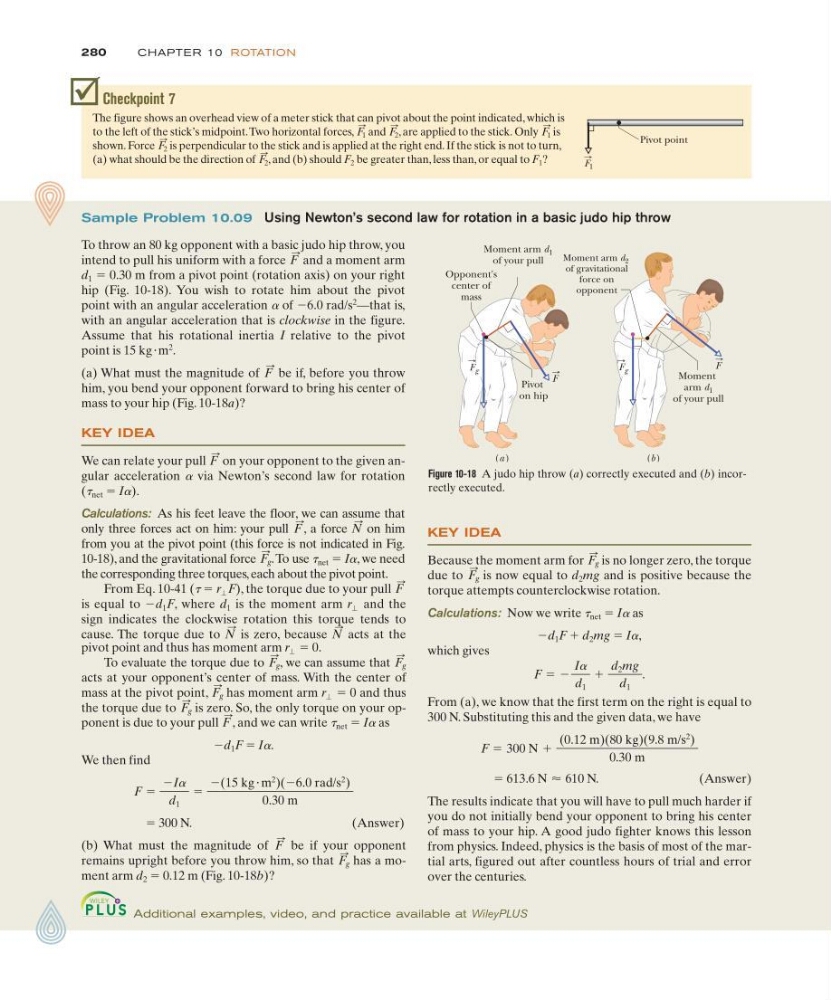
Sample Problem 10.09 Using Newton’s second law for rotation in a basic judo hip throw
To throw an 80 kg opponent with a basic judo hip throw, you
intend to pull his uniform with a force and a moment arm
d 1 ϭ 0.30 m from a pivot point (rotation axis) on your right
hip (Fig. 10-18). You wish to rotate him about the pivot
point with an angular acceleration a of Ϫ6.0 rad/s
2
—that is,
with an angular acceleration that is clockwise in the figure.
Assume that his rotational inertia I relative to the pivot
point is 15 kg иm
2
.
(a) What must the magnitude of
be if, before you throw
him, you bend your opponent forward to bring his center of
mass to your hip (Fig. 10-18a)?
KEY IDEA
We can relate your pull on your opponent to the given angular acceleration a via Newton’s second law for rotation
(t net ϭ Ia).
Calculations: As his feet leave the floor, we can assume that
only three forces act on him: your pull , a force
on him
from you at the pivot point (this force is not indicated in Fig.
10-18), and the gravitational force . To use t net ϭ Ia, we need
the corresponding three torques, each about the pivot point.
From Eq. 10-41 (t ϭ F), the torque due to your pull F
:
r Ќ
F
:
g
N
:
F
:
F
:
F
:
F
:
Figure 10-18 A judo hip throw (a) correctly executed and (b) incorrectly executed.
Opponent's
center of
mass
Moment arm d 1
of your pull
Pivot
on hip
Moment arm d 2
of gravitational
force on
opponent
Moment
arm d 1
of your pull
F g
F g
(a )
(b )
F
F
is equal to Ϫ F, where
is the moment arm
and the
sign indicates the clockwise rotation this torque tends to
cause. The torque due to
is zero, because
acts at the
N
:
N
:
r Ќ
d 1
d 1
pivot point and thus has moment arm ϭ 0.
To evaluate the torque due to , we can assume that
acts at your opponent’s center of mass. With the center of
mass at the pivot point, has moment arm ϭ 0 and thus
r Ќ
F
:
g
F
:
g
F
:
g
r Ќ
ponent is due to your pull , and we can write t net ϭ Ia as
Ϫd 1 F ϭ Ia.
We then find
ϭ 300 N.
(Answer)
(b) What must the magnitude of
be if your opponent
remains upright before you throw him, so that
has a moment arm d 2 ϭ 0.12 m (Fig. 10-18b)?
F
:
g
F
:
F ϭ
ϪIa
d 1
ϭ
Ϫ(15 kgиm
2
)(Ϫ6.0 rad/s
2
)
0.30 m
F
:
the torque due to is zero. So, the only torque on your opF
:
g
due to
is now equal to d 2 mg and is positive because the
torque attempts counterclockwise rotation.
Calculations: Now we write t net ϭ Ia as
Ϫd 1 F ϩ d 2 mg ϭ Ia,
which gives
From (a), we know that the first term on the right is equal to
300 N. Substituting this and the given data, we have
ϭ 613.6 N 610 N.
(Answer)
The results indicate that you will have to pull much harder if
you do not initially bend your opponent to bring his center
of mass to your hip. A good judo fighter knows this lesson
from physics. Indeed, physics is the basis of most of the martial arts, figured out after countless hours of trial and error
over the centuries.
Ϸ
F ϭ 300 N ϩ
(0.12 m)(80 kg)(9.8 m/s
2
)
0.30 m
F ϭ Ϫ
Ia
d 1
ϩ
d 2 mg
d 1
.
F
:
g
CHAPTE R 10 ROTATION
Additional examples, video, and practice available at WileyPLUS
KEY IDEA
Because the moment arm for is no longer zero, the torque
F
:
g
Checkpoint 7
The figure shows an overhead view of a meter stick that can pivot about the point indicated, which is
to the left of the stick’s midpoint.Two horizontal forces, and , are applied to the stick. Only is
shown. Force is perpendicular to the stick and is applied at the right end. If the stick is not to turn,
(a) what should be the direction of , and (b) should F 2 be greater than, less than, or equal to F 1 ?
F
:
2
F
:
2
F
:
1
F
:
2
F
:
1
F 1
Pivot point
Sample Problem 10.09 Using Newton’s second law for rotation in a basic judo hip throw
To throw an 80 kg opponent with a basic judo hip throw, you
intend to pull his uniform with a force and a moment arm
d 1 ϭ 0.30 m from a pivot point (rotation axis) on your right
hip (Fig. 10-18). You wish to rotate him about the pivot
point with an angular acceleration a of Ϫ6.0 rad/s
2
—that is,
with an angular acceleration that is clockwise in the figure.
Assume that his rotational inertia I relative to the pivot
point is 15 kg иm
2
.
(a) What must the magnitude of
be if, before you throw
him, you bend your opponent forward to bring his center of
mass to your hip (Fig. 10-18a)?
KEY IDEA
We can relate your pull on your opponent to the given angular acceleration a via Newton’s second law for rotation
(t net ϭ Ia).
Calculations: As his feet leave the floor, we can assume that
only three forces act on him: your pull , a force
on him
from you at the pivot point (this force is not indicated in Fig.
10-18), and the gravitational force . To use t net ϭ Ia, we need
the corresponding three torques, each about the pivot point.
From Eq. 10-41 (t ϭ F), the torque due to your pull F
:
r Ќ
F
:
g
N
:
F
:
F
:
F
:
F
:
Figure 10-18 A judo hip throw (a) correctly executed and (b) incorrectly executed.
Opponent's
center of
mass
Moment arm d 1
of your pull
Pivot
on hip
Moment arm d 2
of gravitational
force on
opponent
Moment
arm d 1
of your pull
F g
F g
(a )
(b )
F
F
is equal to Ϫ F, where
is the moment arm
and the
sign indicates the clockwise rotation this torque tends to
cause. The torque due to
is zero, because
acts at the
N
:
N
:
r Ќ
d 1
d 1
pivot point and thus has moment arm ϭ 0.
To evaluate the torque due to , we can assume that
acts at your opponent’s center of mass. With the center of
mass at the pivot point, has moment arm ϭ 0 and thus
r Ќ
F
:
g
F
:
g
F
:
g
r Ќ
ponent is due to your pull , and we can write t net ϭ Ia as
Ϫd 1 F ϭ Ia.
We then find
ϭ 300 N.
(Answer)
(b) What must the magnitude of
be if your opponent
remains upright before you throw him, so that
has a moment arm d 2 ϭ 0.12 m (Fig. 10-18b)?
F
:
g
F
:
F ϭ
ϪIa
d 1
ϭ
Ϫ(15 kgиm
2
)(Ϫ6.0 rad/s
2
)
0.30 m
F
:
the torque due to is zero. So, the only torque on your opF
:
g
due to
is now equal to d 2 mg and is positive because the
torque attempts counterclockwise rotation.
Calculations: Now we write t net ϭ Ia as
Ϫd 1 F ϩ d 2 mg ϭ Ia,
which gives
From (a), we know that the first term on the right is equal to
300 N. Substituting this and the given data, we have
ϭ 613.6 N 610 N.
(Answer)
The results indicate that you will have to pull much harder if
you do not initially bend your opponent to bring his center
of mass to your hip. A good judo fighter knows this lesson
from physics. Indeed, physics is the basis of most of the martial arts, figured out after countless hours of trial and error
over the centuries.
Ϸ
F ϭ 300 N ϩ
(0.12 m)(80 kg)(9.8 m/s
2
)
0.30 m
F ϭ Ϫ
Ia
d 1
ϩ
d 2 mg
d 1
.
F
:
g