

279
10-7 NEWTON’S SECOND LAW FOR ROTATION
10-7 NEWTON’S SECOND LAW FOR ROTATION
After reading this module, you should be able to . . .
10.28 Apply Newton’s second law for rotation to relate the
net torque on a body to the body’s rotational inertia and
rotational acceleration, all calculated relative to a specified
rotation axis.
● The rotational analog of Newton’s second law is
t net ϭ Ia,
where t net is the net torque acting on a particle or rigid body,
I is the rotational inertia of the particle or body about the
rotation axis, and a is the resulting angular acceleration about
that axis.
Learning Objective
Key Idea
Newton’s Second Law for Rotation
A torque can cause rotation of a rigid body, as when you use a torque to rotate
a door. Here we want to relate the net torque t net on a rigid body to the angular
acceleration a that torque causes about a rotation axis. We do so by analogy with
Newton’s second law (F net ϭ ma) for the acceleration a of a body of mass m due
to a net force F net along a coordinate axis. We replace F net with t net , m with I, and a
with a in radian measure, writing
t net ϭ Ia (Newton’s second law for rotation).
(10-42)
Proof of Equation 10-42
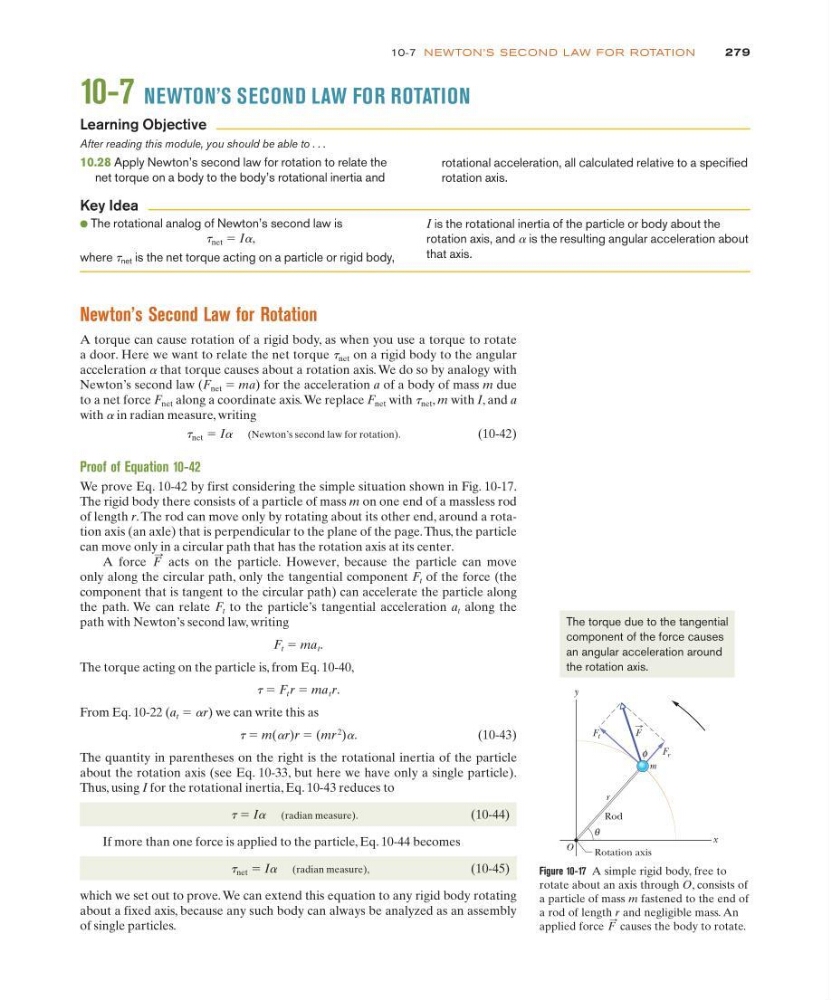
We prove Eq. 10-42 by first considering the simple situation shown in Fig. 10-17.
The rigid body there consists of a particle of mass m on one end of a massless rod
of length r. The rod can move only by rotating about its other end, around a rotation axis (an axle) that is perpendicular to the plane of the page. Thus, the particle
can move only in a circular path that has the rotation axis at its center.
A force
acts on the particle. However, because the particle can move
only along the circular path, only the tangential component F t of the force (the
component that is tangent to the circular path) can accelerate the particle along
the path. We can relate F t to the particle’s tangential acceleration a t along the
path with Newton’s second law, writing
F t ϭ ma t .
The torque acting on the particle is, from Eq. 10-40,
t ϭ F t r ϭ ma t r.
From Eq. 10-22 (a t ϭ ar) we can write this as
t ϭ m(ar)r ϭ (mr
2
)a.
( 1 0 - 4 3 )
The quantity in parentheses on the right is the rotational inertia of the particle
about the rotation axis (see Eq. 10-33, but here we have only a single particle).
Thus, using I for the rotational inertia, Eq. 10-43 reduces to
t ϭ Ia (radian measure).
(10-44)
If more than one force is applied to the particle, Eq. 10-44 becomes
t net ϭ Ia (radian measure),
(10-45)
which we set out to prove. We can extend this equation to any rigid body rotating
about a fixed axis, because any such body can always be analyzed as an assembly
of single particles.
F
:
Figure 10-17 A simple rigid body, free to
rotate about an axis through O, consists of
a particle of mass m fastened to the end of
a rod of length r and negligible mass. An
applied force causes the body to rotate.
F
:
O
x
y
Rod
θ
Rotation axis
r
m
F r
F t
φ
F
The torque due to the tangential
component of the force causes
an angular acceleration around
the rotation axis.
10-7 NEWTON’S SECOND LAW FOR ROTATION
10-7 NEWTON’S SECOND LAW FOR ROTATION
After reading this module, you should be able to . . .
10.28 Apply Newton’s second law for rotation to relate the
net torque on a body to the body’s rotational inertia and
rotational acceleration, all calculated relative to a specified
rotation axis.
● The rotational analog of Newton’s second law is
t net ϭ Ia,
where t net is the net torque acting on a particle or rigid body,
I is the rotational inertia of the particle or body about the
rotation axis, and a is the resulting angular acceleration about
that axis.
Learning Objective
Key Idea
Newton’s Second Law for Rotation
A torque can cause rotation of a rigid body, as when you use a torque to rotate
a door. Here we want to relate the net torque t net on a rigid body to the angular
acceleration a that torque causes about a rotation axis. We do so by analogy with
Newton’s second law (F net ϭ ma) for the acceleration a of a body of mass m due
to a net force F net along a coordinate axis. We replace F net with t net , m with I, and a
with a in radian measure, writing
t net ϭ Ia (Newton’s second law for rotation).
(10-42)
Proof of Equation 10-42
We prove Eq. 10-42 by first considering the simple situation shown in Fig. 10-17.
The rigid body there consists of a particle of mass m on one end of a massless rod
of length r. The rod can move only by rotating about its other end, around a rotation axis (an axle) that is perpendicular to the plane of the page. Thus, the particle
can move only in a circular path that has the rotation axis at its center.
A force
acts on the particle. However, because the particle can move
only along the circular path, only the tangential component F t of the force (the
component that is tangent to the circular path) can accelerate the particle along
the path. We can relate F t to the particle’s tangential acceleration a t along the
path with Newton’s second law, writing
F t ϭ ma t .
The torque acting on the particle is, from Eq. 10-40,
t ϭ F t r ϭ ma t r.
From Eq. 10-22 (a t ϭ ar) we can write this as
t ϭ m(ar)r ϭ (mr
2
)a.
( 1 0 - 4 3 )
The quantity in parentheses on the right is the rotational inertia of the particle
about the rotation axis (see Eq. 10-33, but here we have only a single particle).
Thus, using I for the rotational inertia, Eq. 10-43 reduces to
t ϭ Ia (radian measure).
(10-44)
If more than one force is applied to the particle, Eq. 10-44 becomes
t net ϭ Ia (radian measure),
(10-45)
which we set out to prove. We can extend this equation to any rigid body rotating
about a fixed axis, because any such body can always be analyzed as an assembly
of single particles.
F
:
Figure 10-17 A simple rigid body, free to
rotate about an axis through O, consists of
a particle of mass m fastened to the end of
a rod of length r and negligible mass. An
applied force causes the body to rotate.
F
:
O
x
y
Rod
θ
Rotation axis
r
m
F r
F t
φ
F
The torque due to the tangential
component of the force causes
an angular acceleration around
the rotation axis.