

281
10-7 NEWTON’S SECOND LAW FOR ROTATION
Sample Problem 10.10 Newton’s second law, rotation, torque, disk
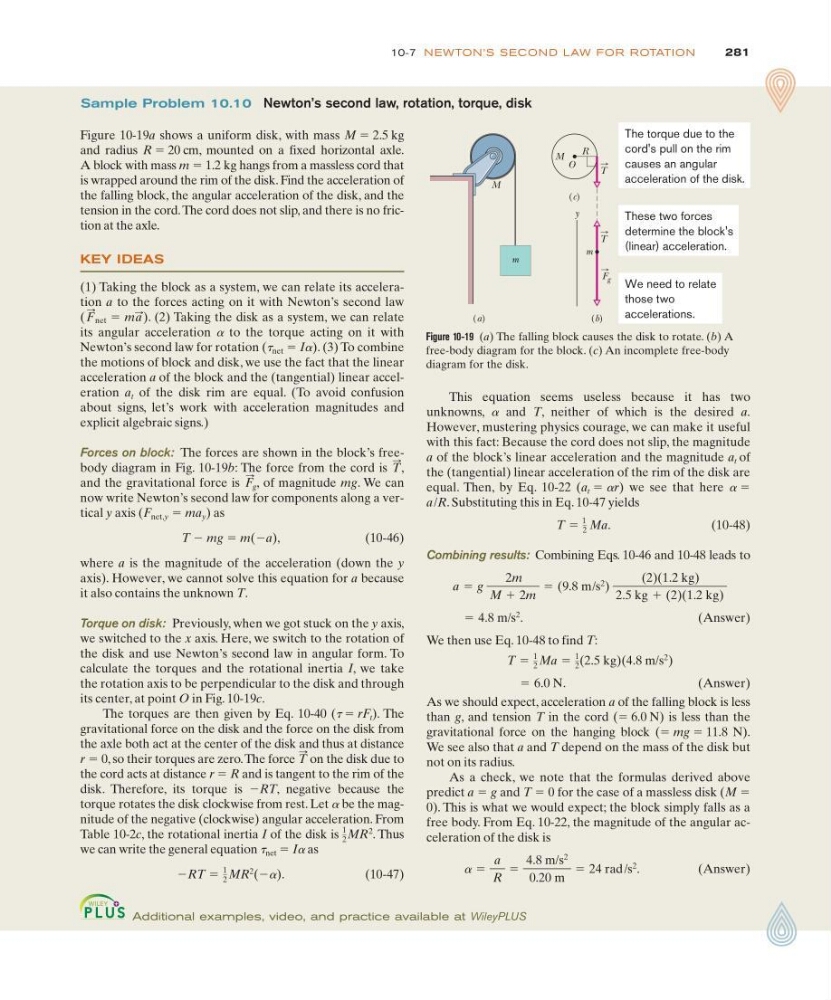
Figure 10-19a shows a uniform disk, with mass M ϭ 2.5 kg
and radius R ϭ 20 cm, mounted on a fixed horizontal axle.
A block with mass m ϭ 1.2 kg hangs from a massless cord that
is wrapped around the rim of the disk. Find the acceleration of
the falling block, the angular acceleration of the disk, and the
tension in the cord. The cord does not slip, and there is no friction at the axle.
KEY IDEAS
(1) Taking the block as a system, we can relate its acceleration a to the forces acting on it with Newton’s second law
(
) .( 2 ) T a k i n g t h e d i s k a s a s y s t e m ,w e c a n r e l a t e
its angular acceleration a to the torque acting on it with
Newton’s second law for rotation (t net ϭ Ia). (3) To combine
the motions of block and disk, we use the fact that the linear
acceleration a of the block and the (tangential) linear acceleration
of the disk rim are equal. (To avoid confusion
about signs, let’s work with acceleration magnitudes and
explicit algebraic signs.)
Forces on block: The forces are shown in the block’s freebody diagram in Fig. 10-19b: The force from the cord is ,
and the gravitational force is , of magnitude mg. We can
now write Newton’s second law for components along a vertical y axis (F net,y ϭ ma y ) as
T Ϫ mg ϭ m(Ϫa),
(10-46)
where a is the magnitude of the acceleration (down the y
axis). However, we cannot solve this equation for a because
it also contains the unknown T.
Torque on disk: Previously, when we got stuck on the y axis,
we switched to the x axis. Here, we switch to the rotation of
the disk and use Newton’s second law in angular form. To
calculate the torques and the rotational inertia I, we take
the rotation axis to be perpendicular to the disk and through
its center, at point O in Fig. 10-19c.
The torques are then given by Eq. 10-40 (t ϭ rF t ). The
gravitational force on the disk and the force on the disk from
the axle both act at the center of the disk and thus at distance
r ϭ 0, so their torques are zero.The force on the disk due to
the cord acts at distance r ϭ R and is tangent to the rim of the
disk. Therefore, its torque is ϪRT, negative because the
torque rotates the disk clockwise from rest. Let a be the magnitude of the negative (clockwise) angular acceleration. From
Table 10-2c, the rotational inertia I of the disk is
. Thus
we can write the general equation t net ϭ Ia as
(10-47)
ϪRT ϭ
1
2 MR
2
(Ϫa).
1
2 MR
2
T
:
F
:
g
T
:
a t
F
:
net ϭ m
:
a
This equation seems useless because it has two
unknowns, a and T, neither of which is the desired a.
However, mustering physics courage, we can make it useful
with this fact: Because the cord does not slip, the magnitude
a of the block’s linear acceleration and the magnitude a t of
the (tangential) linear acceleration of the rim of the disk are
equal. Then, by Eq. 10-22 (a t ϭ ar) we see that here a ϭ
a /R. Substituting this in Eq. 10-47 yields
(10-48)
Combining results: Combining Eqs. 10-46 and 10-48 leads to
.
( A n s w e r )
We then use Eq. 10-48 to find T:
(Answer)
As we should expect, acceleration a of the falling block is less
than g, and tension T in the cord (ϭ 6.0 N) is less than the
gravitational force on the hanging block (ϭ mg ϭ 11.8 N).
We see also that a and T depend on the mass of the disk but
not on its radius.
As a check, we note that the formulas derived above
predict a ϭ g and T ϭ 0 for the case of a massless disk (M ϭ
0). This is what we would expect; the block simply falls as a
free body. From Eq. 10-22, the magnitude of the angular acceleration of the disk is
(Answer)
a ϭ
a
R
ϭ
4.8 m/s
2
0.20 m
ϭ 24 rad/s
2
.
ϭ 6.0 N.
T ϭ
1
2 Ma ϭ
1
2 (2.5 kg)(4.8 m/s
2
)
ϭ 4.8 m/s
2
a ϭ g
2m
M ϩ 2m
ϭ (9.8 m/s
2
)
(2)(1.2 kg)
2.5 kg ϩ (2)(1.2 kg)
T ϭ
1
2 Ma.
m
M
M
R
O
F g
(b)
(a)
(c)
m
T
T
The torque due to the
cord's pull on the rim
causes an angular
acceleration of the disk.
These two forces
determine the block's
(linear) acceleration.
We need to relate
those two
accelerations.
y
Figure 10-19 (a) The falling block causes the disk to rotate. (b) A
free-body diagram for the block. (c) An incomplete free-body
diagram for the disk.
Additional examples, video, and practice available at WileyPLUS
10-7 NEWTON’S SECOND LAW FOR ROTATION
Sample Problem 10.10 Newton’s second law, rotation, torque, disk
Figure 10-19a shows a uniform disk, with mass M ϭ 2.5 kg
and radius R ϭ 20 cm, mounted on a fixed horizontal axle.
A block with mass m ϭ 1.2 kg hangs from a massless cord that
is wrapped around the rim of the disk. Find the acceleration of
the falling block, the angular acceleration of the disk, and the
tension in the cord. The cord does not slip, and there is no friction at the axle.
KEY IDEAS
(1) Taking the block as a system, we can relate its acceleration a to the forces acting on it with Newton’s second law
(
) .( 2 ) T a k i n g t h e d i s k a s a s y s t e m ,w e c a n r e l a t e
its angular acceleration a to the torque acting on it with
Newton’s second law for rotation (t net ϭ Ia). (3) To combine
the motions of block and disk, we use the fact that the linear
acceleration a of the block and the (tangential) linear acceleration
of the disk rim are equal. (To avoid confusion
about signs, let’s work with acceleration magnitudes and
explicit algebraic signs.)
Forces on block: The forces are shown in the block’s freebody diagram in Fig. 10-19b: The force from the cord is ,
and the gravitational force is , of magnitude mg. We can
now write Newton’s second law for components along a vertical y axis (F net,y ϭ ma y ) as
T Ϫ mg ϭ m(Ϫa),
(10-46)
where a is the magnitude of the acceleration (down the y
axis). However, we cannot solve this equation for a because
it also contains the unknown T.
Torque on disk: Previously, when we got stuck on the y axis,
we switched to the x axis. Here, we switch to the rotation of
the disk and use Newton’s second law in angular form. To
calculate the torques and the rotational inertia I, we take
the rotation axis to be perpendicular to the disk and through
its center, at point O in Fig. 10-19c.
The torques are then given by Eq. 10-40 (t ϭ rF t ). The
gravitational force on the disk and the force on the disk from
the axle both act at the center of the disk and thus at distance
r ϭ 0, so their torques are zero.The force on the disk due to
the cord acts at distance r ϭ R and is tangent to the rim of the
disk. Therefore, its torque is ϪRT, negative because the
torque rotates the disk clockwise from rest. Let a be the magnitude of the negative (clockwise) angular acceleration. From
Table 10-2c, the rotational inertia I of the disk is
. Thus
we can write the general equation t net ϭ Ia as
(10-47)
ϪRT ϭ
1
2 MR
2
(Ϫa).
1
2 MR
2
T
:
F
:
g
T
:
a t
F
:
net ϭ m
:
a
This equation seems useless because it has two
unknowns, a and T, neither of which is the desired a.
However, mustering physics courage, we can make it useful
with this fact: Because the cord does not slip, the magnitude
a of the block’s linear acceleration and the magnitude a t of
the (tangential) linear acceleration of the rim of the disk are
equal. Then, by Eq. 10-22 (a t ϭ ar) we see that here a ϭ
a /R. Substituting this in Eq. 10-47 yields
(10-48)
Combining results: Combining Eqs. 10-46 and 10-48 leads to
.
( A n s w e r )
We then use Eq. 10-48 to find T:
(Answer)
As we should expect, acceleration a of the falling block is less
than g, and tension T in the cord (ϭ 6.0 N) is less than the
gravitational force on the hanging block (ϭ mg ϭ 11.8 N).
We see also that a and T depend on the mass of the disk but
not on its radius.
As a check, we note that the formulas derived above
predict a ϭ g and T ϭ 0 for the case of a massless disk (M ϭ
0). This is what we would expect; the block simply falls as a
free body. From Eq. 10-22, the magnitude of the angular acceleration of the disk is
(Answer)
a ϭ
a
R
ϭ
4.8 m/s
2
0.20 m
ϭ 24 rad/s
2
.
ϭ 6.0 N.
T ϭ
1
2 Ma ϭ
1
2 (2.5 kg)(4.8 m/s
2
)
ϭ 4.8 m/s
2
a ϭ g
2m
M ϩ 2m
ϭ (9.8 m/s
2
)
(2)(1.2 kg)
2.5 kg ϩ (2)(1.2 kg)
T ϭ
1
2 Ma.
m
M
M
R
O
F g
(b)
(a)
(c)
m
T
T
The torque due to the
cord's pull on the rim
causes an angular
acceleration of the disk.
These two forces
determine the block's
(linear) acceleration.
We need to relate
those two
accelerations.
y
Figure 10-19 (a) The falling block causes the disk to rotate. (b) A
free-body diagram for the block. (c) An incomplete free-body
diagram for the disk.
Additional examples, video, and practice available at WileyPLUS