

and the conservation of kinetic energy is written as
(9-72)
To solve these simultaneous equations for v 1f and v 2f , we first rewrite Eq. 9-71 as
m 1 (v 1i Ϫ v 1f ) ϭ Ϫm 2 (v 2i Ϫ v 2f ),
(9-73)
and Eq. 9-72 as
m 1 (v 1i Ϫ v 1f )(v 1i ϩ v 1f ) ϭ Ϫm 2 (v 2i Ϫ v 2f )(v 2i ϩ v 2f ).
(9-74)
After dividing Eq. 9-74 by Eq. 9-73 and doing some more algebra, we obtain
(9-75)
and
(9-76)
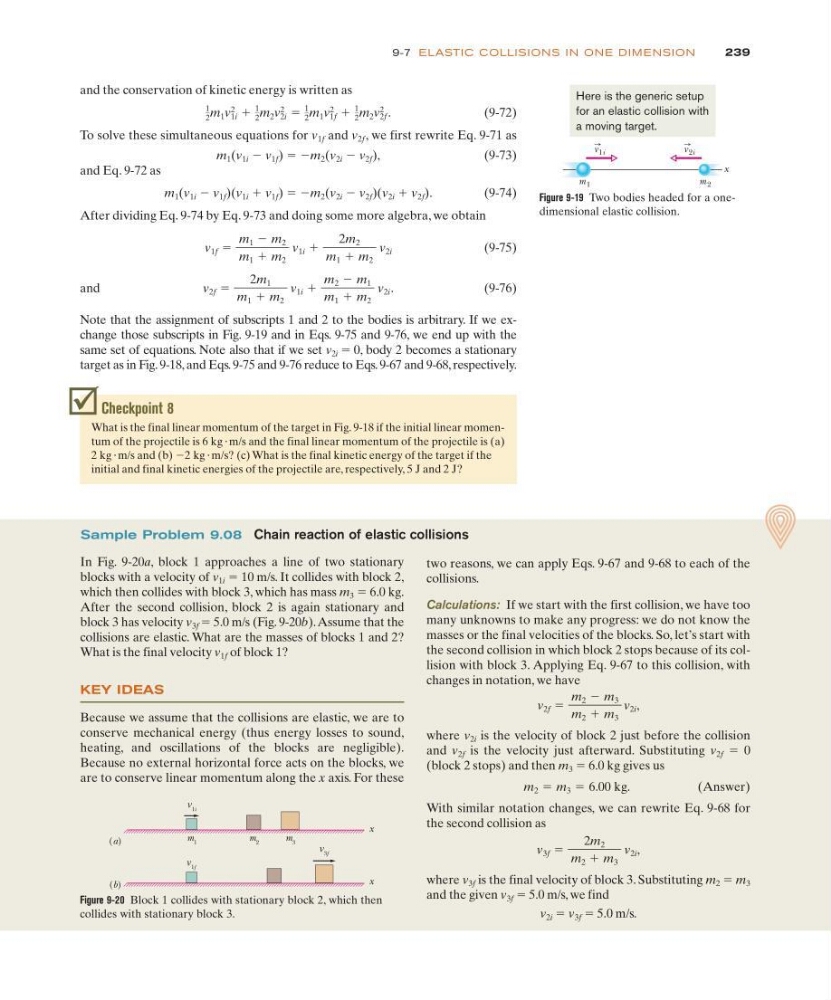
Note that the assignment of subscripts 1 and 2 to the bodies is arbitrary. If we exchange those subscripts in Fig. 9-19 and in Eqs. 9-75 and 9-76, we end up with the
same set of equations. Note also that if we set v 2i ϭ 0, body 2 becomes a stationary
target as in Fig. 9-18, and Eqs. 9-75 and 9-76 reduce to Eqs. 9-67 and 9-68, respectively.
v 2f ϭ
2m 1
m 1 ϩ m 2
v 1i ϩ
m 2 Ϫ m 1
m 1 ϩ m 2
v 2i .
v 1f ϭ
m 1 Ϫ m 2
m 1 ϩ m 2
v 1i ϩ
2m 2
m 1 ϩ m 2
v 2i
1
2 m 1 v 1i
2 ϩ
1
2 m 2 v 2i
2 ϭ
1
2 m 1 v 1f
2 ϩ
1
2 m 2 v 2f
2
.
239
9-7 ELASTIC COLLISIONS IN ONE DIM ENSION
Figure 9-19 Two bodies headed for a onedimensional elastic collision.
x
m 1
v 1i
m 2
v 2i
Here is the generic setup
for an elastic collision with
a moving target.
Checkpoint 8
What is the final linear momentum of the target in Fig. 9-18 if the initial linear momentum of the projectile is 6 kg иm/s and the final linear momentum of the projectile is (a)
2 kg иm/s and (b) Ϫ2 kg иm/s? (c) What is the final kinetic energy of the target if the
initial and final kinetic energies of the projectile are, respectively, 5 J and 2 J?
two reasons, we can apply Eqs. 9-67 and 9-68 to each of the
collisions.
Calculations: If we start with the first collision, we have too
many unknowns to make any progress: we do not know the
masses or the final velocities of the blocks. So, let’s start with
the second collision in which block 2 stops because of its collision with block 3. Applying Eq. 9-67 to this collision, with
changes in notation, we have
where v 2i is the velocity of block 2 just before the collision
and v 2f is the velocity just afterward. Substituting v 2f ϭ 0
(block 2 stops) and then m 3 ϭ 6.0 kg gives us
(Answer)
With similar notation changes, we can rewrite Eq. 9-68 for
the second collision as
where v 3f is the final velocity of block 3. Substituting m 2 ϭ m 3
and the given v 3f ϭ 5.0 m/s, we find
v 2i ϭ v 3f ϭ 5.0 m/s.
v 3f ϭ
2m 2
m 2 ϩ m 3
v 2i ,
m 2 ϭ m 3 ϭ 6.00 kg.
v 2f ϭ
m 2 Ϫ m 3
m 2 ϩ m 3
v 2i ,
Sample Problem 9.08 Chain reaction of elastic collisions
Figure 9-20 Block 1 collides with stationary block 2, which then
collides with stationary block 3.
In Fig. 9-20a, block 1 approaches a line of two stationary
blocks with a velocity of v 1i ϭ 10 m/s. It collides with block 2,
which then collides with block 3, which has mass m 3 ϭ 6.0 kg.
After the second collision, block 2 is again stationary and
block 3 has velocity v 3f ϭ 5.0 m/s (Fig. 9-20b).Assume that the
collisions are elastic. What are the masses of blocks 1 and 2?
What is the final velocity v 1f of block 1?
KEY IDEAS
Because we assume that the collisions are elastic, we are to
conserve mechanical energy (thus energy losses to sound,
heating, and oscillations of the blocks are negligible).
Because no external horizontal force acts on the blocks, we
are to conserve linear momentum along the x axis. For these
(a)
(b)
v 1i
v 1f
v 3f
m 1
m 2
m 3
x
x
(9-72)
To solve these simultaneous equations for v 1f and v 2f , we first rewrite Eq. 9-71 as
m 1 (v 1i Ϫ v 1f ) ϭ Ϫm 2 (v 2i Ϫ v 2f ),
(9-73)
and Eq. 9-72 as
m 1 (v 1i Ϫ v 1f )(v 1i ϩ v 1f ) ϭ Ϫm 2 (v 2i Ϫ v 2f )(v 2i ϩ v 2f ).
(9-74)
After dividing Eq. 9-74 by Eq. 9-73 and doing some more algebra, we obtain
(9-75)
and
(9-76)
Note that the assignment of subscripts 1 and 2 to the bodies is arbitrary. If we exchange those subscripts in Fig. 9-19 and in Eqs. 9-75 and 9-76, we end up with the
same set of equations. Note also that if we set v 2i ϭ 0, body 2 becomes a stationary
target as in Fig. 9-18, and Eqs. 9-75 and 9-76 reduce to Eqs. 9-67 and 9-68, respectively.
v 2f ϭ
2m 1
m 1 ϩ m 2
v 1i ϩ
m 2 Ϫ m 1
m 1 ϩ m 2
v 2i .
v 1f ϭ
m 1 Ϫ m 2
m 1 ϩ m 2
v 1i ϩ
2m 2
m 1 ϩ m 2
v 2i
1
2 m 1 v 1i
2 ϩ
1
2 m 2 v 2i
2 ϭ
1
2 m 1 v 1f
2 ϩ
1
2 m 2 v 2f
2
.
239
9-7 ELASTIC COLLISIONS IN ONE DIM ENSION
Figure 9-19 Two bodies headed for a onedimensional elastic collision.
x
m 1
v 1i
m 2
v 2i
Here is the generic setup
for an elastic collision with
a moving target.
Checkpoint 8
What is the final linear momentum of the target in Fig. 9-18 if the initial linear momentum of the projectile is 6 kg иm/s and the final linear momentum of the projectile is (a)
2 kg иm/s and (b) Ϫ2 kg иm/s? (c) What is the final kinetic energy of the target if the
initial and final kinetic energies of the projectile are, respectively, 5 J and 2 J?
two reasons, we can apply Eqs. 9-67 and 9-68 to each of the
collisions.
Calculations: If we start with the first collision, we have too
many unknowns to make any progress: we do not know the
masses or the final velocities of the blocks. So, let’s start with
the second collision in which block 2 stops because of its collision with block 3. Applying Eq. 9-67 to this collision, with
changes in notation, we have
where v 2i is the velocity of block 2 just before the collision
and v 2f is the velocity just afterward. Substituting v 2f ϭ 0
(block 2 stops) and then m 3 ϭ 6.0 kg gives us
(Answer)
With similar notation changes, we can rewrite Eq. 9-68 for
the second collision as
where v 3f is the final velocity of block 3. Substituting m 2 ϭ m 3
and the given v 3f ϭ 5.0 m/s, we find
v 2i ϭ v 3f ϭ 5.0 m/s.
v 3f ϭ
2m 2
m 2 ϩ m 3
v 2i ,
m 2 ϭ m 3 ϭ 6.00 kg.
v 2f ϭ
m 2 Ϫ m 3
m 2 ϩ m 3
v 2i ,
Sample Problem 9.08 Chain reaction of elastic collisions
Figure 9-20 Block 1 collides with stationary block 2, which then
collides with stationary block 3.
In Fig. 9-20a, block 1 approaches a line of two stationary
blocks with a velocity of v 1i ϭ 10 m/s. It collides with block 2,
which then collides with block 3, which has mass m 3 ϭ 6.0 kg.
After the second collision, block 2 is again stationary and
block 3 has velocity v 3f ϭ 5.0 m/s (Fig. 9-20b).Assume that the
collisions are elastic. What are the masses of blocks 1 and 2?
What is the final velocity v 1f of block 1?
KEY IDEAS
Because we assume that the collisions are elastic, we are to
conserve mechanical energy (thus energy losses to sound,
heating, and oscillations of the blocks are negligible).
Because no external horizontal force acts on the blocks, we
are to conserve linear momentum along the x axis. For these
(a)
(b)
v 1i
v 1f
v 3f
m 1
m 2
m 3
x
x