

Collisions in Two Dimensions
When two bodies collide, the impulse between them determines the directions in
which they then travel. In particular, when the collision is not head-on, the bodies
do not end up traveling along their initial axis. For such two-dimensional
collisions in a closed, isolated system, the total linear momentum must still be
conserved:
.
( 9 - 7 7 )
If the collision is also elastic (a special case), then the total kinetic energy is also
conserved:
K 1i ϩ K 2i ϭ K 1f ϩ K 2f .
( 9 - 7 8 )
Equation 9-77 is often more useful for analyzing a two-dimensional collision
if we write it in terms of components on an xy coordinate system. For example,
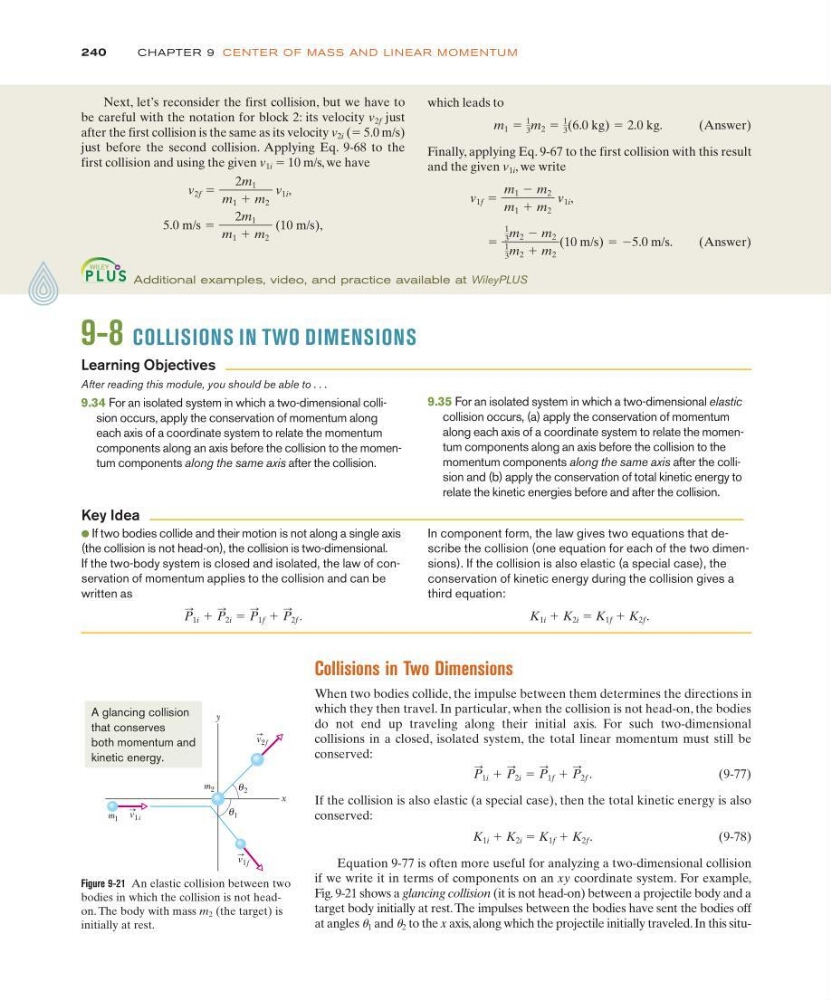
Fig. 9-21 shows a glancing collision (it is not head-on) between a projectile body and a
target body initially at rest. The impulses between the bodies have sent the bodies off
at angles u 1 and u 2 to the x axis, along which the projectile initially traveled. In this situP
:
1i ϩ P
:
2i ϭ P
:
1f ϩ P
:
2f
240
CHAPTE R 9 CE NTE R OF MASS AN D LI N EAR M OM E NTU M
Additional examples, video, and practice available at WileyPLUS
which leads to
(Answer)
Finally, applying Eq. 9-67 to the first collision with this result
and the given v 1i , we write
(Answer)
ϭ
1
3 m 2 Ϫ m 2
1
3 m 2 ϩ m 2
(10 m/s) ϭ Ϫ5.0 m/s.
v 1f ϭ
m 1 Ϫ m 2
m 1 ϩ m 2
v 1i ,
m 1 ϭ
1
3 m 2 ϭ
1
3 (6.0 kg) ϭ 2.0 kg.
Next, let’s reconsider the first collision, but we have to
be careful with the notation for block 2: its velocity v 2f just
after the first collision is the same as its velocity v 2i (ϭ 5.0 m/s)
just before the second collision. Applying Eq. 9-68 to the
first collision and using the given v 1i ϭ 10 m/s, we have
5.0 m/s ϭ
2m 1
m 1 ϩ m 2
(10 m/s),
v 2f ϭ
2m 1
m 1 ϩ m 2
v 1i ,
9-8 COLLISIONS IN TWO DIMENSIONS
After reading this module, you should be able to . . .
9.34 For an isolated system in which a two-dimensional collision occurs, apply the conservation of momentum along
each axis of a coordinate system to relate the momentum
components along an axis before the collision to the momentum components along the same axis after the collision.
9.35 For an isolated system in which a two-dimensional elastic
collision occurs, (a) apply the conservation of momentum
along each axis of a coordinate system to relate the momentum components along an axis before the collision to the
momentum components along the same axis after the collision and (b) apply the conservation of total kinetic energy to
relate the kinetic energies before and after the collision.
● If two bodies collide and their motion is not along a single axis
(the collision is not head-on), the collision is two-dimensional.
If the two-body system is closed and isolated, the law of conservation of momentum applies to the collision and can be
written as
.
P
:
1i ϩ P
:
2i ϭ P
:
1f ϩ P
:
2f
In component form, the law gives two equations that describe the collision (one equation for each of the two dimensions). If the collision is also elastic (a special case), the
conservation of kinetic energy during the collision gives a
third equation:
K 1i ϩ K 2i ϭ K 1f ϩ K 2f .
Learning Objectives
Key Idea
Figure 9-21 An elastic collision between two
bodies in which the collision is not headon. The body with mass m 2 (the target) is
initially at rest.
x
y
θ 2
θ 1
v 1i
v 2f
v 1f
m 1
m 2
A glancing collision
that conserves
both momentum and
kinetic energy.
When two bodies collide, the impulse between them determines the directions in
which they then travel. In particular, when the collision is not head-on, the bodies
do not end up traveling along their initial axis. For such two-dimensional
collisions in a closed, isolated system, the total linear momentum must still be
conserved:
.
( 9 - 7 7 )
If the collision is also elastic (a special case), then the total kinetic energy is also
conserved:
K 1i ϩ K 2i ϭ K 1f ϩ K 2f .
( 9 - 7 8 )
Equation 9-77 is often more useful for analyzing a two-dimensional collision
if we write it in terms of components on an xy coordinate system. For example,
Fig. 9-21 shows a glancing collision (it is not head-on) between a projectile body and a
target body initially at rest. The impulses between the bodies have sent the bodies off
at angles u 1 and u 2 to the x axis, along which the projectile initially traveled. In this situP
:
1i ϩ P
:
2i ϭ P
:
1f ϩ P
:
2f
240
CHAPTE R 9 CE NTE R OF MASS AN D LI N EAR M OM E NTU M
Additional examples, video, and practice available at WileyPLUS
which leads to
(Answer)
Finally, applying Eq. 9-67 to the first collision with this result
and the given v 1i , we write
(Answer)
ϭ
1
3 m 2 Ϫ m 2
1
3 m 2 ϩ m 2
(10 m/s) ϭ Ϫ5.0 m/s.
v 1f ϭ
m 1 Ϫ m 2
m 1 ϩ m 2
v 1i ,
m 1 ϭ
1
3 m 2 ϭ
1
3 (6.0 kg) ϭ 2.0 kg.
Next, let’s reconsider the first collision, but we have to
be careful with the notation for block 2: its velocity v 2f just
after the first collision is the same as its velocity v 2i (ϭ 5.0 m/s)
just before the second collision. Applying Eq. 9-68 to the
first collision and using the given v 1i ϭ 10 m/s, we have
5.0 m/s ϭ
2m 1
m 1 ϩ m 2
(10 m/s),
v 2f ϭ
2m 1
m 1 ϩ m 2
v 1i ,
9-8 COLLISIONS IN TWO DIMENSIONS
After reading this module, you should be able to . . .
9.34 For an isolated system in which a two-dimensional collision occurs, apply the conservation of momentum along
each axis of a coordinate system to relate the momentum
components along an axis before the collision to the momentum components along the same axis after the collision.
9.35 For an isolated system in which a two-dimensional elastic
collision occurs, (a) apply the conservation of momentum
along each axis of a coordinate system to relate the momentum components along an axis before the collision to the
momentum components along the same axis after the collision and (b) apply the conservation of total kinetic energy to
relate the kinetic energies before and after the collision.
● If two bodies collide and their motion is not along a single axis
(the collision is not head-on), the collision is two-dimensional.
If the two-body system is closed and isolated, the law of conservation of momentum applies to the collision and can be
written as
.
P
:
1i ϩ P
:
2i ϭ P
:
1f ϩ P
:
2f
In component form, the law gives two equations that describe the collision (one equation for each of the two dimensions). If the collision is also elastic (a special case), the
conservation of kinetic energy during the collision gives a
third equation:
K 1i ϩ K 2i ϭ K 1f ϩ K 2f .
Learning Objectives
Key Idea
Figure 9-21 An elastic collision between two
bodies in which the collision is not headon. The body with mass m 2 (the target) is
initially at rest.
x
y
θ 2
θ 1
v 1i
v 2f
v 1f
m 1
m 2
A glancing collision
that conserves
both momentum and
kinetic energy.