

To do so, we rewrite Eq. 9-63 as
m 1 (v 1i Ϫ v 1f ) ϭ m 2 v 2f
(9-65)
and Eq. 9-64 as*
(9-66)
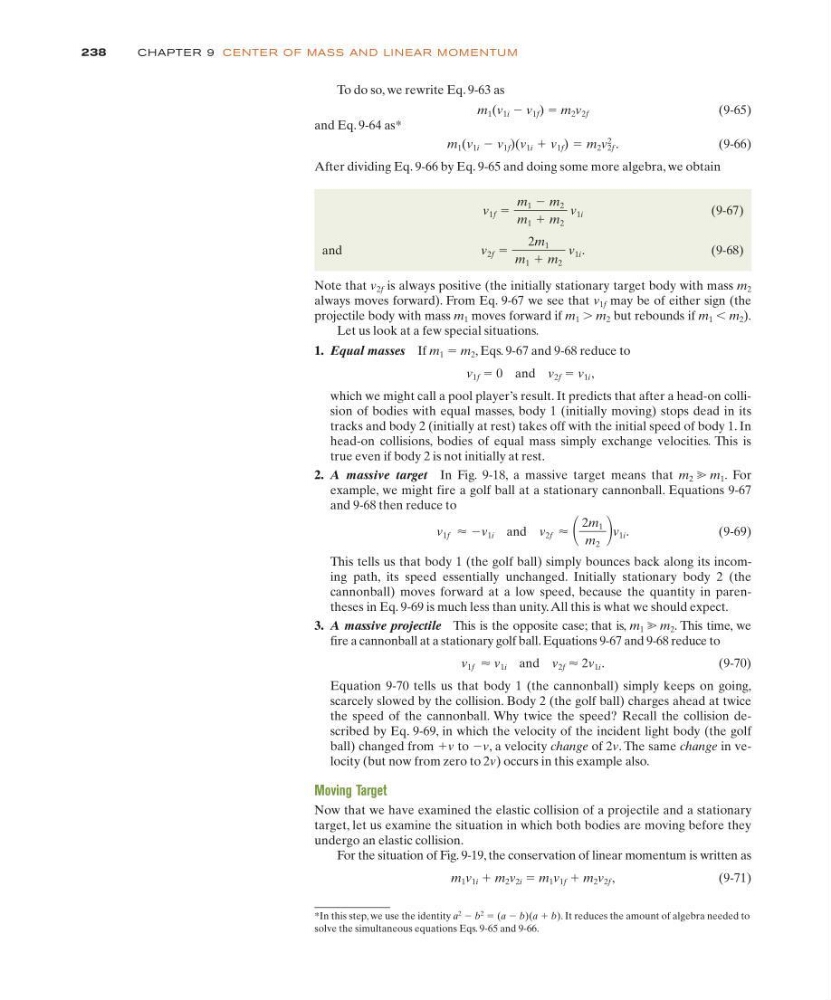
After dividing Eq. 9-66 by Eq. 9-65 and doing some more algebra, we obtain
(9-67)
and
(9-68)
Note that v 2f is always positive (the initially stationary target body with mass m 2
always moves forward). From Eq. 9-67 we see that v 1f may be of either sign (the
projectile body with mass m 1 moves forward if m 1 Ͼ m 2 but rebounds if m 1 Ͻ m 2 ).
Let us look at a few special situations.
1. Equal masses If m 1 ϭ m 2 , Eqs. 9-67 and 9-68 reduce to
v 1f ϭ 0 and v 2f ϭ v 1i ,
which we might call a pool player’s result. It predicts that after a head-on collision of bodies with equal masses, body 1 (initially moving) stops dead in its
tracks and body 2 (initially at rest) takes off with the initial speed of body 1. In
head-on collisions, bodies of equal mass simply exchange velocities. This is
true even if body 2 is not initially at rest.
2. A massive target In Fig. 9-18, a massive target means that m 2 m 1 . For
example, we might fire a golf ball at a stationary cannonball. Equations 9-67
and 9-68 then reduce to
(9-69)
This tells us that body 1 (the golf ball) simply bounces back along its incoming path, its speed essentially unchanged. Initially stationary body 2 (the
cannonball) moves forward at a low speed, because the quantity in parentheses in Eq. 9-69 is much less than unity. All this is what we should expect.
3. A massive projectile This is the opposite case; that is, m 1 m 2 . This time, we
fire a cannonball at a stationary golf ball. Equations 9-67 and 9-68 reduce to
v 1f Ϸ v 1i and v 2f Ϸ 2v 1i .
( 9 - 7 0 )
Equation 9-70 tells us that body 1 (the cannonball) simply keeps on going,
scarcely slowed by the collision. Body 2 (the golf ball) charges ahead at twice
the speed of the cannonball. Why twice the speed? Recall the collision described by Eq. 9-69, in which the velocity of the incident light body (the golf
ball) changed from ϩv to Ϫv, a velocity change of 2v. The same change in velocity (but now from zero to 2v) occurs in this example also.
Moving Target
Now that we have examined the elastic collision of a projectile and a stationary
target, let us examine the situation in which both bodies are moving before they
undergo an elastic collision.
For the situation of Fig. 9-19, the conservation of linear momentum is written as
m 1 v 1i ϩ m 2 v 2i ϭ m 1 v 1f ϩ m 2 v 2f ,
( 9 - 7 1 )
ӷ
v 1f Ϸ Ϫv 1i and v 2f Ϸ
2m 1
m 2
v 1i .
ӷ
v 2f ϭ
2m 1
m 1 ϩ m 2
v 1i .
v 1f ϭ
m 1 Ϫ m 2
m 1 ϩ m 2
v 1i
m 1 (v 1i Ϫ v 1f )(v 1i ϩ v 1f ) ϭ m 2 v 2f
2
.
238
CHAPTE R 9 CE NTE R OF MASS AN D LI N EAR M OM E NTU M
*In this step, we use the identity a
2 Ϫ b
2 ϭ (a Ϫ b)(a ϩ b). It reduces the amount of algebra needed to
solve the simultaneous equations Eqs. 9-65 and 9-66.
m 1 (v 1i Ϫ v 1f ) ϭ m 2 v 2f
(9-65)
and Eq. 9-64 as*
(9-66)
After dividing Eq. 9-66 by Eq. 9-65 and doing some more algebra, we obtain
(9-67)
and
(9-68)
Note that v 2f is always positive (the initially stationary target body with mass m 2
always moves forward). From Eq. 9-67 we see that v 1f may be of either sign (the
projectile body with mass m 1 moves forward if m 1 Ͼ m 2 but rebounds if m 1 Ͻ m 2 ).
Let us look at a few special situations.
1. Equal masses If m 1 ϭ m 2 , Eqs. 9-67 and 9-68 reduce to
v 1f ϭ 0 and v 2f ϭ v 1i ,
which we might call a pool player’s result. It predicts that after a head-on collision of bodies with equal masses, body 1 (initially moving) stops dead in its
tracks and body 2 (initially at rest) takes off with the initial speed of body 1. In
head-on collisions, bodies of equal mass simply exchange velocities. This is
true even if body 2 is not initially at rest.
2. A massive target In Fig. 9-18, a massive target means that m 2 m 1 . For
example, we might fire a golf ball at a stationary cannonball. Equations 9-67
and 9-68 then reduce to
(9-69)
This tells us that body 1 (the golf ball) simply bounces back along its incoming path, its speed essentially unchanged. Initially stationary body 2 (the
cannonball) moves forward at a low speed, because the quantity in parentheses in Eq. 9-69 is much less than unity. All this is what we should expect.
3. A massive projectile This is the opposite case; that is, m 1 m 2 . This time, we
fire a cannonball at a stationary golf ball. Equations 9-67 and 9-68 reduce to
v 1f Ϸ v 1i and v 2f Ϸ 2v 1i .
( 9 - 7 0 )
Equation 9-70 tells us that body 1 (the cannonball) simply keeps on going,
scarcely slowed by the collision. Body 2 (the golf ball) charges ahead at twice
the speed of the cannonball. Why twice the speed? Recall the collision described by Eq. 9-69, in which the velocity of the incident light body (the golf
ball) changed from ϩv to Ϫv, a velocity change of 2v. The same change in velocity (but now from zero to 2v) occurs in this example also.
Moving Target
Now that we have examined the elastic collision of a projectile and a stationary
target, let us examine the situation in which both bodies are moving before they
undergo an elastic collision.
For the situation of Fig. 9-19, the conservation of linear momentum is written as
m 1 v 1i ϩ m 2 v 2i ϭ m 1 v 1f ϩ m 2 v 2f ,
( 9 - 7 1 )
ӷ
v 1f Ϸ Ϫv 1i and v 2f Ϸ
2m 1
m 2
v 1i .
ӷ
v 2f ϭ
2m 1
m 1 ϩ m 2
v 1i .
v 1f ϭ
m 1 Ϫ m 2
m 1 ϩ m 2
v 1i
m 1 (v 1i Ϫ v 1f )(v 1i ϩ v 1f ) ϭ m 2 v 2f
2
.
238
CHAPTE R 9 CE NTE R OF MASS AN D LI N EAR M OM E NTU M
*In this step, we use the identity a
2 Ϫ b
2 ϭ (a Ϫ b)(a ϩ b). It reduces the amount of algebra needed to
solve the simultaneous equations Eqs. 9-65 and 9-66.