

rho) is the same for any given element of an object as for the whole object. From
Eq. 1-8, we can write
(9-10)
where dV is the volume occupied by a mass element dm, and V is the total volume of the object. Substituting dm ϭ (M/V) dV from Eq. 9-10 into Eq. 9-9 gives
(9-11)
Symmetry as a Shortcut. You can bypass one or more of these integrals if
an object has a point, a line, or a plane of symmetry. The center of mass of such
an object then lies at that point, on that line, or in that plane. For example, the
center of mass of a uniform sphere (which has a point of symmetry) is at the
center of the sphere (which is the point of symmetry). The center of mass of a
uniform cone (whose axis is a line of symmetry) lies on the axis of the cone. The
center of mass of a banana (which has a plane of symmetry that splits it into two
equal parts) lies somewhere in the plane of symmetry.
The center of mass of an object need not lie within the object. There is no
dough at the com of a doughnut, and no iron at the com of a horseshoe.
x com ϭ
1
V
͵xdV, y com ϭ
1
V
͵ydV, z com ϭ
1
V
͵zdV.
r ϭ
dm
dV
ϭ
M
V
,
217
9-1 CE NTE R OF MASS
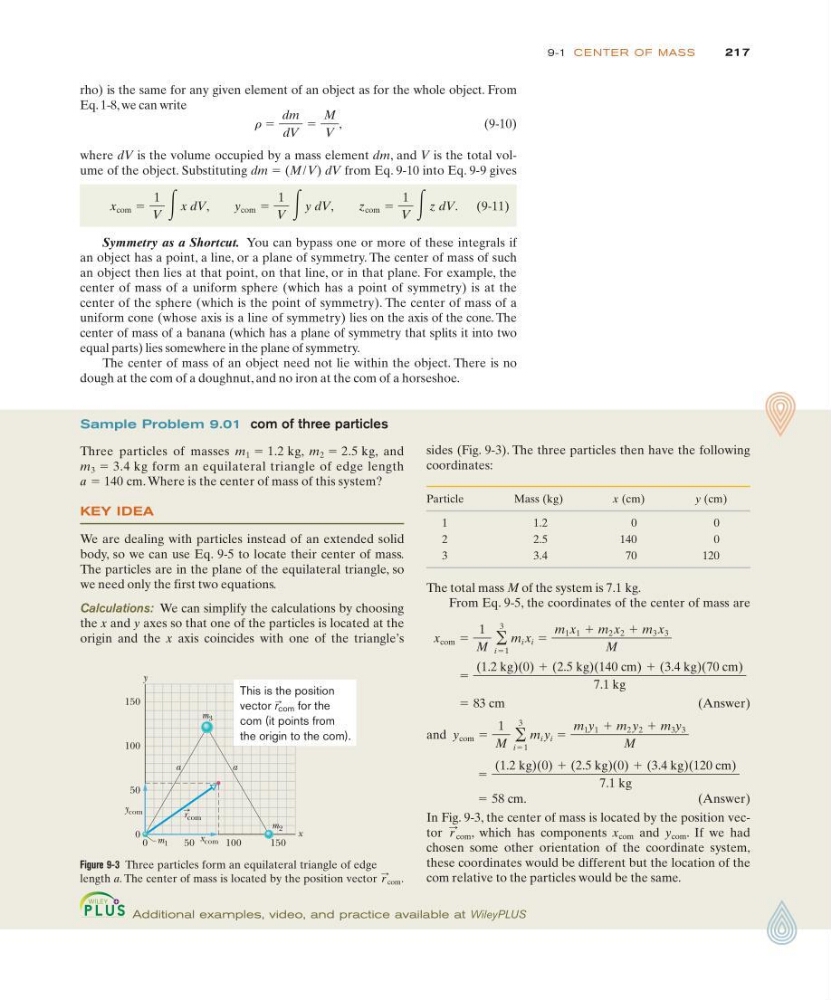
sides (Fig. 9-3). The three particles then have the following
coordinates:
Particle
Mass (kg)
x (cm)
y (cm)
1
1.2
0
0
2
2.5
140
0
3
3.4
70
120
The total mass M of the system is 7.1 kg.
From Eq. 9-5, the coordinates of the center of mass are
(Answer)
and
(Answer)
In Fig. 9-3, the center of mass is located by the position vector
, which has components x com and y com . If we had
chosen some other orientation of the coordinate system,
these coordinates would be different but the location of the
com relative to the particles would be the same.
r
:
com
ϭ 58 cm.
ϭ
(1.2 kg)(0) ϩ (2.5 kg)(0) ϩ (3.4 kg)(120 cm)
7.1 kg
y com ϭ
1
M ͚
3
iϭ1
m i y i ϭ
m 1 y 1 ϩ m 2 y 2 ϩ m 3 y 3
M
ϭ 83 cm
ϭ
(1.2 kg)(0) ϩ (2.5 kg)(140 cm) ϩ (3.4 kg)(70 cm)
7.1 kg
x com ϭ
1
M ͚
3
iϭ1
m i x i ϭ
m 1 x 1 ϩ m 2 x 2 ϩ m 3 x 3
M
Sample Problem 9.01 com of three particles
Three particles of masses m 1 ϭ 1.2 kg, m 2 ϭ 2.5 kg, and
m 3 ϭ 3.4 kg form an equilateral triangle of edge length
a ϭ 140 cm. Where is the center of mass of this system?
KEY IDEA
We are dealing with particles instead of an extended solid
body, so we can use Eq. 9-5 to locate their center of mass.
The particles are in the plane of the equilateral triangle, so
we need only the first two equations.
Calculations: We can simplify the calculations by choosing
the x and y axes so that one of the particles is located at the
origin and the x axis coincides with one of the triangle’s
Figure 9-3 Three particles form an equilateral triangle of edge
length a. The center of mass is located by the position vector
.
r
:
com
y
x
0
50
1 00
1 50
50
100
150
y com
x com
m 1
m 2
m 3
r com
a
a
0
This is the position
vector r com for the
com (it points from
the origin to the com).
Additional examples, video, and practice available at WileyPLUS
Eq. 1-8, we can write
(9-10)
where dV is the volume occupied by a mass element dm, and V is the total volume of the object. Substituting dm ϭ (M/V) dV from Eq. 9-10 into Eq. 9-9 gives
(9-11)
Symmetry as a Shortcut. You can bypass one or more of these integrals if
an object has a point, a line, or a plane of symmetry. The center of mass of such
an object then lies at that point, on that line, or in that plane. For example, the
center of mass of a uniform sphere (which has a point of symmetry) is at the
center of the sphere (which is the point of symmetry). The center of mass of a
uniform cone (whose axis is a line of symmetry) lies on the axis of the cone. The
center of mass of a banana (which has a plane of symmetry that splits it into two
equal parts) lies somewhere in the plane of symmetry.
The center of mass of an object need not lie within the object. There is no
dough at the com of a doughnut, and no iron at the com of a horseshoe.
x com ϭ
1
V
͵xdV, y com ϭ
1
V
͵ydV, z com ϭ
1
V
͵zdV.
r ϭ
dm
dV
ϭ
M
V
,
217
9-1 CE NTE R OF MASS
sides (Fig. 9-3). The three particles then have the following
coordinates:
Particle
Mass (kg)
x (cm)
y (cm)
1
1.2
0
0
2
2.5
140
0
3
3.4
70
120
The total mass M of the system is 7.1 kg.
From Eq. 9-5, the coordinates of the center of mass are
(Answer)
and
(Answer)
In Fig. 9-3, the center of mass is located by the position vector
, which has components x com and y com . If we had
chosen some other orientation of the coordinate system,
these coordinates would be different but the location of the
com relative to the particles would be the same.
r
:
com
ϭ 58 cm.
ϭ
(1.2 kg)(0) ϩ (2.5 kg)(0) ϩ (3.4 kg)(120 cm)
7.1 kg
y com ϭ
1
M ͚
3
iϭ1
m i y i ϭ
m 1 y 1 ϩ m 2 y 2 ϩ m 3 y 3
M
ϭ 83 cm
ϭ
(1.2 kg)(0) ϩ (2.5 kg)(140 cm) ϩ (3.4 kg)(70 cm)
7.1 kg
x com ϭ
1
M ͚
3
iϭ1
m i x i ϭ
m 1 x 1 ϩ m 2 x 2 ϩ m 3 x 3
M
Sample Problem 9.01 com of three particles
Three particles of masses m 1 ϭ 1.2 kg, m 2 ϭ 2.5 kg, and
m 3 ϭ 3.4 kg form an equilateral triangle of edge length
a ϭ 140 cm. Where is the center of mass of this system?
KEY IDEA
We are dealing with particles instead of an extended solid
body, so we can use Eq. 9-5 to locate their center of mass.
The particles are in the plane of the equilateral triangle, so
we need only the first two equations.
Calculations: We can simplify the calculations by choosing
the x and y axes so that one of the particles is located at the
origin and the x axis coincides with one of the triangle’s
Figure 9-3 Three particles form an equilateral triangle of edge
length a. The center of mass is located by the position vector
.
r
:
com
y
x
0
50
1 00
1 50
50
100
150
y com
x com
m 1
m 2
m 3
r com
a
a
0
This is the position
vector r com for the
com (it points from
the origin to the com).
Additional examples, video, and practice available at WileyPLUS